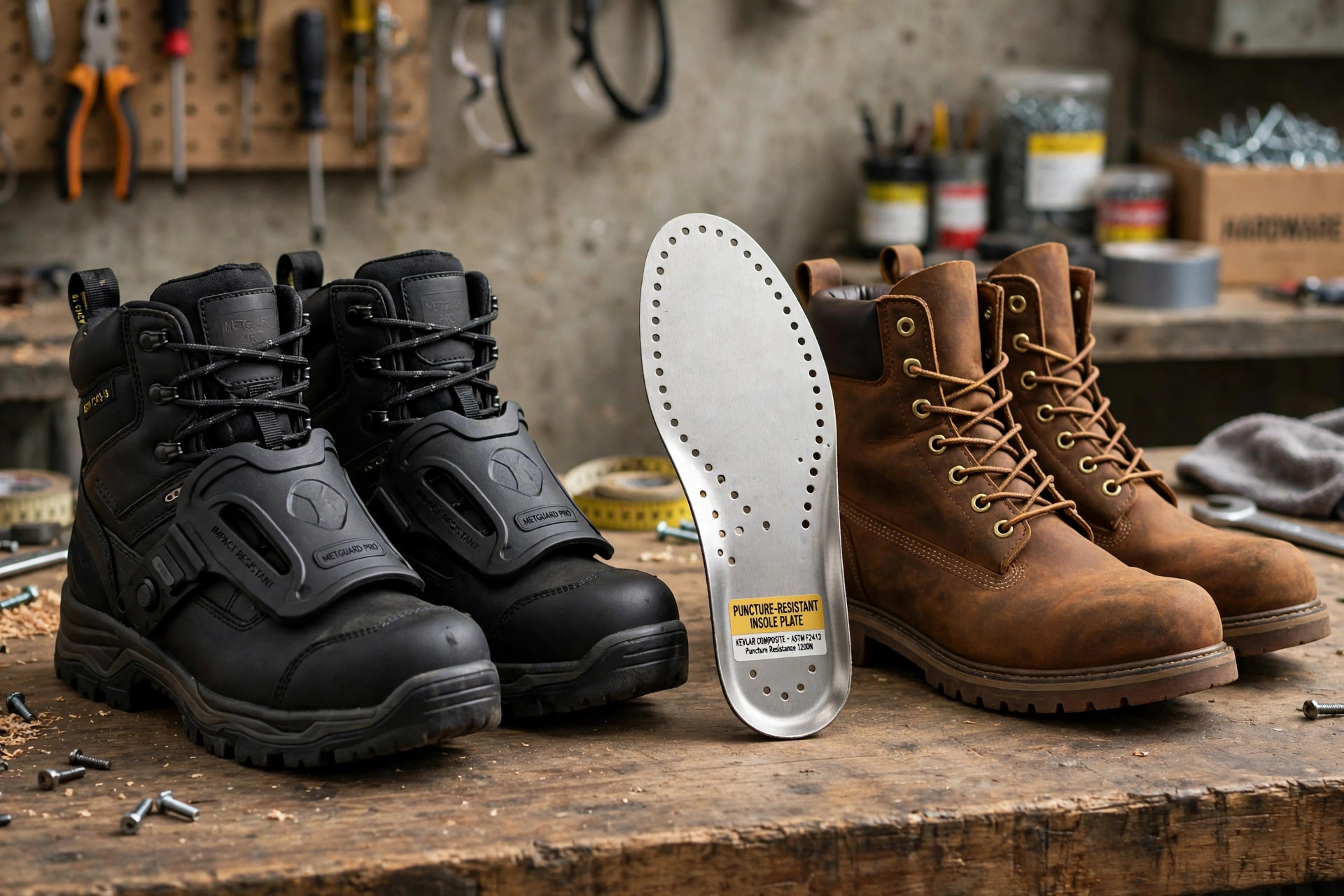
Beyond the toe cap itself, protective footwear can carry specialty features, each tested and coded on the boot’s ASTM F2413 label: metatarsal guards (Mt) that extend protection over the top of the foot, electrical hazard (EH) construction, static-dissipative (SD) and ESD footwear that bleed off static charge, and puncture-resistant (PR) plates in the sole. This guide explains each in general terms; our safety toe boots guide covers the cap materials themselves.
Metatarsal Guards
The metatarsals are the long bones on top of the foot, beyond the toe cap’s coverage and vulnerable to dropped tools and rolling loads. Metatarsal guards bridge from the cap over the instep — built in as internal guards under the leather, or as external guards strapped or laced over the boot. Foundries, heavy fabrication, warehousing with rolling stock, and demolition work commonly specify them. External guards must be fitted so they cannot catch or shift; internal guards trade a little internal room for a cleaner profile.
Electrical Hazard and Static Control
Electrical hazard (EH) footwear is built with non-conductive soles and heels tested to reduce the flow of electricity under certain dry conditions — secondary protection for accidental contact, never a substitute for electrical safe-work practices or the arc-rated clothing system. Static-dissipative (SD) and ESD footwear do nearly the opposite job in a controlled way: they conduct static charge from the body to the ground gradually, protecting electronics, munitions, and flammable-atmosphere work from spark discharge, while still limiting shock exposure from low-level circuits as their standards require. EH and SD are different specifications — a boot is chosen for one or the other, not both at once.
Puncture-Resistant Plates
Puncture-resistant (PR) plates sit in or above the midsole to stop nails, screws, glass, and metal shards from reaching the foot — the signature hazard of construction, demolition, roofing tear-off, waste handling, and disaster cleanup. Plates are steel in traditional designs and flexible non-metallic composites in modern ones, which bend more naturally and suit detector-sensitive sites alongside composite toe boots. A PR plate protects the sole only: step hazards to the side of the foot and ankle still call for work practice, not just footwear.
FAQs
- What does EH mean on a boot label?
- EH marks electrical hazard footwear: soles and heels tested to provide secondary protection against accidental contact with live circuits under dry conditions. It is one tested feature among several that can appear on an ASTM F2413 label.
- What is the difference between SD and ESD footwear?
- Both manage static electricity by conducting charge safely to ground. ESD footwear is the more conductive, tighter-controlled category used around sensitive electronics; SD footwear dissipates static in a higher resistance range and is common in general industry. Programs specify which range the site requires.
- Do puncture-resistant boots protect the whole foot?
- The PR plate covers the sole against upward punctures from nails and sharp debris. It does not protect the sides or top of the foot — that is what the toe cap and metatarsal guards are for, and why features are specified in combination.
Workwear & PPE Guides
This guide is part of the Apparel Search workwear and PPE systems series. Browse the full series and the related trade uniform guides below.
- High-Visibility Clothing
- Hi-Vis Classes
- Arc-Rated Clothing
- NFPA 2112
- Flame-Resistant Clothing
- Welding Apparel
- Chainsaw Chaps
- Cut-Resistant Sleeves
- Disposable Coveralls
- Protective Aprons
- Safety Toe Boots
- Composite Toe Boots
- Steel-Toe Boots (Men's Clothes Guide)
Trade Uniform Guides
Apparel Search: explore the Clothes Guide and shopping directory for more workwear and uniform resources.