Security Uniforms Guide
Authority you can read at fifty metres: security guard uniform styles from corporate blazer to tactical, hi-vis requirements, and duty-belt-friendly design.
Shop Security Uniforms Now
Shop Security Uniforms on Amazon Shop Security Uniforms on eBayThe Amazon and eBay links on this page are affiliate links. If you make a purchase through them, Apparel Search may earn a commission.
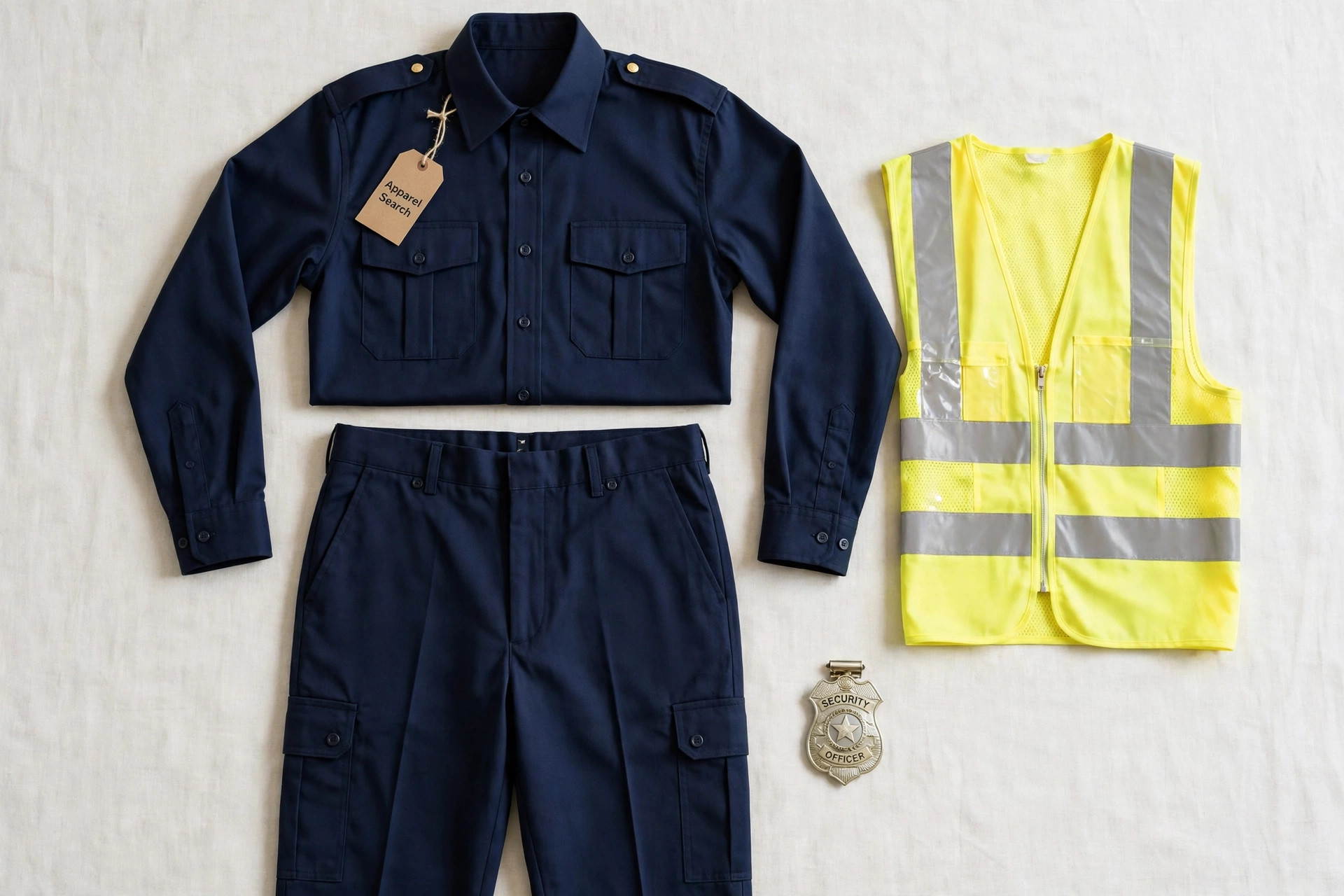
A security uniform is a communication device before it is clothing: it must announce authority to the public, reassure clients, and never be mistakable for a police uniform where the law reserves police insignia. Styles run from the corporate blazer-and-tie worn in office towers to the tactical shirt and cargo trousers of site and event security, with hi-vis layered over everything outdoors. The right choice depends on the post — a shopping centre, a construction site and a nightclub door need visibly different officers.
This guide covers the main uniform families, the visibility and identification rules, and the practical design points — duty belts, boots, radios — that generic workwear gets wrong. It sits in the uniform family alongside our military uniforms guide and the general men's uniforms guide.
Uniform Styles by Post
The corporate style — blazer, shirt, tie, tailored trousers — serves offices, hotels and front-of-house posts where the officer is also a greeter; it borrows its polish from hospitality uniforms. The classic guard style is the navy or black uniform shirt with epaulettes, matching trousers with a leg stripe, and a peaked cap or soft cap — the most widely recognised security silhouette. The tactical style — polo or tactical shirt, cargo trousers, boots — suits patrol, site and event work where movement and kit-carrying dominate.
Whatever the style, identification is non-negotiable: 'SECURITY' lettering on chest and back, a company patch, and a visible ID or licence badge where the jurisdiction issues one. Colours deliberately differ from local police livery in most regions, and reputable employers design to that rule rather than around it.
Hi-Vis, Weather and the Duty Belt
Outdoor and traffic-facing posts require high-visibility garments meeting the local standard (such as ANSI/ISEA 107 in the US or EN ISO 20471 in Europe): fluorescent fabric with reflective tape that returns headlight beams at night. Hi-vis is usually a layer — vest, jacket or softshell — over the base uniform, so the officer's identification stays consistent as layers change with the weather. Cold and wet posts need insulated, waterproof outers that still fit over body armour where it is worn.
Trousers must be chosen with the duty belt in mind: belt loops wide and strong enough for a loaded belt, reinforced seat and knees, and pockets placed where kit doesn't sit. Shirts need pen pockets, microphone tabs and epaulettes that lie flat under a vest. Boots are part of the uniform system — supportive, polishable where the post demands shine, and broken in before the first long shift, not during it.
Fit, Issue and Care
Security work is hours of standing and walking punctuated by incidents, so fit is a safety issue: trousers that allow a full stride and a kneel, shirts that stay tucked through a shift (shirt stays or a proper length), and layering room for armour. Employers typically issue multiple sets and specify the complete worn standard in writing — which cap, which tie, when hi-vis is mandatory — because a uniform only reads as a uniform when the whole team matches.
Care is straightforward: wash to the label, keep reflective tape effective by avoiding high-heat drying that degrades it, and replace hi-vis when the fluorescent ground fades — a dull vest is no longer compliant kit. Polish and presentation checks are part of the job in corporate posts; in tactical posts, working zips, intact Velcro and serviceable boots are the equivalent standard.
Common Questions
What do security guards wear?
It depends on the post: corporate posts wear a blazer, shirt and tie; most guarding uses a uniform shirt with epaulettes, matching trousers and SECURITY lettering; patrol and event work uses tactical shirts and cargo trousers. Outdoor posts add compliant hi-vis layers.
Can a security uniform look like a police uniform?
It should not. Most jurisdictions restrict police insignia, titles and sometimes colours, and good practice is to design security uniforms to be clearly identifiable as security — with SECURITY lettering and company patches — and visibly distinct from local police.
What hi-vis class do security guards need?
For traffic-facing and roadside work in the US, ANSI/ISEA 107 Type R Class 2 or 3 is typical; in Europe, EN ISO 20471 Class 2 or 3. The employer or site risk assessment specifies the class — guards should wear what is issued and report faded garments for replacement.
More Trade Uniform Guides in This Cluster
The other trade uniform guides in this wave — hospitality, security, salon and spa, mechanic and restaurant server uniforms:
Workwear & PPE Guides
Protective workwear systems from Apparel Search — hi-vis, flame-resistant and arc-rated clothing, welding and chainsaw protection, and safety footwear:
More to Explore on Apparel Search
From the door to the treatment room — continue to the salon and spa uniforms guide.
Next: Women's Salon & Spa Uniforms Guide: Tunics, Aprons & Scrubs-Style Sets »Looking for Men's Clothing Stores?
This guide helps you choose security uniforms matched to the post, the risk and the employer's image. To browse where to buy, visit our mens clothing store directory, where you can find retailers that carry them.