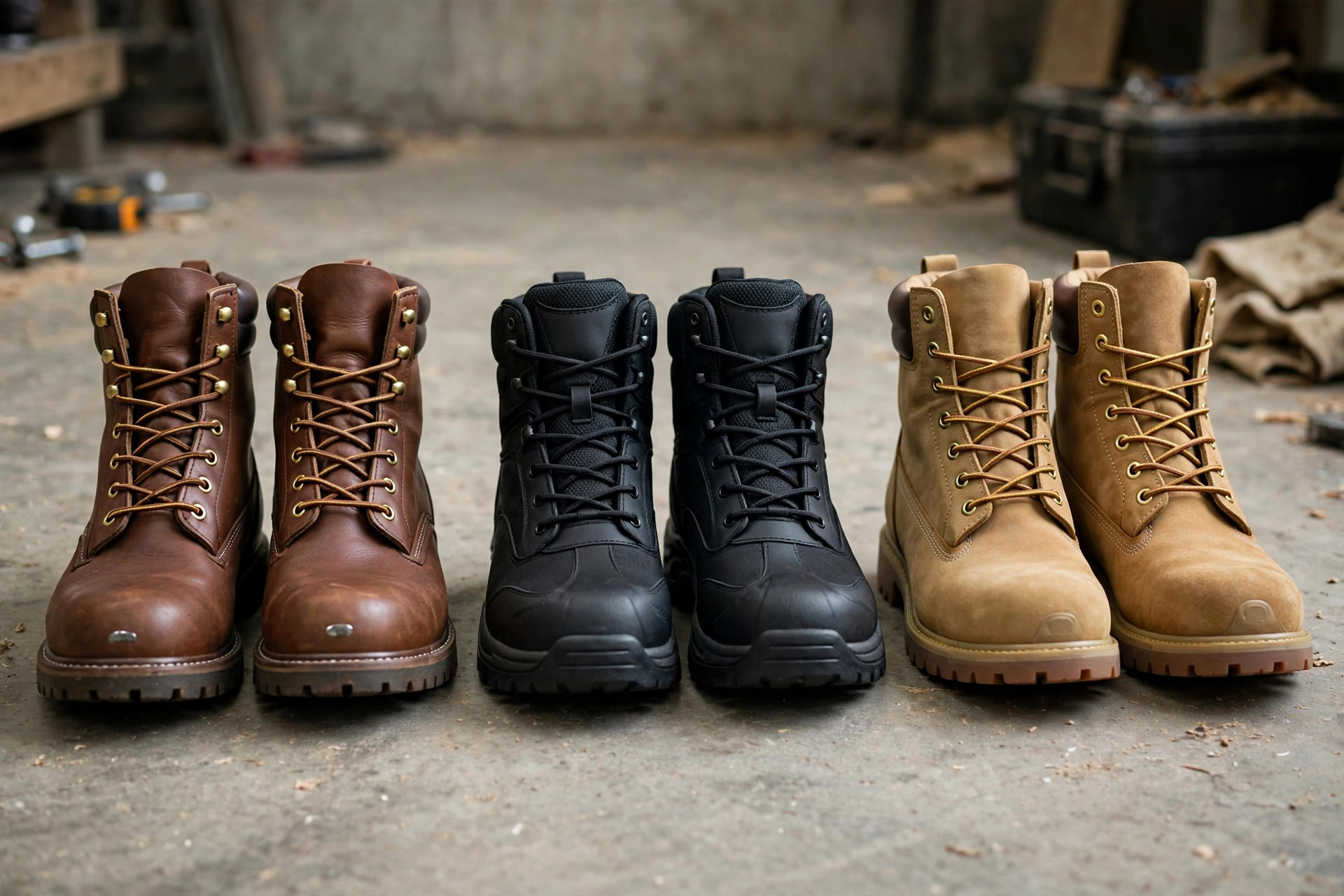
Safety toe boots carry a protective cap over the toes that shields against impact and compression from falling and rolling objects. The cap is built from one of three material families — steel, alloy (typically aluminum-based), or composite (non-metallic materials such as carbon fiber, fiberglass, or engineered plastics). In the United States, protective footwear is described by ASTM F2413, whose labeling tells you the impact and compression ratings and any additional protections the boot was tested for.
The Three Toe Materials
Steel toe is the original: strong, widely available, and often the most economical, at the cost of the heaviest cap and a cap that conducts heat and cold. Our dedicated steel-toe boots guide covers steel-toe selection in depth. Alloy toe caps use lighter metals to cut weight while keeping a slim profile, often at a higher price. Composite toe caps are non-metallic and lighter still in feel, do not conduct temperature the way metal does, and pass through metal detectors without setting them off — the full story is in our composite toe boots guide. All three can meet the same ASTM impact and compression ratings; the rating on the label, not the material story, is what certifies protection.
Reading ASTM F2413 Labels, in General Terms
Protective footwear labeling identifies the standard, the wearer category, and the impact (I) and compression (C) performance, followed by codes for added features the boot was tested for — such as metatarsal protection, electrical hazard resistance, static dissipation, or puncture resistance, which our specialty safety toes guide explains one by one. Employers specify required features from their hazard assessment: falling objects, rolling loads, electrical exposure, slippery or puncturing debris.
Fit and Care
Fit safety boots at the end of the day, in work socks, with room ahead of the toes — the cap does not stretch. Break in leather gradually, keep it cleaned and conditioned, dry wet boots away from direct heat, and retire boots after a significant cap impact, when the cap shows through worn leather, or when soles are worn smooth.
FAQs
- Which toe material is strongest: steel, alloy, or composite?
- All three are built to meet the same ASTM F2413 impact and compression ratings, and a boot's label states the rating it achieved. The practical differences are weight, temperature conduction, metal content, and price — choose on those, and on the features your hazard assessment requires.
- Do composite toe boots set off metal detectors?
- Composite caps contain no metal, so they are the usual choice for workers who pass through detectors daily. Note that other boot components — shanks, hardware, or puncture plates — can be metallic, so detector-friendly boots are specified as fully non-metallic.
- When should safety toe boots be replaced?
- Replace them after a heavy impact or compression event to the cap, if the cap becomes visible through damaged material, if linings collapse so the foot shifts, or when tread and soles are worn out. Protective footwear is inspected like any other PPE.
Workwear & PPE Guides
This guide is part of the Apparel Search workwear and PPE systems series. Browse the full series and the related trade uniform guides below.
- High-Visibility Clothing
- Hi-Vis Classes
- Arc-Rated Clothing
- NFPA 2112
- Flame-Resistant Clothing
- Welding Apparel
- Chainsaw Chaps
- Cut-Resistant Sleeves
- Disposable Coveralls
- Protective Aprons
- Composite Toe Boots
- Specialty Safety Toe Features
- Steel-Toe Boots (Men's Clothes Guide)
Trade Uniform Guides
Apparel Search: explore the Clothes Guide and shopping directory for more workwear and uniform resources.
Please note: ASTM F2413 protective footwear requirements are maintained by ASTM International and revised over time. This page is a general overview provided for information only — it is not legal or compliance advice, and it may not reflect the most current version. Always confirm the current requirements directly with ASTM International rather than relying on this website.