Special Suits
Clothing Definitions — definitions of garments and clothing terms from Apparel Search
Search Apparel Search
At a Glance
Definition: Special suits are the protective and occupational suit types defined in this section — suits built for extreme environments and named hazards rather than for appearance: atmospheric diving suits, diving suits, pressure suits, space suits, space activity suits, hazmat suits, environmental suits, g-suits, flight suits, clean room suits and wetsuits among them.
Category: Clothing Definitions
There are many different types of suits, and they are not all worn as business attire. Alongside the business suit stand whole families of protective and occupational suits built for extreme environments: atmospheric diving suits and diving suits for pressure underwater, pressure suits, space suits and space activity suits for altitude and space, hazmat and environmental suits against contamination, g-suits and flight suits for aviation, clean room suits for sterile work, and water garments such as wetsuits and swim suits. Each type is defined on its own page, linked from the clothing definitions — this page is their index, and the place where the family can be read whole.
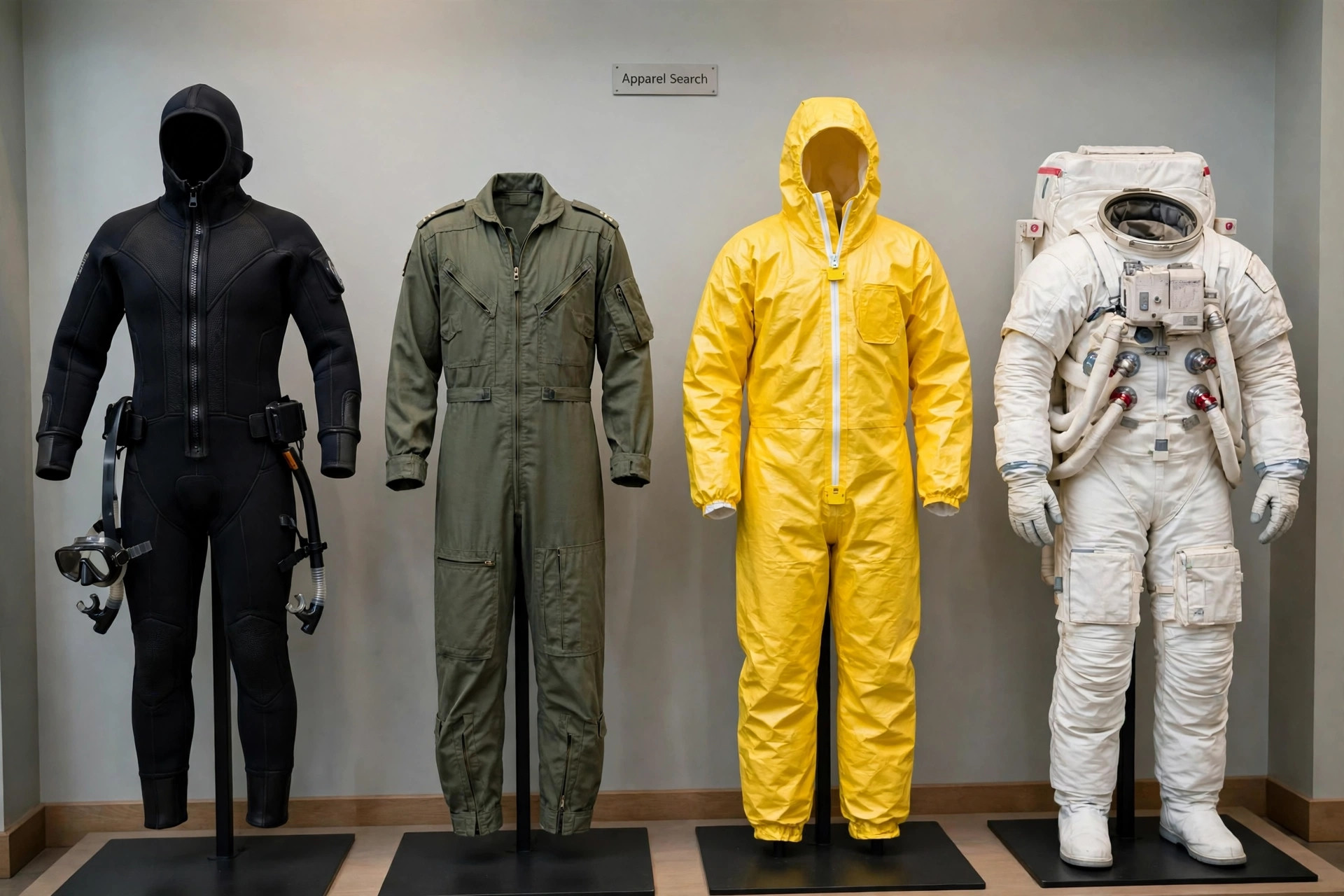
Suits as Equipment
The word suit covers two very different families of clothing. One family is about matching: a jacket, trousers and waistcoat cut from the same cloth, worn so the wearer looks correct for business or ceremony — the suit of the tailor, with its formal wear relations. The other family, gathered on this page, is about survival and function. A special suit is a wearable system engineered against a named hazard: water pressure at depth, vacuum in orbit, chemical contamination on the ground, crushing acceleration in a fighter aircraft, sterile conditions in a clean room, or cold water during a dive or a surf session.
Because the hazard comes first, special suits are specified the way equipment is specified. An atmospheric diving suit is a rigid, articulated shell that keeps sea pressure off the diver entirely. A pressure suit keeps breathing gas at a safe pressure around a pilot or astronaut. A hazmat suit is a chemical barrier with sealed seams and its own air supply. A g-suit squeezes the legs and abdomen with inflatable bladders so acceleration does not drain blood from the pilot's brain. A wetsuit takes the opposite approach to water: it lets a thin layer in, warms it with body heat, and insulates it with neoprene.
The environmental suit is the family's general definition — a suit designed for one particular hostile environment — and each page in this section is one of its species. The clean room suit is the family's inversion, protecting the workplace from the wearer instead of the wearer from the workplace. The flight suit is its most uniform-like member, as much dress as equipment. The ski suit is its most familiar, the hostile environment being nothing more exotic than a winter mountain. What unites them is not a material or a shape but a method: start from the hazard, and let the hazard write the specification.
Reading the Suit Family
The suit types also borrow from one another. Space suit design grew out of high-altitude pressure suits, which grew out of diving dress and oxygen equipment. The space activity suit borrows the wetsuit's insight that a close elastic garment can itself do useful work on the body. The ski suit and the flight suit share the jumpsuit's one-piece practicality. Following the links from this index to each definition shows the family connections: the same basic idea — a complete garment fitted closely to a task — worked out again and again for new environments.
The family's outliers prove the rule by stretching it. The catsuit and the union suit are suits by construction — complete, close, one-piece garments — without a hostile environment to answer. The Mao suit and the seersucker suit are suits by tailoring that became, in their different ways, environmental answers too: one to a political climate, the other to a literal one. The word holds all of them because the construction holds: a suit is a complete clothing system, worn as one thing.
The Technical End of Apparel
For the clothing industry, special suits sit at the technical end of apparel: small production runs, demanding materials, and performance judged by test results rather than by fashion. They are a reminder that a suit is not only a style category but also one of the oldest engineering forms in clothing — a fitted shell between a person and the world.
That is the thread to follow through the definitions linked from this page. Each suit begins where an ordinary garment stops: at the point where the environment would injure, incapacitate or kill the wearer, and the clothing has to become a system — sealed, pressurised, insulated, supplied — to keep its wearer working. The fashion industry measures most suits by how they look; these are measured by what they withstand.
Use this page as the map. The links above run in both directions of the family tree: down into the water, with the diving suits and the wetsuit; up into the air and beyond it, with the flight suit, g-suit, pressure suit, space suit and space activity suit; and sideways into the controlled environments of the ground, with the hazmat suit, the environmental suit and the clean room suit. Each destination page defines its suit in full — its construction, its history, and the hazard it answers.
Common Questions
What counts as a special suit?
A special suit is a suit built for a protective or occupational job rather than for appearance: diving suits, pressure suits, space suits, hazmat suits, G-suits, flight suits, clean room suits, environmental suits and wetsuits are all examples. The shared idea is a complete garment system fitted to a hostile environment.
How does a special suit differ from a business suit?
A business suit is a matching set of jacket, trousers and optional waistcoat worn for appearance and convention. A special suit is equipment: its materials, seals, pressure and life-support features are engineered for a specific hazard or task, and appearance is incidental.
Where are the individual suit types defined?
Each type has its own definition page in the clothing definitions, including atmospheric diving suits, catsuits, clean room suits, diving suits, environmental suits, flight suits, G-suits, hazmat suits, jumpsuits, Mao suits, pressure suits, seersucker suits, ski suits, space activity suits, space suits, swim suits, union suits and wet suits.