Mukluks (Mukluk Boots)
Footwear Definitions — shoes, boots and footwear terms from Apparel Search
Mukluks, or kamik, are a soft boot traditionally made of reindeer skin or sealskin and originally worn by Arctic aboriginal peoples, including the Inuit and Yupik. The word mukluk is of Yupik origin, from maklak, the bearded seal, while kamik is an Inuit word.
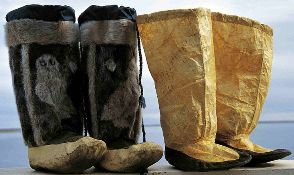 Mukluks
or Kamik (singular:
kamak) are a soft
boot
traditionally made of
reindeer skin or sealskin and were originally worn by Arctic aboriginals,
including the Inuit and Yupik. The term mukluk
is often used for any soft
boot designed for cold weather
and modern designs are often
similar to high-top
athletic
shoes. The word "mukluk"
is of
Yupik origin, from
maklak, the
bearded seal, while "kamik"
is an Inuit word. In the
Inuipiaq language the "u"
makes an "oo"
sound, and so the spelling "maklak"
is used with the same pronunciation.
Another type of boot, sometimes called an Inuit boot, originating in Greenland and the eastern part of Alaska, are made by binding them with animal cartilage and have a centre seam running down to the foot of the boot.
Mukluks weigh little and allow hunters to move very quietly. They may be adorned with pompons and beads and may be lined with furs such as rabbit, fox and raccoon.
Modern man has also found utility in the design of the mukluk, especially paired with a rugged contemporary sole. The key component of its success is its ability to breathe, that is, to allow air exchange. This is an advantage in extremely cold conditions where perspiration may become a factor in frostbite on your feet. The bulkiness paired with their poor performance in slush makes them less ideal for the casual winter wearer.
Another kind of mukluk is knitted with a soft leather sole. These are worn primarily by ballet dancers in place of leg/foot warmers.
If you enjoy shoes, Learn more about shoes.
| The above article is licensed under the GNU Free Documentation License. From Wikipedia, the free encyclopedia (https://en.wikipedia.org/wiki/mukluk). 12/7/09 Modified by Apparel Search. |
| Footwear & Shoe Industry Definitions |
| Fashion Industry |
Soft Boots for Dry ColdThe mukluk is engineered for a specific climate: the dry, deep cold of the Arctic, where snow stays powdery and temperatures sit far below freezing. Sealskin and reindeer skin give a boot that weighs little, so hunters can move very quietly across snow, and the soft construction flexes with the foot instead of fighting it, the opposite approach to a rigid mountaineering boot. Breathability is the decisive feature. Hard work in heavy clothing makes feet perspire even in severe cold, and in an impermeable boot that moisture has nowhere to go: it condenses, soaks the insulation and can freeze, turning sweat into a frostbite risk. The mukluk's air exchange lets the moisture escape outward continuously, keeping the inside dry through a day's travel. Fur linings of rabbit, fox or raccoon add still-air insulation, and decoration, pompons and beads, marks pairs made for wear beyond the hunt. Variations and the Modern MuklukThe name covers a family rather than a single pattern. In the Inupiaq language the u makes an oo sound, so the spelling maklak is used with the same pronunciation, a reminder that the word names the bearded seal the skins came from. Another type, sometimes called an Inuit boot, originating in Greenland and the eastern part of Alaska, is made by binding the skins with animal cartilage and has a centre seam running down to the foot of the boot. Modern makers have found utility in the design as well, pairing the soft, breathable upper with a rugged contemporary sole, and the term mukluk is now often used for any soft boot designed for cold weather, including designs similar to high-top athletic shoes. At the gentle end of the family, one kind of mukluk is knitted with a soft leather sole and worn primarily by ballet dancers in place of leg and foot warmers, proof that a boot built to breathe and flex adapts to any work done on cold floors. Common QuestionsWhy do mukluks work in extreme cold?The key component of the mukluk's success is its ability to breathe, to allow air exchange. In extremely cold conditions perspiration may become a factor in frostbite, and a breathable soft boot lets moisture escape instead of freezing inside. What are traditional mukluks made of?Mukluks are traditionally made of reindeer skin or sealskin, and may be lined with furs such as rabbit, fox and raccoon and adorned with pompons and beads. The skins are light, which lets hunters move very quietly. What are the mukluk's weaknesses?Mukluks are bulky, and their poor performance in slush makes them less ideal for the casual winter wearer. They are designed for dry, deep cold, not for wet streets at temperatures near freezing. More to Explore
More from Apparel Search: Footwear Definitions | Clothing Industry Glossary | Fashion Terms | Apparel Search Home
|