Dress Size
Miscellaneous Definitions — standard dimensions for a dress, and why the same size fits differently, from Apparel Search
Search Apparel Search
At a Glance
Definition: A dress size is a set of standard dimensions for a dress: a named bundle of body measurements, drawn from combinations commonly seen in the general population, that lets dresses be mass-produced as ready-to-wear instead of made for each wearer.
Category: Miscellaneous Definitions
In clothing, dress size refers to a set of standard dimensions for a dress. Every person has unique body measurements, so ideally every dress would be made for its wearer by a custom dressmaker — but the Industrial Revolution introduced the mass production of clothing in standard sizes, known as ready-to-wear, with sizes purportedly arrived at by statistical analysis of large numbers of people. This page covers why standard sizes exist, the measurements bundled into a size, the US standard clothing size and the European EN 13402 standard, and why size names drift — the problem of vanity sizing.
Why Standard Sizes Exist
Every person has unique body measurements, unique habits of movement and unique ideas of clothing, such as the placement and shape of the neckline, waistline and hemline. Therefore every dress should ideally be designed and made for each wearer by a custom dressmaker, who fits the dress to the measurements of the wearer with an appropriate amount of ease — and dresses were made in this way until the end of the 19th century.
The Industrial Revolution changed the economics. It introduced the mass production of clothing in standard sizes, known as ready-to-wear clothing. Standard sizes were also used earlier in designing uniforms, especially for the armed forces of various countries, where fitting thousands of bodies from a limited set of patterns was a necessity long before fashion adopted it. The standard sizes are purportedly arrived at by statistical analysis of large numbers of people: measure a population, find the combinations of dimensions that recur, and build a size for each combination.
The classification of body measurements into standard sizes has been useful for industrialising the manufacture of clothing, because a factory can cut, sew, stock and ship named sizes far more efficiently than individual garments. However, the present system is not ideal, since a significant percentage of women do not match one of the 20 common sizes. Moreover, many styles of dress are not made for all the standard sizes — petite sizes are an example of a range often left out. Unfortunately, more sizes and broader manufacture of styles seem unlikely, since they would likely diminish the economies of scale associated with mass production, so the misfit between unique bodies and standard bundles is structural, not a problem any single brand can solve.
The Measurements Behind a Size
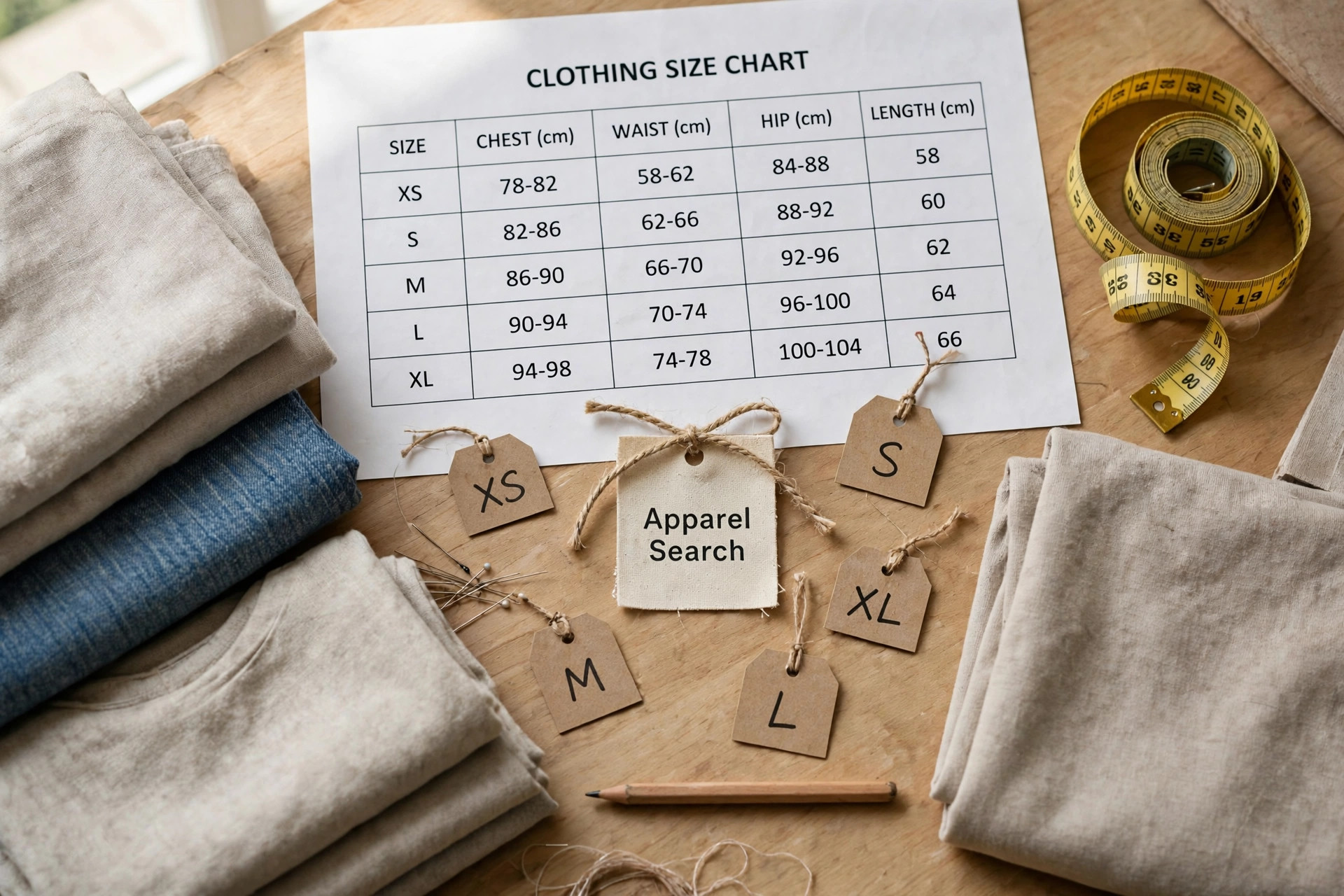
The standard sizes describe combinations of body measurements that are commonly seen in the general population. Horizontal torso measurements that can be specified include the neck circumference, the shoulder width, the over-bust circumference, the bust circumference, the bust-point separation, the under-bust (rib-cage) circumference, the natural waist circumference, the upper hip circumference and the lower hip circumference.
Vertical torso measurements that can be specified include the back (neck-waist) length, the shoulder-waist length — not the same as the back length, due to the slope of the shoulder — the bust-shoulder length, the bust-waist length, and the two hip-waist lengths. Sleeve measurements that can be specified include the under-arm and over-arm lengths, the fore-arm length, the wrist circumference and the biceps circumference. However, because of the drape and ease of the fabric, relatively few measurements are needed to obtain a well-fitting dress in most styles: bust, waist, hip and a length or two carry most of the fit, and the rest fine-tune it. A tailor or dressmaker fitting an individual works from the same measurement families, taken on one body instead of averaged across a population.
Unstable Names and Vanity Sizing
The names of the sizes are the system’s weakest part. The standard sizes have not had stable names: the dimensions of two size 10 dresses from different companies, or even from the same company, may have grossly different dimensions, and both are almost certainly larger than the size 10 dimensions described in the US standard. Vanity sizing may be partly responsible for this deviation, which began in earnest in the 1980s, as labels were adjusted so customers could buy a smaller number than their measurements once required.
Dress sizes are included in the US standard clothing size and the newer European standard EN 13402, and another standard has been produced by the American Society for Testing and Materials (ASTM). The European standard seeks to address the naming problem, since it is an absolute scale and mandatory; there is no mandatory clothing size standard in the U.S. That difference is why a dress size remains a starting point for trying on rather than a guarantee of fit — the number names a bundle of dimensions, and bundles with the same name need not match.
Common Questions
What is a dress size?
Dress size refers to a set of standard dimensions for a dress. The standard sizes describe combinations of body measurements that are commonly seen in the general population, so a size is a named bundle of measurements rather than a single number on the body.
Why do two dresses of the same size fit differently?
The standard sizes have not had stable names: the dimensions of two size 10 dresses from different companies, or even from the same company, may have grossly different dimensions. Vanity sizing, which began in earnest in the 1980s, may be partly responsible for this deviation.
Which body measurements define dress sizes?
Horizontal torso measurements include neck, shoulder width, over-bust, bust, under-bust, natural waist, and upper and lower hip circumferences. Vertical measurements include back length, shoulder-waist and bust-waist lengths, and sleeve measurements include under-arm and over-arm lengths and wrist and biceps circumferences.