Airline Uniforms by Airline · New Zealand
Air New Zealand: Two Uniforms, One Airline
Air New Zealand is living between two wardrobes. The uniform its crew wear today is Trelise Cooper’s colour-coded design of 2011 — pink for the cabin, green for the ground, blue for managers. Waiting in the wings is Emilia Wickstead’s violet collection, unveiled to great fanfare in 2025 but not due on board until 2027. This guide keeps the two eras straight.
The Design — In Service Today
The Trelise Cooper Wardrobe, 2011–Present
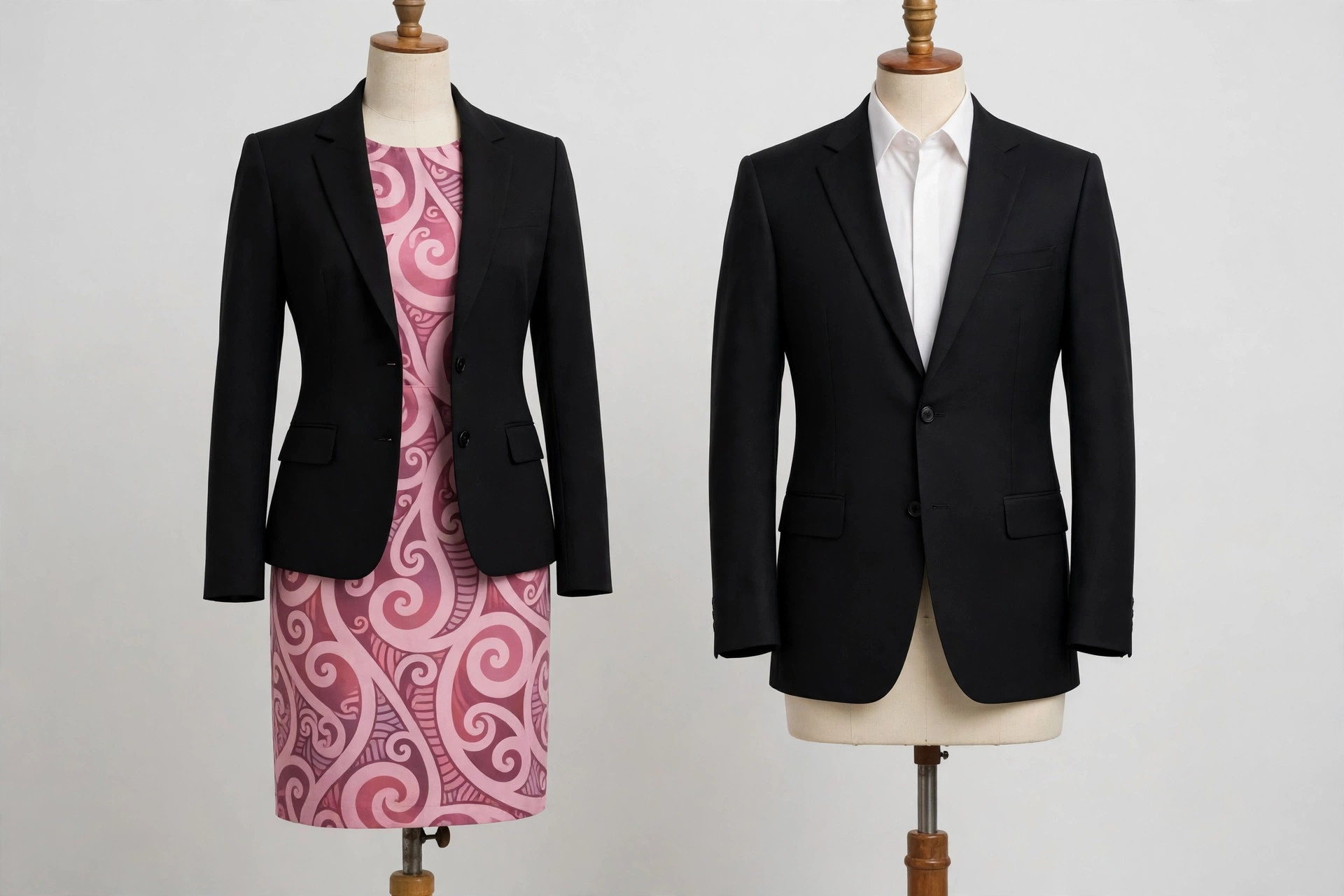
The uniform actually flying today debuted in 2011, timed to the Boeing 777-300ER’s entry into service, with some 90,000 garments issued to more than 5,000 staff. Its designer is Dame Trelise Cooper, one of New Zealand’s best-known fashion names, chosen after the airline reviewed more than 25 New Zealand designers; the wardrobe was made by Deane Apparel and is recorded in the New Zealand Fashion Museum’s collection.
Consider the scale of that 2011 moment: 90,000 garments for more than 5,000 people, issued to coincide with a new flagship aircraft. A uniform launch at that scale is a logistics operation as much as a design event — every pilot, crew member, concierge and ground agent changing identity on the same programme — and it explains why this airline changes uniforms rarely and deliberates publicly when it does. The wardrobe that resulted has now been in service longer than most airlines keep an aircraft type.
Cooper’s idea was a wardrobe system rather than a single outfit.
A formal black base — suits, coats and tailored separates — runs through every work group, and identity comes from colour-coded highlights and New Zealand-themed koru and flora prints laid over it. Formality flexes with the moment: sharper and more formal at the airport and for boarding, more relaxed in the air. It was a deliberate break from the muted teal of the Zambesi uniform it replaced — black tailoring with flashes of unmistakably local colour.The prints deserve a note of their own. The koru — the unfurling fern frond — is the defining motif of Māori art, a spiral of new growth, and it runs through this uniform family as it runs through the airline’s tails and cabins. Cooper’s treatment put that motif into the cloth itself, most memorably in the cabin crew’s pink print dress, rather than leaving it to a scarf or a tie. It set the pattern the Wickstead collection would later follow at greater depth: the print is not decoration applied to a uniform, it is the uniform’s main event, with the black tailoring acting as its frame.

The Components
The Outfit, Piece by Piece
- The Black Formal Base
- Suits and coats in black form the shared foundation for women and men alike — the tailored constant underneath every work group’s colour.
- Women’s Options
- Jacket, skirt and trouser combinations, dresses, blouses and shirts, with matching accessories — a mix-and-match wardrobe rather than one fixed outfit, per the Fashion Museum’s record of the design.
- The Koru-Print Dress
- The signature piece: a dress in the twilight pink koru print worn by cabin crew — the garment most passengers picture when they picture this airline.
- Men’s Tailoring
- Black suits and coats with the same work-group colour highlights as the women’s wardrobe; the launch photography documented the male manager’s suit finished with sky-blue highlights.
- Beyond the Cabin
- The Cooper programme covered the whole airline — the launch release lists uniforms for inflight concierges, pilots and several other work groups within the same black-and-colour family, though pilot garments were not itemised piece by piece in the sources for this guide.
The Colour Code
Pink, Green and Blue: Who Does What
Air New Zealand reads its uniform by work group, not by rank stripes. Stand in an Auckland terminal and the colours tell you who you are looking at:
| Highlight colour | Work group | Where you see them |
|---|---|---|
| Twilight Pink | Cabin crew | In the cabin — the pink koru-print dress is the emblem of the group. |
| Godzone Green | Ground staff | At check-in, gates and lounges across the network. |
| Sky Blue | Ground & inflight managers | The supervisory layer, on the ground and in the air. |
The system also flexes through the working day. The wardrobe was designed with varying formality built in — the full tailored register for the airport, boarding and disembarkation, when the airline is most on show, and a more casual register in the air, when the work is physical and the cabin is a workplace rather than a stage. Jackets come off, sleeves roll, and the colour coding survives every stage of undress, because it lives in the dresses, shirts and highlights rather than in a single formal layer.
It is a passenger-friendly system:
no braid to memorise, no stripes to count — just find the colour of the help you need. The successor collection, below, codes its people differently, by garment rather than by colour.A Designer Lineage Few Airlines Can Match
By the airline’s own telling, its uniform history runs through Christian Dior and Nina Ricci in the TEAL era, Isobel Harris, Barbara Lee’s long-lived “Pacific Wave” of 1992, and Zambesi’s pounamu-toned design of 2005, before Cooper in 2011 and Wickstead next. New Zealand’s national carrier has treated the uniform as a national design showcase for the better part of a century — each generation handed to a name that says something about the country at that moment.
Evolution
From Dior to Zambesi
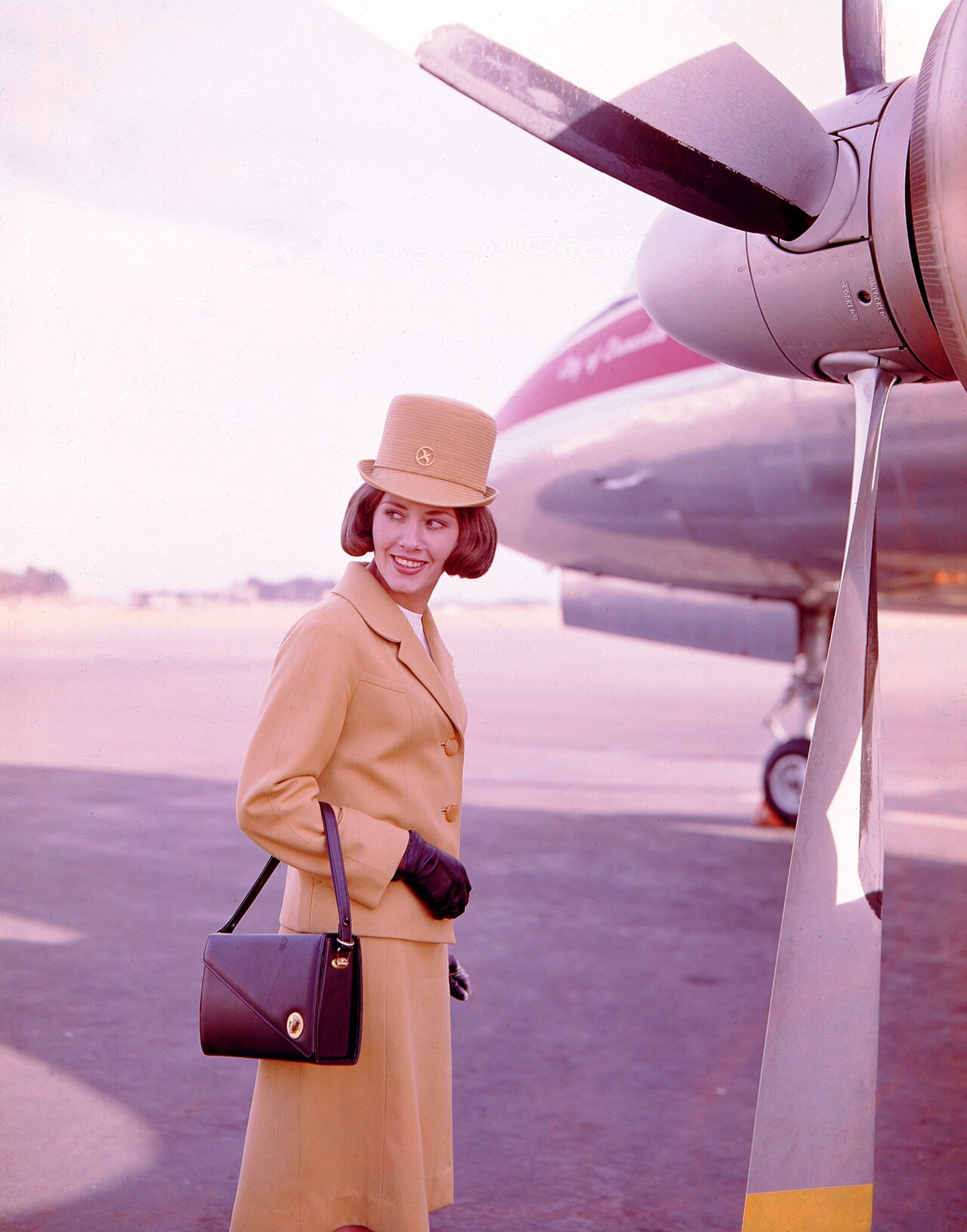
The lineage the airline itself names begins with Christian Dior and Nina Ricci dressing crew in the TEAL era, when the Tasman Empire Airways predecessor carried a distinctly European glamour. Isobel Harris followed, and in 1992 Barbara Lee’s “Pacific Wave” — Pacific jade and navy — began one of the longest runs in the airline’s history: refreshed in 1996, it served some thirteen to eighteen years in its successive forms. Zambesi, the Auckland fashion house, took over in 2005 with muted teal, pounamu and schist tones and koru curves — a moodier, landscape-led design that Cooper’s black-and-bright wardrobe replaced in 2011.
Each of those predecessors carried its era. Lee’s Pacific Wave, in Pacific jade and navy, was the uniform of the airline’s confident 1990s expansion, and its near-two-decade run made it the look a generation of New Zealanders grew up flying in — longevity that set the benchmark Cooper’s wardrobe has now also passed, at fifteen years and counting. Zambesi’s 2005 design swung the palette toward the land itself: pounamu greenstone, schist grey-browns and shadowy teal, with koru curves softening the tailoring. Read in sequence — jade, then landscape, then black with bright local colour, then violet — the uniforms chart New Zealand fashion’s own journey from elegance to identity.
The Successor
The Wickstead Collection — Arriving From 2027
In November 2023 Air New Zealand selected Emilia Wickstead, the New Zealand-born, London-based designer, for its next uniform, and unveiled the collection in Auckland on 11 April 2025 for some 6,000 staff. Its prints were hand-drawn by tā moko artist Te Rangitu Netana (Ngāpuhi, Ngāti Wai, Te Arawa) — a collaboration the airline presented as central to the design, not decoration. The signature colour is violet-purple, and the fabrics include organic cotton, recycled polyester and recycled-polyester/wool blends.
- The Fine Print Dress
- The hero piece: a dress with a tūī-knot neckline and a kōwhai print carrying the story of Ngatoro-i-Rangi — protection, responsibility and belonging.
- The Collective Thread Shirt
- A shirt patterned with purapura whetū — star patterns — designed to be worn by any cabin or ground staff member.
- The Wrap Around Trench
- A trench coat in purple-violet pinstripe, the collection’s outer layer.
- The Runway Cut Waistcoat
- A waistcoat for male crew and ground staff, in some versions carrying kākā-feather or pepeha prints.
- The Woven One — Ie Faitaga
- A Pasifika cultural garment, included in the collection on trial — a first for the airline, recognising its Pacific staff and passengers in cloth.
- The Pilot Suit
- A bold pinstripe suit with a kiwi-feather print lining, designed to symbolise leadership and prestige; here rank returns as a garment, not a colour.
Two pieces carry particular cultural weight. The Ie Faitaga — the formal wrapped garment worn across Samoa and the Pacific — appears in a major airline uniform, on trial, as a recognised cultural dress option for Pasifika staff rather than a costume for a theme flight; Auckland is the largest Polynesian city in the world, and the airline’s workforce and passengers reflect that. And the kōwhai print on The Fine Print dress is narrative, not floral filler: the story of Ngatoro-i-Rangi, the tohunga who called fire to the summit of Tongariro, is a story of protection and responsibility — the two things an airline most needs its crew to embody. Wickstead and Netana built the collection’s meanings the way Matemosi built Fiji’s: garment first, story woven in.
The fabrics mark a generational shift, too. Where earlier wardrobes in this lineage were specified for looks and durability, the Wickstead collection publishes its material conscience: organic cotton, recycled polyester, and wool blended with recycled polyester. Uniforms are among the largest clothing contracts any country issues — thousands of wearers, tens of thousands of garments, replaced on a cycle — so a national carrier’s fabric choices are industrial policy as much as fashion. The collection’s violet pinstripes will be its public face; its fibre list may be its longer legacy.
Wearer trials with around 400 staff began in May 2025 — and the trials talked back: a short-sleeve shirt option was added on crew feedback. The rollout originally planned for 2026 was then pushed back, with the airline’s brand leadership confirming that trial feedback is being used to refine the collection; the revised plan is a progressive rollout from 2027 (reported as March 2027 — treat the exact month as provisional). Until that rollout, the Cooper uniform remains the uniform of Air New Zealand, and this guide presents it that way.The Rules
Grooming: Not Publicly Documented
That openness is itself a change worth recording. The Cooper wardrobe arrived the conventional way — a designer selected, a launch date set, a fleet of people re-dressed. The Wickstead wardrobe is arriving by negotiation with its wearers, in public, over years: unveiled, trialled, amended, delayed, refined. However the finished collection looks when it finally boards in 2027, its development has already made it the most wearer-shaped uniform in this airline’s long designer history.
No Air New Zealand grooming manual or published appearance code was found in reputable sources for this guide, and none is invented here. What the record does show is a design process unusually open to the wearers themselves: the Wickstead collection was reshaped by the staff who trialled it, down to sleeve length. For this airline, the documented “rules” story is not a grooming code — it is a uniform being fitted, in public, to the people who will wear it.The Meaning
Why This Uniform Matters
There is a practical coda: a wardrobe in service since 2011 has outlasted the aircraft type it was launched with as the fleet’s flagship, several chief executives, and the entire first design life of its successor. Longevity at that scale is not inertia — replacing 90,000 garments is a decision an airline takes only when the new design earns it, which is the standard the Wickstead collection is being held to in its extended trials.
Air New Zealand’s uniform is a rolling exhibition of New Zealand design: Paris couture in the TEAL years, local heroes ever since, and prints that carry Māori and Pasifika artistry into every cabin. The Cooper wardrobe’s colour code made the system legible to any passenger in seconds; the Wickstead collection promises to make it richer in story. Few airlines ask their uniforms to say this much about home — or take this much care, and this much time, over changing them. For the country behind the koru, see our New Zealand clothing industry page.Airlines refresh their uniforms from time to time, so the details here describe the uniform as documented for this guide — the airline’s own site always carries the latest version.
Common Questions
Common Questions
Who designed the current Air New Zealand uniform?
Dame Trelise Cooper. Her wardrobe debuted in 2011, coinciding with the Boeing 777-300ER’s entry into service, and it is still the uniform in service today. Cooper was chosen after the airline reviewed more than 25 New Zealand designers.
What do the Air New Zealand uniform colours mean?
Colour identifies the wearer’s work group rather than their rank. Twilight pink highlights and the pink koru-print dress mark cabin crew, godzone green marks ground staff, and sky blue marks ground and inflight managers — all over a shared black formal base of suits and coats.
Is the Emilia Wickstead Air New Zealand uniform in service yet?
No. The Wickstead collection was unveiled on 11 April 2025 and went into wearer trials, but its rollout was pushed back from 2026 to a progressive introduction from 2027 — reported as March 2027. Until then, the Trelise Cooper uniform of 2011 remains the uniform passengers see.
What is special about the Wickstead collection?
Its prints were hand-drawn by tā moko artist Te Rangitu Netana, and its named pieces include The Fine Print dress with a kōwhai print, The Collective Thread shirt with purapura whetū star patterns, a violet pinstripe trench and pilot suit, and The Woven One — an Ie Faitaga, a Pasifika cultural garment included on trial.
Which famous designers dressed Air New Zealand crew before?
The airline’s own lineage runs from Christian Dior and Nina Ricci in the TEAL era through Isobel Harris, Barbara Lee’s 1992 Pacific Wave uniform and Zambesi’s 2005 design, before Trelise Cooper’s 2011 wardrobe — one of the longest designer pedigrees of any airline.
Keep Exploring
More to Explore
In This Series
Airline Uniforms by Airline
The series hub — every airline’s guide, the designers behind them, and the ones in preparation.
Read ↑New Zealand Clothing Industry
The airline’s home country in the World Clothing Industry directory.
Read ↑Go Deeper
Keep Exploring
Explore Fashion for Travel
The crew are only half the fashion on a flight — the other half is what the passengers are wearing. Our travel guides cover the traveller’s side of the same subject, and they link back here.
Outfits for Flying
Travel Outfits
What to wear when you are going somewhere — outfit systems built for transit days.
Read ↑Airport Outfits
Security-friendly shoes, cabin layers and the full airport dressing system.
Read ↑What to Wear on a Long Flight
Dressing for the overnight haul — comfort, warmth and arriving presentable.
Read ↑What to Wear When Traveling
The destination-rules guide to building a travel wardrobe that works on arrival.
Read ↑Business Travel Wardrobe Guide
A working wardrobe that travels — suits, wrinkle strategy and boardroom-ready arrivals.
Read ↑Packing & Capsule Wardrobes
Travel Capsule Wardrobe Guide
A small set of pieces that combine into a trip’s worth of outfits.
Read ↑Travel Packing Guide
The complete packing method — lists, order and wrinkle control.
Read ↑How to Pack a Suit
Getting a tailored jacket and trousers across the world without the creases.
Read ↑Carry-On Packing Guide
Everything in one bag — the carry-on-only system, piece by piece.
Read ↑Travel Comfort & Accessories
Search Apparel Search