Airline Uniforms by Airline · South Korea
The Korean Air Uniform: Celadon, Beige and Ferré
Since 2005, Korean Air's crew have worn one Italian designer's answer to a Korean brief: beige tailoring over a shimmering celadon blouse, a scarf tied to suggest a wing, and a hair ribbon borrowed from traditional dress. It is the airline's eleventh uniform — and, by a distance, its longest-lived. This is its story, piece by piece.
The Design
A Ferré Commission That Never Came Off
Most airline uniforms last a decade if they are lucky. Korean Air's current uniform has been flying since 2005 — the longest-serving wardrobe in the airline's history — and it began as a genuine couture commission. The designer was Gianfranco Ferré, the Italian designer who had spent the late 1980s and 1990s as stylistic director of Christian Dior. Korean Air's own 50th-anniversary retrospective, reported by the Korea JoongAng Daily, states the attribution plainly: in 2005 the airline adopted a uniform designed by Ferré, in beige and celadon green, and has kept it ever since. The airline's 2005 launch release said the same thing at the time, so this is one of the best-documented designer attributions in commercial aviation — a contemporary record, not a later legend.
The 2005 programme was also the broadest the airline had ever attempted. Earlier Korean Air uniforms had dressed the cabin; the Ferré wardrobe was the first sweeping change to cover every employee group at once — cabin attendants, front-line ground employees, pilots and mechanics — rolled out in stages during 2005, beginning with the cabin attendants. One design language, from the check-in desk to the flight deck, was itself the statement: a single, calm, unmistakably Korean palette carried across the whole company.
The timing deserves a note. When the airline marked its 50th anniversary, it published a retrospective of all eleven uniforms — and the Ferré wardrobe was the one entry in that history that was not history at all, but the uniform its crew were wearing that morning. Retrospectives are where airlines bury old uniforms; Korean Air's instead read as a reigning champion's record, fourteen years into a title reign that has since stretched past twenty. The retrospective's phrasing — adopted in 2005, "kept ever since" — was the airline saying, in its own institutional voice, that the redesign cycle had stopped by choice rather than by neglect.
Ferré died in 2007, only two years after the launch. The uniform he left behind has outlived the usual redesign cycle several times over — through a global financial crisis, a pandemic, and now a merger — which is why this guide treats it less as a fashion story than as a case study in what happens when an airline decides its uniform is finished. Read more about the designer in our Gianfranco Ferré designer profile.

The Components
The Outfit, Piece by Piece
- The Jacket
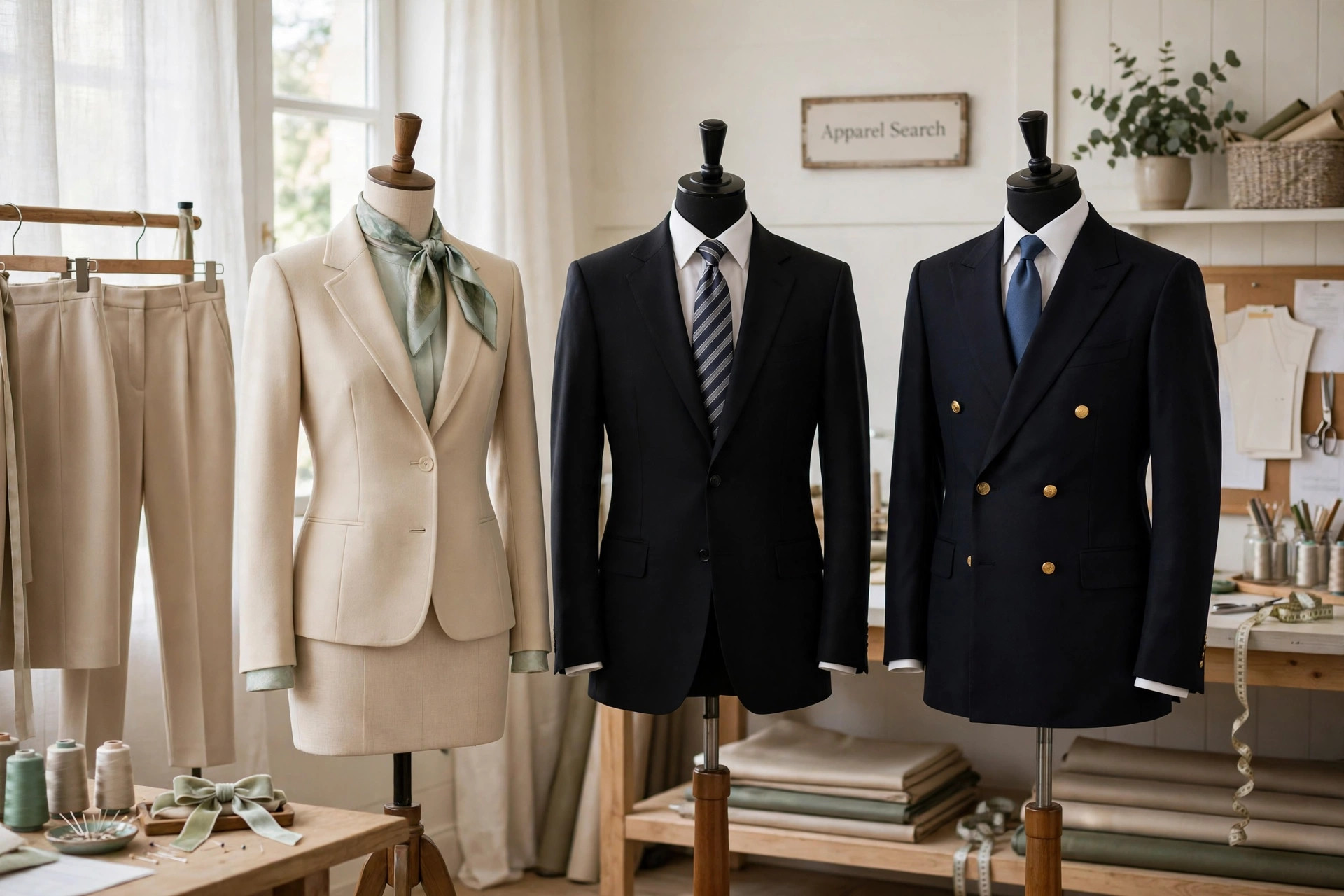
- A tailored jacket in warm beige-cream for general flight attendants — the soft, sand-toned half of the Ferré palette, cut as classic suiting rather than fashion tailoring, so it has dated far more slowly than most 2005 design.
- The Celadon Blouse
- Under the jacket, a blouse in celadon green — the pale jade, blue-green shade named for Korea's classic ceramic glaze — with a shimmering, water-like finish that catches the cabin light. It is the colour passengers remember, and the one that sets this uniform apart from every navy wardrobe in the sky.
- Skirt or Trousers
- A beige skirt or trousers. The choice is younger than the uniform: for the wardrobe's first eight years female crew were required to wear the tight, knee-length skirt, and trousers were allowed only from 2013, after the National Human Rights Commission of Korea urged a policy change — a story told in full in the dark panel below.
- The Wing Scarf
- A silk neck scarf tied at an angle so that one end stands up like a wing — the uniform's signature flourish, and a deliberate piece of theatre: a static garment given a suggestion of flight. Our scarf definition covers the accessory family it belongs to.
- The Binyeo Ribbon
- The hair is finished with a ribbon accessory modelled on the binyeo, the traditional Korean hairpin — a small, deliberate quotation of historic Korean dress inside an Italian-designed suit, and the clearest sign that Ferré was asked to design a Korean uniform, not merely a uniform for Korea. The dress tradition behind it is covered in our hanbok guide.
- Pilots and Ground Staff
- Both groups were dressed in the same 2005 Ferré programme, so the whole company changed together. Korean Air has not published a garment-by-garment breakdown of the pilot and ground wardrobes in the sources for this guide, and rather than invent one, this guide describes in detail only what is documented: the cabin wardrobe above and the men's suiting below.
The Rank Code
Rank, Read from the Jacket
Korean Air carries its cabin hierarchy in cloth, not braid: there are no shoulder insignia for cabin crew, because the jacket itself does the talking. The code below is the one consistently described by experienced Korean Air crew and frequent flyers; the airline has not published an official rank chart, so treat this as well-corroborated practice rather than a company document.
| What you see | Who is wearing it | How it works |
|---|---|---|
| Beige-cream jacket (women) | Flight attendants | The standard Ferré jacket of the general cabin crew ranks. |
| Blue jacket and cardigan (women) | Assistant / deputy purser and above | Promotion changes the jacket colour — the whole silhouette shifts from beige to blue. |
| Single-breasted jacket, striped tie (men) | Below purser rank | The junior men's configuration of the black suit. |
| Double-breasted jacket, solid blue tie (men) | Purser rank and above | Seniority adds a second row of buttons and removes the stripe from the tie. |
It is an unusually legible system for passengers who know it — a blue jacket in the aisle means a supervisor is on board — and an unusually quiet one for those who do not: nothing about it looks like a badge of office.
The Men's Uniform
A Black Suit, Two Configurations
The men's cabin uniform is a black suit whose meaning is in its construction. Junior ranks wear it single-breasted with a striped tie; from purser rank upward it becomes double-breasted with a solid blue tie. The palette could hardly differ more from the women's celadon and beige — black suiting against pale jade — yet the two wardrobes were designed as one programme, and they share the same tailored discipline: nothing loose, nothing casual, nothing that would look out of place in a Seoul boardroom.
That contrast is worth pausing on, because it explains the Ferré wardrobe's longevity. The women's uniform carries the identity — colour, scarf, hair ribbon — while the men's carries the formality. Airlines that put the branding on every wearer tend to tire of it faster; Korean Air concentrated its signature on one wardrobe and let the other simply be a good suit, and both halves are still in service more than twenty years later.
The Skirt, the Trousers and 2013
For its first eight years, the Ferré uniform came with a rule the designer never drew: female crew had to wear the tight, knee-length skirt. Trousers existed in the wardrobe's logic but not in its regulations. That changed in 2013, when — after the National Human Rights Commission of Korea urged a policy change — Korean Air allowed its female flight attendants to wear trousers. The episode matters beyond one airline: it is the moment a couture uniform met a human-rights standard, and the standard won. The beige trousers in today's cabin are not a fashion update; they are a rights milestone that happens to be worn.
The Rules
Heels, Glasses and a 57-Year Rule Under Review
Korean Air's appearance rules were, for most of the uniform's life, as fixed as its colours. Reporting by the Korea JoongAng Daily documents the framework: female flight attendants were required to wear heels of 3–5 cm on duty — a rule dating back to 1969, the airline's founding era — and detailed regulations historically covered skirt length, earring size and material, nail colour, hairstyle and makeup. Glasses, once prohibited, tell the direction of travel: Korean Air permitted glasses in February 2026.
Put the dates together and the grooming story becomes a single arc: a heel rule born with the airline in 1969, a skirt rule relaxed under human-rights pressure in 2013, job titles made gender-neutral in 2022, glasses permitted in 2026, and the heel itself under formal review the same year. Each change arrived separately, but they all move the same way — from appearance prescribed in detail toward function argued in the open, with labour-management consultation, not a designer's sketch, as the mechanism. The Ferré clothes have stayed still while the rules for wearing them have been renegotiated, piece by piece, around them.
The heel rule itself is now formally in question. In April 2026 the airline was reported to be reviewing, through labour-management consultation, an end to the 57-year requirement — allowing sneakers or functional shoes for in-flight duty — and stated it was "working on introducing work shoes designed with safety and functionality in mind for in-flight service". As of that reporting the change was under review, not yet implemented, and this guide states it no more strongly than that: the heels are still the documented rule, the sneakers are a documented proposal. A smaller change did land earlier: in November 2022 the airline replaced the job titles "steward" and "stewardess" with the gender-neutral "Flight Attendant".
Evolution
Eleven Uniforms, One Survivor
Korean Air has dressed its crew in eleven uniforms since 1969, and the early ones chased their decades as eagerly as any airline's: the first, in 1969, paired a scarlet skirt with a collarless shirt in full miniskirt-era spirit; a new uniform followed in 1972 for the airline's first Pacific crossing; the 1980s brought a red uniform tied to the 1986 Asian Games and the 1988 Seoul Olympics; and from 1991 a navy uniform served for fourteen years. Then came Ferré in 2005 — and the cycle simply stopped.
It very nearly restarted. Korean reporting in late 2022 said a new uniform would accompany the 2022 title change, aimed at the first half of 2023. That redesign never entered service — crew were still wearing the 2005 uniform in 2026 reporting and photography. What did change was everything around the clothes: Korean Air unveiled a new corporate identity and livery on 11 March 2025, after acquiring a controlling stake in Asiana Airlines in December 2024, but no new crew uniform was unveiled with it. As of April 2026 reporting, the airline was instead "pushing ahead with uniform improvements… focusing on structural and functional enhancements to improve comfort and ease of movement" — a functional refresh of the existing Ferré wardrobe, not a new design. The integrated Korean Air–Asiana carrier is scheduled to launch on 17 December 2026; any unified uniform for the merged airline remains unannounced, and claims of a full redesign rollout should be treated as unverified until the airline shows one.
The Icon
Why This Uniform Matters
Airline uniforms usually matter because they change. This one matters because it did not. The Ferré wardrobe has become Korean Air's longest continuous piece of design — older than its current livery, older than its alliance-era branding, now carrying the company into a merger that will redefine almost everything else about it. Its celadon blouse and wing-tied scarf did something rare: they made a national colour palette board an aircraft and stay there, unchanged, until passengers stopped seeing a uniform and started seeing the country. Whatever the merged airline eventually wears, the twenty-year run of beige and celadon is the standard it will be judged against. For the industry behind it, see our South Korea fashion and textiles page.
Airlines refresh their uniforms from time to time, so the details here describe the uniform as documented for this guide — the airline’s own site always carries the latest version.
Common Questions
Common Questions
Who designed the Korean Air uniform?
Italian designer Gianfranco Ferré, the former stylistic director of Christian Dior. His beige and celadon uniform was adopted in 2005 and has been kept ever since, making it the longest-serving of Korean Air's eleven uniforms since 1969.
What do the Korean Air jacket colours mean?
For women, the jacket colour shows rank: the beige-cream jacket is worn by general flight attendants, while the blue jacket and cardigan mark assistant or deputy purser rank and above. For men, purser rank and above wear a double-breasted jacket with a solid blue tie; below purser the suit is single-breasted with a striped tie.
When were Korean Air flight attendants allowed to wear trousers?
From 2013. For the first eight years of the Ferré uniform, female crew were required to wear the tight, knee-length skirt; trousers were allowed only after the National Human Rights Commission of Korea urged a policy change.
Are Korean Air flight attendants switching from heels to sneakers?
Not yet, on the documented record. Female crew were required to wear heels of 3–5 cm under a rule dating to 1969. In April 2026 the airline was reported to be reviewing an end to that rule through labour-management consultation, with functional shoes for in-flight duty in development — under review, not confirmed as implemented. Glasses, once prohibited, were permitted in February 2026.
Will Korean Air get a new uniform for the Asiana merger?
No new uniform has been announced. Korean Air unveiled a new corporate identity and livery on 11 March 2025, but no crew uniform came with it, and reporting in April 2026 described functional improvements to the existing uniform rather than a new design. A redesign reported in late 2022 for 2023 never entered service.
Keep Exploring
More to Explore
In This Series
Airline Uniforms by Airline
The series hub — every airline's guide, the designers behind them, and the ones in preparation.
Read ↑South Korea Fashion & Textiles
The airline's home country in the World Clothing Industry directory.
Read ↑Gianfranco Ferré
The Italian designer behind the celadon uniform — his house, his Dior years and his career, in our designer profile.
Read ↑Go Deeper
Uniforms — Definition
What a uniform is, and why organisations dress their people alike.
Read ↑Scarf — Definition
The silk accessory tied into a wing at the Korean Air collar, defined.
Read ↑Tie & Necktie — Definition
Striped for junior ranks, solid blue for pursers — the men's rank signal, defined.
Read ↑Hanbok — Traditional Dress of Korea
The dress tradition behind the binyeo hair ribbon in the Ferré uniform.
Read ↑Keep Exploring
Explore Fashion for Travel
The crew are only half the fashion on a flight — the other half is what the passengers are wearing. Our travel guides cover the traveller’s side of the same subject, and they link back here.
Outfits for Flying
Travel Outfits
What to wear when you are going somewhere — outfit systems built for transit days.
Read ↑Airport Outfits
Security-friendly shoes, cabin layers and the full airport dressing system.
Read ↑What to Wear on a Long Flight
Dressing for the overnight haul — comfort, warmth and arriving presentable.
Read ↑What to Wear When Traveling
The destination-rules guide to building a travel wardrobe that works on arrival.
Read ↑Business Travel Wardrobe Guide
A working wardrobe that travels — suits, wrinkle strategy and boardroom-ready arrivals.
Read ↑Packing & Capsule Wardrobes
Travel Capsule Wardrobe Guide
A small set of pieces that combine into a trip’s worth of outfits.
Read ↑Travel Packing Guide
The complete packing method — lists, order and wrinkle control.
Read ↑How to Pack a Suit
Getting a tailored jacket and trousers across the world without the creases.
Read ↑Carry-On Packing Guide
Everything in one bag — the carry-on-only system, piece by piece.
Read ↑Travel Comfort & Accessories
Search Apparel Search