Airline Uniforms by Airline · Vietnam
The Vietnam Airlines Áo Dài by Minh Hạnh
Since July 2015, Vietnam Airlines crew have worn a modernised áo dài by the designer who knows the garment best: Minh Hạnh's long tunic with a lotus-shaped neckline, in jade green for Economy and gold for Business, over white trousers. It replaced one of the world's most admired uniforms — and kept its soul. This is its story, piece by piece.
The Design
Minh Hạnh Reworks the Áo Dài
Replacing a beloved uniform is the riskiest brief in airline design, and Vietnam Airlines knew it: the red áo dài it retired in 2015 had flown for fifteen years and had been named among the world's ten most beautiful flight-attendant uniforms only the year before. The airline's answer was to keep the garment and change everything about its execution. The new uniform was designed by Minh Hạnh, the veteran Vietnamese fashion designer who specialises in the áo dài — an attribution carried consistently by the trade press of the launch, including Business Traveller's 2015 uniform roundup, which lists the designer, the July 2015 introduction and the colour system in a single entry. No competing attribution exists.
The choice of designer was itself a statement about what kind of uniform this would be. Minh Hạnh is not an imported couture name attached for a launch headline; she is a Vietnamese designer whose career has been built on the áo dài — its cloth, its construction and its modernisation — and the airline's brief played directly to that specialism. Where other carriers of the period bought a fashion moment, Vietnam Airlines bought garment expertise: the 2015 uniform's innovations are all in the áo dài's own terms — a rethought neckline, a printed emblem, a colour system — rather than in tailoring borrowed from Western suiting. The result reads as a national dress that has been professionally redesigned, not a uniform that has been decorated with national motifs.
The launch itself was unusually public. The uniform was trialled from 8 March 2015, on flight VN236 from Ho Chi Minh City to Hanoi, expressly so the public could react before the decision hardened — a wearer-and-passenger consultation built into the rollout. It was then introduced in July 2015 as part of the airline's new brand identity, timed with the entry into service of its Airbus A350 and Boeing 787-9 fleets: new aircraft, new identity, new dress, one coordinated arrival. The design's signature is at the throat: a lotus-inspired neckline, taking Vietnam's national flower and the airline's own Golden Lotus emblem and folding it into the garment's construction rather than pinning it on.

The Components
The Outfit, Piece by Piece
- The Áo Dài Tunic
- A modernised áo dài: the long, fitted Vietnamese tunic, its neckline shaped after the lotus and the Golden Lotus logo printed into the fabric itself, so the branding is woven into the dress rather than applied to it. The garment's long history is covered in our áo dài guide and our Vietnam áo dài traditional dress guide.
- White Trousers and Black Heels
- The tunic is worn over white trousers — the áo dài's classic pairing — with closed-toe black heels. The white trouser is the constant that links this uniform to the pink and red áo dài generations before it.
- The Jade Blazer
- For winter and cold destinations there is a matching jade-green blazer with an áo-dài-style collar — tailoring that borrows the tunic's neckline, so the cold-weather layer reads as part of the same garment family rather than a coat thrown over it.
- The Men's Wardrobe
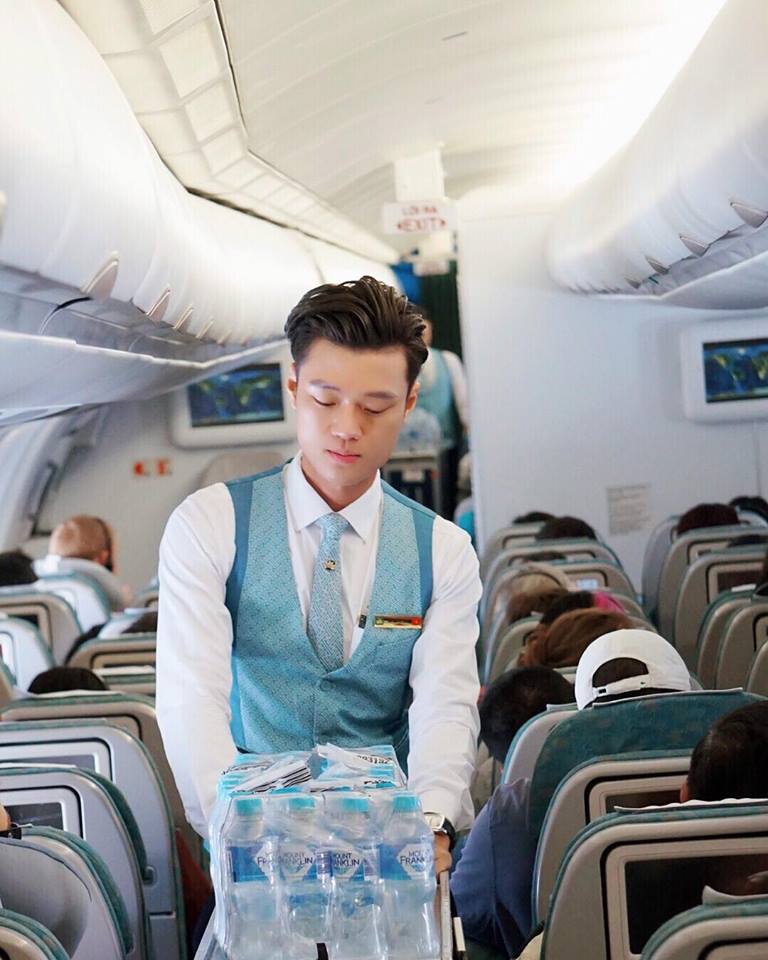
- White dress shirt and dark trousers under a vest or waistcoat and sweater in the jade-turquoise family, the Golden Lotus embossed on the sweater and the tie — detailed in the men's section below.
- Pilots
- White shirt, navy trousers and vest, cap and logo tie, with gold-stripe epaulettes marking captain, first officer and second officer in the conventional way.
- Ground Staff
- Women on the ground wear a modernised sky-blue áo dài similar to the flight attendants' but without the printed logo; men wear a white shirt, black trousers and black shoes with a jade-green tie. The sky blue is a deliberate echo — it was the áo dài's first colour at this airline, generations earlier.
The Colour Code
Jade for Economy, Gold for Business
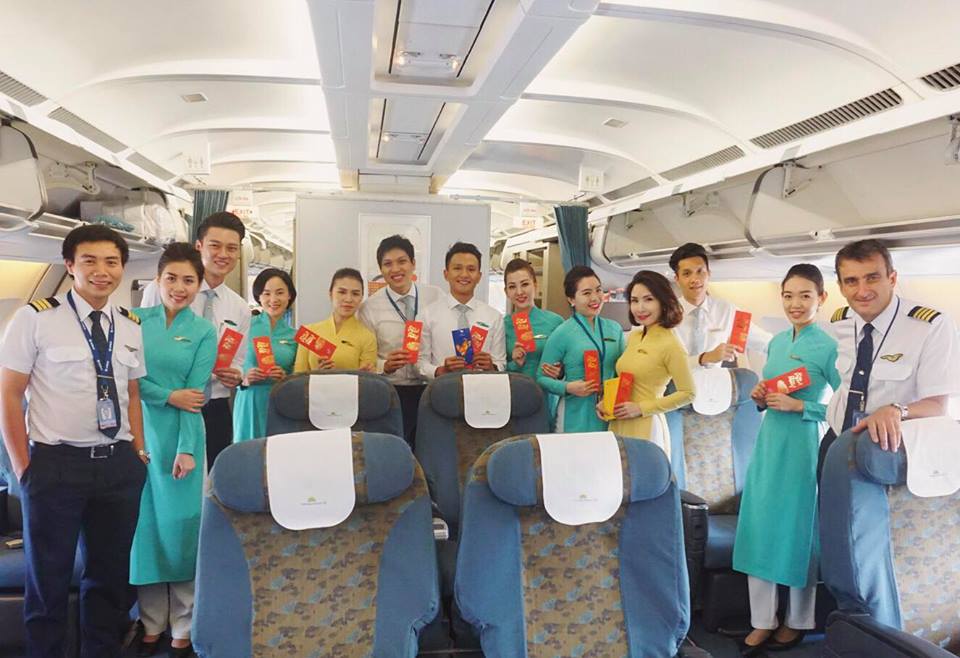
Vietnam Airlines codes its cabin not by seniority but by cabin served — you can read which class a crew member works from across the aisle. One naming caution before the table: the sources call the economy colour blue, jade green, turquoise and teal in different places. It is one colour — the jade-turquoise green of the photographs — and this guide calls it jade green throughout.
| Colour | Who wears it | Meaning |
|---|---|---|
| Yellow / gold áo dài | Chief flight attendants and Business Class attendants (women) | The premium cabin and its senior crew, in the Golden Lotus colour itself. |
| Jade green áo dài | Economy Class attendants (women) | The economy cabin — the colour most passengers fly with. |
| Gold tie / blue tie | Male cabin crew | The men's version of the same code: gold tie for Business, blue tie for Economy. |
| Black suit, gold tie | Senior male attendants | Seniority, for men, steps out of the colour system into a full black suit. |
The system rewards a second look for what it refuses to do. It does not grade the whole cabin hierarchy — a junior and a senior attendant working the same cabin wear the same colour, because the information a passenger actually needs is not "how senior is this person?" but "who is looking after my cabin?". Seniority surfaces only at the top of the structure: the chief attendants join the Business colour, and senior men leave the colour system entirely for the black suit. It is a service map first and a rank ladder second, which is why it photographs so clearly — two colours, two cabins, no decoding required.
The photograph at the top of this page shows the system whole: both áo dài colours in one crew, with the pilots' gold-striped epaulettes alongside — colour doing in the cabin what stripes do on the flight deck. Our epaulette definition explains the stripe half of that language.
The Men's Uniform
Vests, Sweaters and an Embossed Lotus
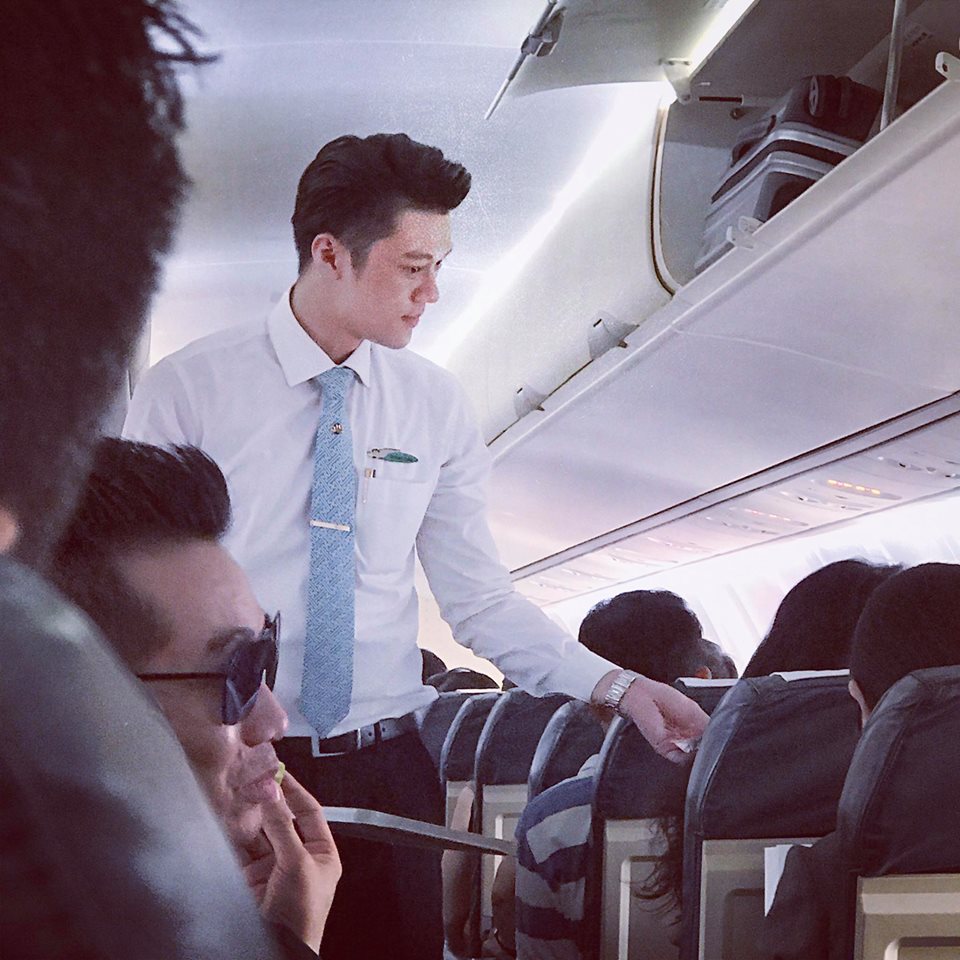
The men's cabin wardrobe is built in layers around the same jade family as the women's Economy áo dài: a white dress shirt and dark trousers, a vest or waistcoat and a sweater in jade-turquoise, and a tie colour-matched to the cabin served — gold for Business, blue for Economy. The Golden Lotus is embossed on both sweater and tie, so the emblem the women wear printed across their tunics appears on the men in miniature, tone on tone.
Seniority changes the men's silhouette more than the women's: a senior male attendant moves into a black suit with a white shirt and gold tie — the wardrobe's one piece of conventional executive tailoring, reserved for its senior rank, just as the women's yellow áo dài marks both the premium cabin and the chief attendants who lead it.
The Red Áo Dài It Replaced
To understand the 2015 uniform, stand in front of the one it retired. The red áo dài with gold trim, introduced in 2000, flew for fifteen years and became the airline's international portrait — in 2014 it was named among the world's ten most beautiful flight-attendant uniforms. Replacing it was never going to be a routine procurement decision; it was the retirement of a national image. Vietnam Airlines' response is the lesson of this page: it trialled the successor in public, on a domestic flagship route, months before the brand launch — and it kept the áo dài itself, changing the colour story, the neckline and the cloth rather than the garment. The red dress was mourned; the áo dài never left.
The Rules
Recruitment Standards, and an Unpublished Code
Vietnam Airlines' detailed in-service grooming code is not publicly documented, and this guide does not reconstruct one from photographs. What is on the record comes from the airline's recruitment ecosystem: height ranges of 158–175 cm for women and 168–182 cm for men, weight in proportion (assessed by BMI), no visible tattoos, and a well-groomed appearance as an entry condition. Those are hiring standards, not a grooming manual — the distinction matters, and it is the same honesty this series applies wherever an airline keeps its appearance rules internal. What passengers can verify with their own eyes is the outcome the standards produce: a cabin in which the áo dài is worn as formal dress, fitted and formal, rather than as a costume.
Evolution
Six Designs, One Garment's Long Takeover
Vietnam Airlines has changed its uniform five times — six designs in all — and the sequence is really the story of the áo dài slowly taking over. The first uniform, in 1956, was Western and modest: a white shirt with a vest collar and black trousers. The second era kept the white shirt and added a sky-blue skirt and blue tie. With the third design the áo dài arrived, in sky blue — the colour today's ground staff still wear in its honour. The fourth turned the tunic pink, the colour of the lotus. The fifth, in 2000, was the famous red áo dài with gold trim that flew for fifteen years and into the world's top-ten lists. The sixth, in 2015, is Minh Hạnh's jade-and-gold uniform on this page.
Notice the rhythm in that sequence: each era lasted longer and changed less than the one before, as if the wardrobe were converging on its final form. The shirt-and-trousers beginning was generic international dress; the sky-blue skirt era added colour; the áo dài eras added identity; and from 2000 onward the question was never again which garment but only which colour and which details. Red answered it for fifteen years, jade and gold have answered it since — the design argument at Vietnam Airlines has been settled, for a quarter of a century now, in favour of the national dress.
There is no seventh design on the horizon in any source opened for this guide: no successor or redesign has been announced, and the airline's 2026 imagery still shows the jade áo dài in service. A uniform that replaced a top-ten icon and then settled for a decade has arguably completed the hardest manoeuvre in uniform design — it made itself the new normal.
The Icon
Why This Uniform Matters
Longevity will be the final test, and the early signs are strong: a decade in service, no successor announced, and the design still anchoring the airline's imagery in 2026. Uniforms earn that kind of tenure only when crew can work in them and passengers can read them — the jade and gold áo dài passes both tests daily, on every sector, in both cabins at once.
Vietnam Airlines did the thing national carriers are always advised to do and rarely manage: it put the national dress at the centre of the brand, in its modernised rather than museum form, and organised the whole cabin's information system — cabin, class and seniority — in its colours. The lotus at the neckline is the detail to remember: not a badge pinned to a generic uniform, but the emblem grown into the garment's own construction. Jade and gold, economy and business, flower and dress — the uniform is a small, complete piece of national design, worn at 35,000 feet. For the country behind it, see our Vietnam clothing industry page.
Airlines refresh their uniforms from time to time, so the details here describe the uniform as documented for this guide — the airline’s own site always carries the latest version.
Common Questions
Common Questions
Who designed the Vietnam Airlines uniform?
Vietnamese fashion designer Minh Hạnh, a specialist in the áo dài. Her modernised áo dài was trialled from 8 March 2015 and introduced with the airline's new brand identity in July 2015, alongside the arrival of the Airbus A350 and Boeing 787-9.
What do the Vietnam Airlines áo dài colours mean?
Colour shows the cabin served. The yellow-gold áo dài is worn by chief flight attendants and Business Class attendants; the jade green áo dài — called blue, turquoise or teal in some sources — is worn by Economy Class attendants. Men's ties follow the same code: gold for Business, blue for Economy.
What did the 2015 Vietnam Airlines uniform replace?
The red áo dài with gold trim, introduced in 2000 and worn for fifteen years. It was named among the world's ten most beautiful flight-attendant uniforms in 2014, which is why the airline trialled its successor in public before the July 2015 launch.
What do Vietnam Airlines pilots and ground staff wear?
Pilots wear a white shirt, navy trousers and vest, a cap and logo tie, with gold-stripe epaulettes by rank. Ground staff women wear a sky-blue áo dài without the printed logo; ground staff men wear a white shirt, black trousers and a jade-green tie.
Is Vietnam Airlines planning a new uniform?
No successor or redesign has been announced in any source for this guide. The 2015 Minh Hạnh uniform remains current, and the airline's 2026 imagery still shows the jade áo dài in service.
Keep Exploring
More to Explore
In This Series
Airline Uniforms by Airline
The series hub — every airline's guide, the designers behind them, and the ones in preparation.
Read ↑Vietnam Clothing Industry
The airline's home country in the World Clothing Industry directory.
Read ↑Go Deeper
Uniforms — Definition
What a uniform is, and why organisations dress their people alike.
Read ↑Áo Dài Guide
The garment itself — its history, cuts and place in Vietnamese dress.
Read ↑Áo Dài — Traditional Dress of Vietnam
The national dress in our traditional dress series.
Read ↑Epaulette — Definition
The gold-stripe system that reads a pilot's rank, defined.
Read ↑Keep Exploring
Explore Fashion for Travel
The crew are only half the fashion on a flight — the other half is what the passengers are wearing. Our travel guides cover the traveller’s side of the same subject, and they link back here.
Outfits for Flying
Travel Outfits
What to wear when you are going somewhere — outfit systems built for transit days.
Read ↑Airport Outfits
Security-friendly shoes, cabin layers and the full airport dressing system.
Read ↑What to Wear on a Long Flight
Dressing for the overnight haul — comfort, warmth and arriving presentable.
Read ↑What to Wear When Traveling
The destination-rules guide to building a travel wardrobe that works on arrival.
Read ↑Business Travel Wardrobe Guide
A working wardrobe that travels — suits, wrinkle strategy and boardroom-ready arrivals.
Read ↑Packing & Capsule Wardrobes
Travel Capsule Wardrobe Guide
A small set of pieces that combine into a trip’s worth of outfits.
Read ↑Travel Packing Guide
The complete packing method — lists, order and wrinkle control.
Read ↑How to Pack a Suit
Getting a tailored jacket and trousers across the world without the creases.
Read ↑Carry-On Packing Guide
Everything in one bag — the carry-on-only system, piece by piece.
Read ↑Travel Comfort & Accessories
Search Apparel Search