Airline Uniforms by Airline · Thailand
The Thai Airways Uniform: Two Uniforms, One Flight
Thai Airways crew wear two uniforms on a single duty: a tailored purple suit for the ground, and — changed into before boarding, changed out of before landing — the Ruean Ton, Thailand's traditional silk dress, worn in the cabin for over sixty years and rewoven in 2024 from recycled plastic and silk. This is how the system works, piece by piece.
The Design
One Wardrobe, Two Costumes, Sixty Years
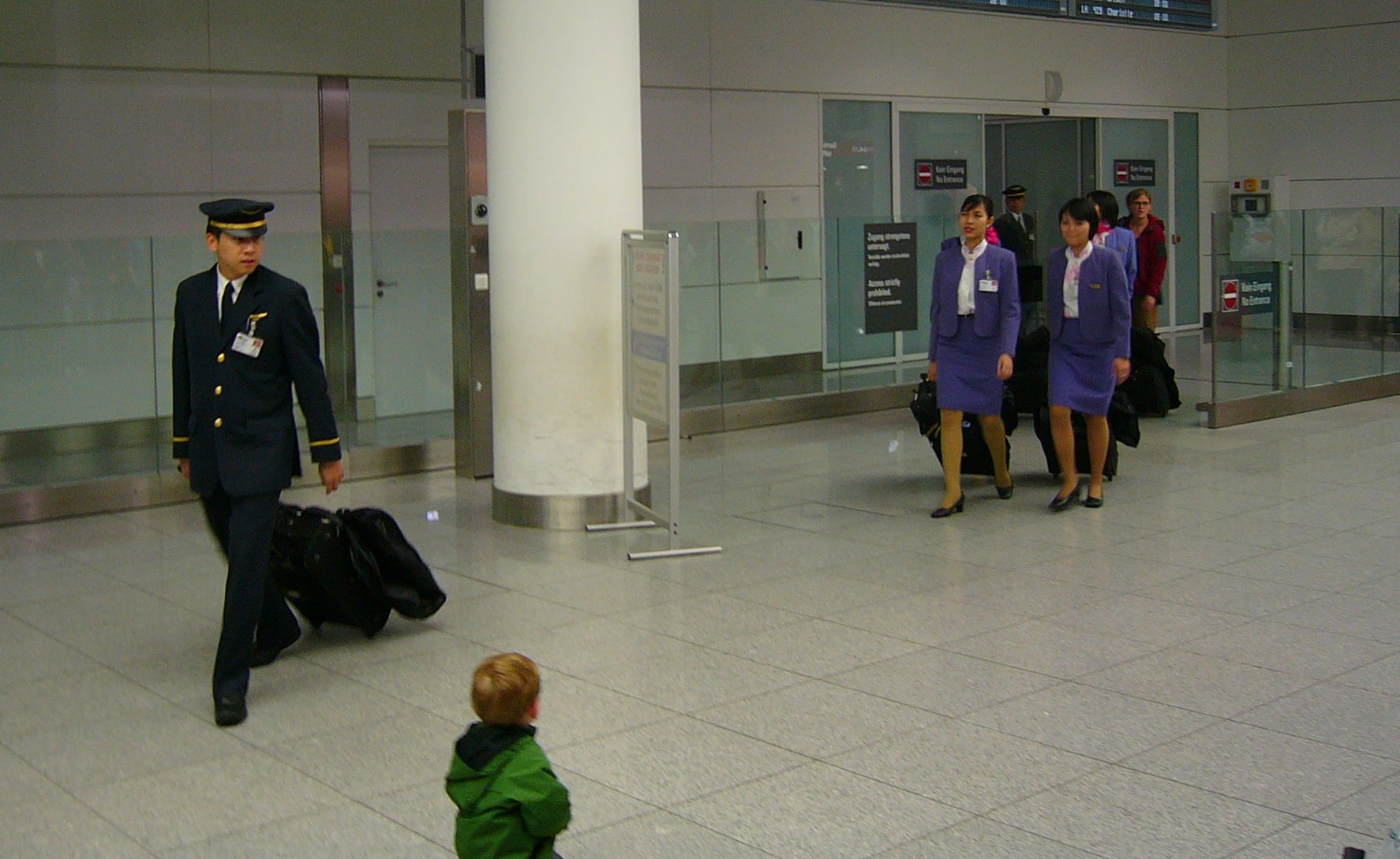
Thai Airways International asks its female cabin crew to do something almost no other airline asks: to change costume in the middle of the working day. On the ground — at the airport, in the boarding area, before boarding and after landing — they wear a tailored purple corporate suit. Before general boarding, they change into traditional Thai dress, the Ruean Ton in Thai silk, and work the flight in it; before disembarkation, they change back. The passenger who meets the crew at the gate and the passenger served at 35,000 feet are looking at two different uniforms, worn by the same women, on the same duty.
The wardrobe underneath that ritual has a named designer. In the airline's own words, quoted in its uniform history: "Nowadays, Thai cabin crew wears a uniform designed by Ms. Pichitra Boonyarataphan, a Thai designer who won the uniform competition in 2005, with a stylish contemporary fashion blended with Thai's traditional concept of the uniform." Contemporary reporting on the 2005 corporate-identity wardrobe described Pichitra's designs as based on clothes worn in the Thai palace and on Thai classical dance accessories — which is exactly the blend the two-uniform system performs: palace dress for the cabin, contemporary suiting for the ground.
The Ruean Ton form itself is older than the airline and is not any one designer's invention: it is one of the Chut Thai, the formal Thai dress forms codified for Queen Sirikit's 1960 state-visit wardrobe, a project the Queen developed with French couturier Pierre Balmain. That origin explains a persistent confusion this guide will not repeat: Balmain did not design the current Thai Airways uniform. The airline's own uniform history additionally claims "Balmain outfits, designed by French couturier Pierre Balmain in 1987" among its historical uniforms — a claim this guide reports as the airline's own, no more strongly, not least because Balmain himself died in 1982, so a 1987 attribution could only mean the House of Balmain. The documented designer of the wardrobe in service is Pichitra Boonyarataphan (2005); the documented story of its newest version is told in the dark panel below.

The Components
The Outfit, Piece by Piece
- The Purple Suit (Ground)
- The corporate face of the airline: a tailored purple jacket and skirt worn with a pink-purple blouse. This is the uniform of the airport, the gate and the jet bridge — sharp, international and deliberately contemporary next to the silk it gives way to.
- The Ruean Ton Blouse (In Flight)
- A collarless, fitted, long-sleeved blouse in the Ruean Ton form of Thai national dress — modest, elegant and unmistakably Thai, worn for the whole of the in-flight service on international routes.
- The Pha Sin Skirt
- The blouse is worn with a long wrap skirt, the pha sin, in Thai silk — purple, pink and other colours across the wardrobe — completing a silhouette that has represented Thailand in the sky for over six decades. Our silk definition covers the fibre at the heart of it.
- The Orchid Corsage
- An orchid corsage or brooch at the lapel finishes the in-flight dress — the airline's floral emblem worn on the cloth itself.
- The Panbuppha Brooch (2025/26)
- The newest component is an accessory with a supply chain: the Panbuppha Brooch, an orchid brooch made by design studio PIPATCHARA from collected Royal Orchid water bottle caps, now worn by cabin crew and ground service teams alike — the 2024 recycled-silk logic extended to jewellery.
- Men, Pilots and Ground Staff
- Male crew wear a dark suit on the ground, and secondary accounts describe a different on-board jacket for male flight attendants; no primary source itemises the men's garments, so this guide does not invent the detail. Pilots wear the conventional dark pilot uniform with cap and epaulettes, as the photograph at the top of this page shows, and ground staff wear the corporate purple family.
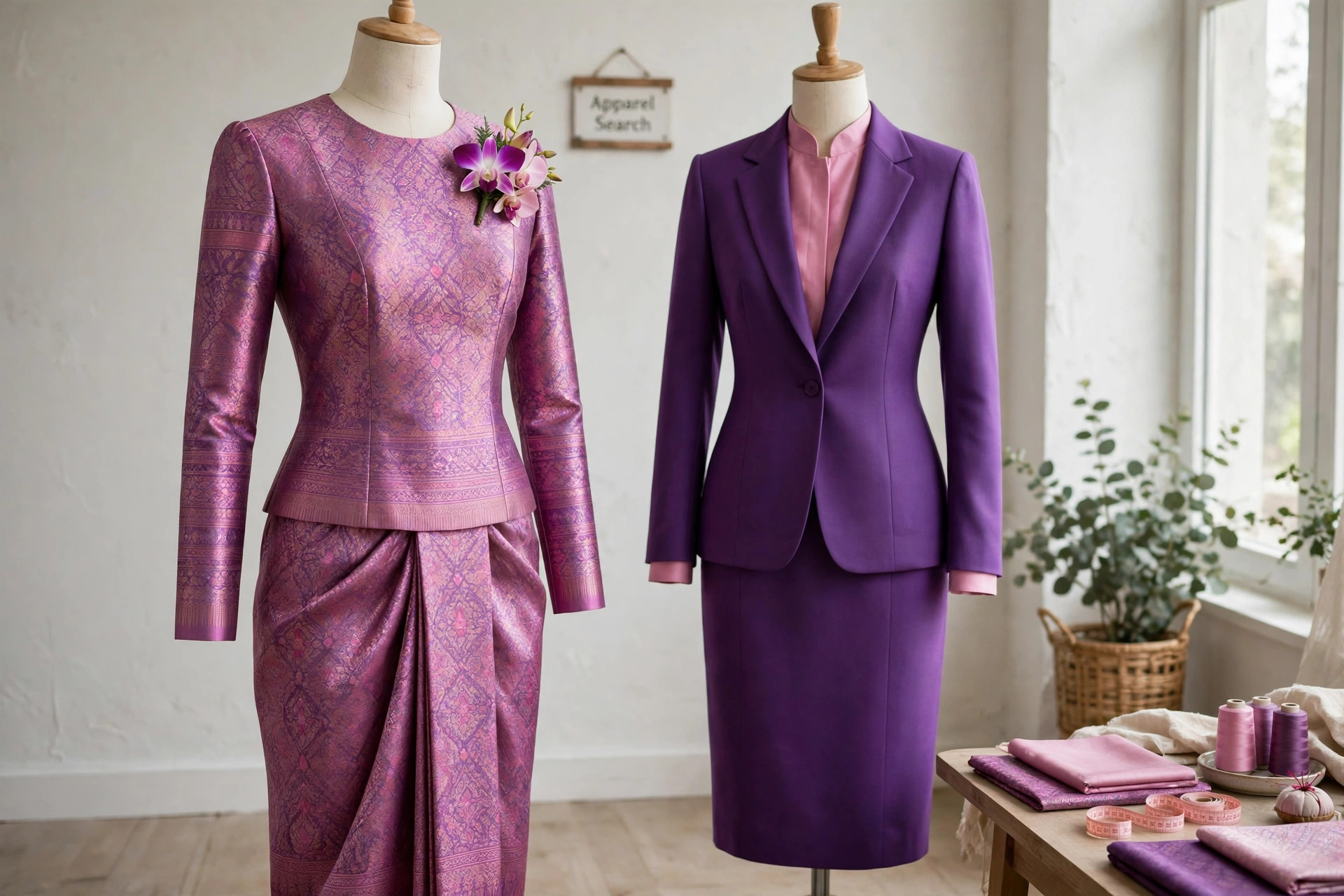
Consider what the two halves of this wardrobe ask of their cloth. The purple suit is a working garment in the modern sense — tailored, crease-resistant, made to survive a full day of terminals and jet bridges. The Ruean Ton was, for six decades, the opposite proposition: real Thai silk, with silk's beauty and silk's demands, worn not despite the practical difficulties but as a deliberate statement that the cabin was a ceremonial space. That is precisely why the 2024 fabric change matters so much in this uniform's story: blending recycled synthetic thread through the silk was the airline's way of keeping the ceremony while retiring the fragility — easier care and safety-standard performance, in the airline's own launch terms, without touching the silhouette the ceremony depends on.
The dress tradition the Ruean Ton belongs to is covered in full in our Chut Thai traditional dress guide.
Reading the Uniform
What Changes Is the Costume, Not the Colour
A warning first, because the internet needs one: listicles circulate a colour ladder for Thai Airways — blue, green, red and purple by rank. That system belongs to Singapore Airlines, whose kebaya colours genuinely work that way; it has been transplanted onto THAI without evidence, and THAI does not publish a colour-rank system. This guide will not invent one.
What actually differentiates Thai Airways crew is which uniform they are wearing, and where you are standing when you see it:
| Where you see the crew | What they are wearing | What it tells you |
|---|---|---|
| Airport, gate, boarding, after landing | The purple corporate suit with pink-purple blouse | The ground uniform — the Pichitra wardrobe's contemporary half. |
| On board, during the flight | The Ruean Ton in Thai silk, with orchid corsage | The in-flight uniform — the traditional half, changed into before general boarding. |
| Flight deck crew, anywhere | Dark pilot uniform, cap, epaulettes | Rank read the conventional way, in stripes — see our epaulette definition. |
Seniority in the cabin is carried by role, name and wing badges and the orchid brooch rather than by a change of dress colour — a quieter system than its famous neighbour's, and, on the published record, the only honest description of it.
From Purple to Purpose
On 1 January 2024 the Ruean Ton changed its cloth without changing its cut. Under the concept "From Purple to Purpose", part of the airline's Zero Waste Living project, the in-flight dress was re-issued woven from synthetic thread made from recycled plastic bottles blended with Thai silk — 70% recycled plastic fibre, 30% silk — for easier care and to safety standards. No designer is named for the re-issue, because there isn't one in the fashion sense: it is the existing traditional design, re-engineered as a material. The airline expected all of its roughly 2,100 female cabin crew to be wearing it by the end of 2024. A six-decade-old national dress, rewoven from bottles the airline itself collected — the Panbuppha brooch, made by PIPATCHARA from Royal Orchid bottle caps, is the same idea worn at the lapel.
The Rules
The Change Itself Is the Rule
Thai Airways does not publish a grooming code, and this guide will not manufacture one: no documented public standard for hair, makeup or jewellery was found in the airline's releases or reputable reporting, and academic commentary about crew presentation is not an airline rule. What is documented — and functions as the uniform's real discipline — is the change ritual itself. The traditional dress is for the aircraft only: it is changed into before general boarding and out of before disembarkation, every flight, without exception in the airline's own descriptions of the system. The purple suit bookends the duty; the silk owns the sky.
One further rule is widely reported in secondary summaries of the airline's corporate image: crew who are not Thai nationals may not wear the traditional Thai dress, which is reserved as a national costume rather than issued as a generic uniform. This guide flags it for what it is — a long-standing policy reported at secondary level, not a rule quoted from an airline manual — but it fits the system's logic: the Ruean Ton is presented as Thailand dressing its guests, and the airline guards who may wear the country's dress accordingly.
Evolution
Six Decades of Purple and Silk
The airline's own uniform history, quoted in its anniversary statements, runs like this: the first uniform in 1960 was a pale purple dress with a pillbox hat; 1977 brought a "new look" in mauve, pastel pink, yellow and sky blue; the airline claims 1987 "Balmain outfits" in Thai-orchid colours — reported here as the airline's own claim, hedged as the design section explains; and in 2005 Pichitra Boonyarataphan's competition-winning wardrobe set the current corporate identity. Through every change of suit, the constant was the second uniform: the Thai silk in-flight dress, historically worn with a sabai shoulder drape, remained the cabin's face while the ground wardrobe revolved around it.
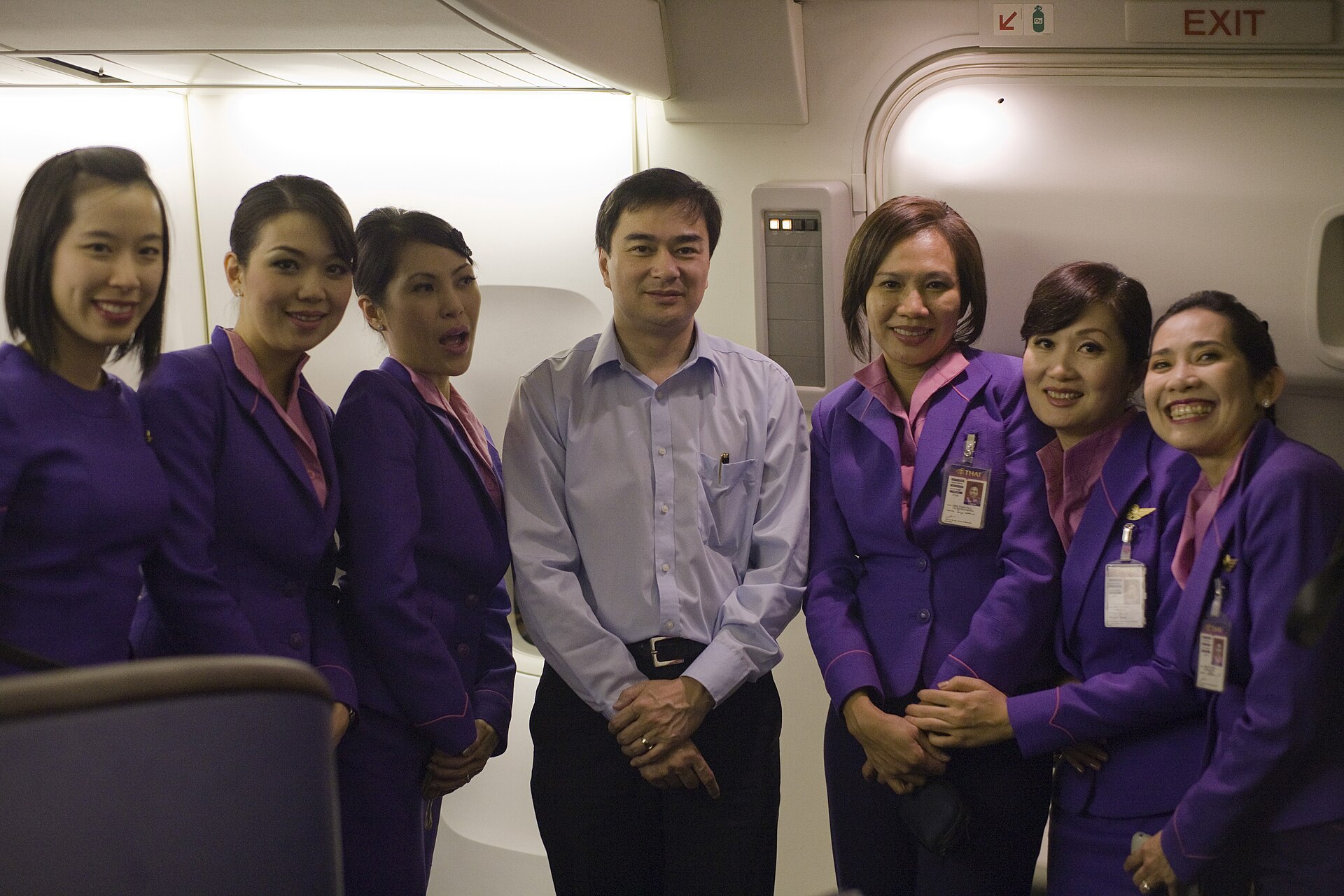
The 2005 chapter deserves its weight in that timeline, because it is the last time the system itself was designed rather than maintained. A uniform competition — won by a Thai designer, for a wardrobe explicitly blending contemporary fashion with the traditional concept — is a very Thai solution to the moderniser's dilemma: the airline did not import a European couturier to interpret Thailand, as so many carriers of the era did, but held a contest at home and chose the designer who proposed keeping the tradition and tailoring around it. Every development since — the recycled cloth, the recycled brooch — has followed that 2005 settlement: innovate in the material, never in the meaning.
The modern chapter is material rather than visual: the 2024 recycled-silk Ruean Ton, in service now, and the 2025/26 Panbuppha recycled brooch. No successor uniform has been announced in any source opened for this guide — the next chapter, whenever it comes, will have to improve on a system that has already survived sixty years by changing its cloth instead of its mind.
The Icon
Why This Uniform Matters
Every airline uniform negotiates between the global and the local; Thai Airways is the only major carrier that refused to choose, and instead scheduled the negotiation — tailoring for the terminal, national dress for the flight. The change of clothes in the galley, invisible to timetables and fare classes, is the airline's whole brand argument performed twice a sector: this is a modern international carrier, and this is Thailand, and they are the same people. The mid-duty change looks like theatre, and it is, but it is theatre with a thesis: that Thailand itself is the product, and the aircraft is where it is served. The 2024 re-issue gave that thesis a second act, proving the traditional dress could carry a sustainability story without surrendering a stitch of its silhouette. For the country behind it, see our Thailand clothing industry page.
Airlines refresh their uniforms from time to time, so the details here describe the uniform as documented for this guide — the airline’s own site always carries the latest version.
Common Questions
Common Questions
Why do Thai Airways crew change uniforms during a duty?
Because the airline runs a two-uniform system. Female cabin crew wear the tailored purple corporate suit outside the aircraft — at the airport, before boarding and after landing — and change into the traditional Thai Ruean Ton dress before general boarding, working the flight in silk and changing back before disembarkation.
Who designed the Thai Airways uniform?
The wardrobe in service was designed by Thai designer Pichitra Boonyarataphan, who won the airline's uniform competition in 2005, blending contemporary fashion with Thailand's traditional dress concept. The Ruean Ton form itself is traditional Thai national dress, not a fashion designer's creation.
What is the Thai Airways in-flight uniform made of now?
Since 1 January 2024 the Ruean Ton has been re-issued in a blend of 70% synthetic thread made from recycled plastic bottles and 30% Thai silk, under the airline's From Purple to Purpose concept. It is the same traditional design in a new, easier-care fabric, and no designer is named for the re-issue.
Did Pierre Balmain design the Thai Airways uniform?
Not the current one, on the documented record. Balmain worked with Queen Sirikit on the 1960 wardrobe that codified the Chut Thai dress forms, and the airline's own uniform history claims Balmain outfits in 1987 — a claim reported here as the airline's own, noting Balmain died in 1982, so it could only mean his fashion house. The current wardrobe is Pichitra Boonyarataphan's 2005 design.
What do the Thai Airways uniform colours mean?
There is no published colour-rank system at Thai Airways. Colour lists circulating online that assign ranks to blue, green, red and purple belong to Singapore Airlines' kebaya system, not to THAI. At Thai Airways the meaningful difference is which uniform is worn — purple suit on the ground, Ruean Ton in flight — with pilot rank shown by conventional epaulettes.
Keep Exploring
More to Explore
In This Series
Airline Uniforms by Airline
The series hub — every airline's guide, the designers behind them, and the ones in preparation.
Read ↑Thailand Clothing Industry
The airline's home country in the World Clothing Industry directory.
Read ↑Go Deeper
Uniforms — Definition
What a uniform is, and why organisations dress their people alike.
Read ↑Silk — Definition
The fibre of the Ruean Ton — and of its 2024 recycled blend.
Read ↑Chut Thai — Traditional Dress of Thailand
The formal dress system the Ruean Ton belongs to, in our traditional dress series.
Read ↑Epaulette — Definition
How pilot rank is read in stripes, defined.
Read ↑Keep Exploring
Explore Fashion for Travel
The crew are only half the fashion on a flight — the other half is what the passengers are wearing. Our travel guides cover the traveller’s side of the same subject, and they link back here.
Outfits for Flying
Travel Outfits
What to wear when you are going somewhere — outfit systems built for transit days.
Read ↑Airport Outfits
Security-friendly shoes, cabin layers and the full airport dressing system.
Read ↑What to Wear on a Long Flight
Dressing for the overnight haul — comfort, warmth and arriving presentable.
Read ↑What to Wear When Traveling
The destination-rules guide to building a travel wardrobe that works on arrival.
Read ↑Business Travel Wardrobe Guide
A working wardrobe that travels — suits, wrinkle strategy and boardroom-ready arrivals.
Read ↑Packing & Capsule Wardrobes
Travel Capsule Wardrobe Guide
A small set of pieces that combine into a trip’s worth of outfits.
Read ↑Travel Packing Guide
The complete packing method — lists, order and wrinkle control.
Read ↑How to Pack a Suit
Getting a tailored jacket and trousers across the world without the creases.
Read ↑Carry-On Packing Guide
Everything in one bag — the carry-on-only system, piece by piece.
Read ↑Travel Comfort & Accessories
Search Apparel Search