Airline Uniforms by Airline · Malaysia
The Malaysia Airlines Sarong Kebaya
A deep teal-green kebaya printed with Malaysian flowers over a bamboo-weave ground has represented Malaysia Airlines since 1986 — designed by a national fashion school, flowered by an Italian house, and still flying after an announced couture redesign came and went without touching it. This is its story, piece by piece.
The Design
Designed by a Fashion School, Finished by Florals
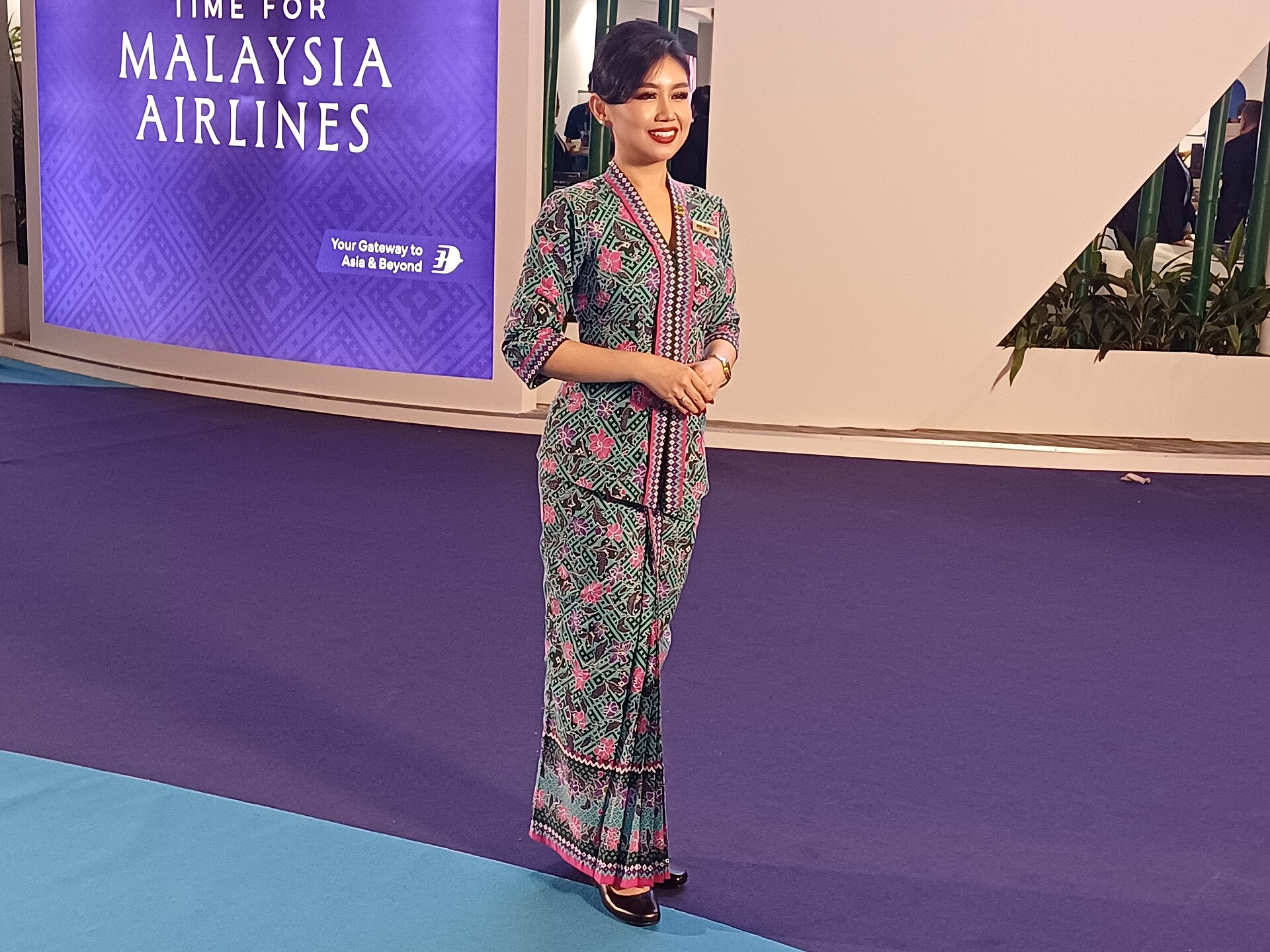
The Malaysia Airlines sarong kebaya is usually credited, in quick listicles, to an Italian fashion house. The airline's own record tells a better and more Malaysian story, in layers. The design still worn today was introduced on 1 March 1986 and designed by the School of Fashion at the Mara Institute of Technology (Institut Teknologi Mara, today Universiti Teknologi Mara) — a national fashion school, not a couture label, given the national carrier's dress to design. In 1992 the Italian fashion house Gherardini added local floral patterns to that design, and Malaysia Airlines' own 2024 heritage release describes today's kebaya exactly that way: the Gherardini reiteration of 1992, updated with deeper hues of pink and purple. Gherardini decorated the kebaya; Mara designed it. The distinction matters, and this guide keeps it.
One more separation, because it is the classic error in this category: Pierre Balmain did not design this uniform. Balmain designed a sarong kebaya in 1968 for Malaysia–Singapore Airlines, the joint predecessor of two modern carriers. After the 1972 split, that lineage continued at Singapore Airlines. Malaysia Airlines' own line runs separately — through the first Malaysian Airline System kebaya of 1972, credited in Malaysian reporting to designer Andy Chiew, winner of a nine-design competition (a credit carried at secondary level, and flagged as such here) — to the 1986 Mara design that founded the modern uniform. Two airlines, two kebayas, one shared ancestor: keeping them apart is the whole of the law in this corner of uniform history.
There is no logo figure on this page for a simple, honest reason: no freely licensed file of the airline's current wordmark was verified for this guide, so the name is carried in type alone.
The Components
The Outfit, Piece by Piece
- The Kebaya Top
- A batik kebaya top with three-quarter sleeves and a V-neckline, its lapels and sleeve edges trimmed with Sarawakian geometric patterning — East Malaysian geometry framing a Peninsular garment, a small federation sewn into the collar.
- The Sarong Skirt
- A matching pleated sarong skirt, worn as the kebaya's lower half in the same printed cloth. Our sarong definition covers the wrapped skirt's wider history.
- The Kelarai Ground
- The cloth's quiet layer: a subdued kelarai pattern — the woven geometry of bamboo matting — runs as the background of the print, a reference to Malaysian bamboo-weave craft underneath everything else.
- The Flora
- Over the kelarai ground sit the superimposed flowers of Malaysia — cempaka (champak), jasmine and hibiscus leaves — in pink and purple over a deep teal-green base the airline's descriptions call ottanio. These are the Gherardini-era florals, deepened in hue for the current iteration. The print technique it echoes is explained in our batik definition.
- Badges, Not Scarves
- The cabin kebaya is worn with a name badge and no scarf — the print is busy enough to be its own accessory, and the silhouette is left clean.
- Ground Staff (from 2024)
- Ground frontliners no longer wear the kebaya at all: their uniform, detailed in the evolution section, is a navy three-piece suit with a songket motif — the cloth of our songket guide — with an optional matching hijab and even a handbag repurposed from retired kebayas.
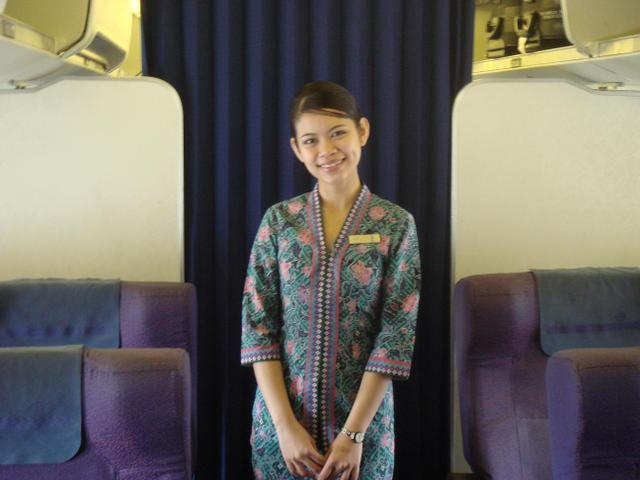
Read the cloth closely and it is a map of the country in layers: a bamboo-weave ground from Malaysian craft tradition, Sarawakian geometry at the collar and cuffs from the Borneo states, and a garden of Peninsular flowers over the top of both. Airline prints are usually abstract — waves, ribbons, speed lines. This one is botanical and regional, assembled the way the federation itself is: distinct regional elements held in a single pattern repeat, so that the crew member wearing it is, quite literally, carrying the whole country in one garment. That density of meaning in the print is why the kebaya has never needed a scarf, a hat or a statement accessory: the cloth already says everything.
The garment family itself is covered in our kebaya guide.
The Rank Code
One Red Kebaya in a Green Cabin
Malaysia Airlines has not published a rank chart, so the code below is presented as it deserves to be: as the system consistently described in Malaysian reporting and passenger accounts, not as an airline document. Its logic is simpler than its famous neighbour's — where Singapore Airlines runs a four-colour ladder, Malaysia Airlines essentially runs a spotlight.
| Kebaya | Rank / role | Notes |
|---|---|---|
| Red, with yellow flowers | Inflight Supervisor | The one red kebaya on the aircraft — the most senior cabin crew member, visible at a glance. |
| Green, with pink flowers | Chief, Leading and Flight Stewardesses | The standard kebaya; these three ranks are not colour-separated from each other in the sources found. |
| Green, with magenta flowers | Ground frontliners (pre-2024) | The ground variant of the kebaya era, retired when ground staff moved to the navy suit in 2024. |
The spotlight logic has a practical virtue worth naming: in a disruption — a medical event, a disruptive passenger, a hurried deplaning — the person in charge of the cabin can be found instantly, by passengers and by junior crew alike, without anyone reading a badge. Rank systems in braid and stripes require literacy in the airline's private code; a single red dress in a green cabin requires none. Whether or not that was the designers' intention in 1986, it is how the system functions in service, and it is a large part of why the code has never needed elaborating into the four-colour ladder its neighbour uses.
For men, the tie is reported to mirror the same code — a Chief Steward, for example, wears a red tie. And a necessary caution: the blue-green-red-purple ladder often pasted onto Malaysia Airlines in online lists is Singapore Airlines' system, not this one. Malaysia's code, on the evidence available, is red for the supervisor and green for everyone else in the cabin.
The Men's Uniform
Grey Jackets and a Mirrored Tie
The men's cabin uniform is documented more thinly than the kebaya, and this guide says so rather than dressing the gap: the corporate-image summaries describe grey jackets with shirt and trousers, with rank shown by tie colour mirroring the women's code — the red tie of a Chief Steward answering the red kebaya of the Inflight Supervisor. No primary source opened for this guide itemises the men's wardrobe further, and the flight-deck uniform is likewise described only as the standard pilot dress. What can be said honestly is that the men's system was designed to be read alongside the kebaya rather than instead of it: one colour language, spoken by a print on one side of the cabin and a tie on the other.
The Redesign That Never Arrived
In 2016 Malaysia Airlines announced a partnership with Malaysian fashion house FARAH KHAN — Dato' Seri Dr Farah Khan — to design the airline's full uniform range: flight deck, cabin crew, airport and engineering, with an unveiling planned for the fourth quarter of that year. It would have been the kebaya's first true succession contest since 1986. No Farah Khan uniform ever entered service. No unveiling followed, the kebaya flew on, and in November 2024 the airline was still celebrating the unchanged 1986 lineage in its heritage campaign — with 2025 photography showing the same kebaya in service. Announced is not worn: the Farah Khan chapter belongs in this guide precisely because it never reached the cabin.
The Rules
What Is — and Is Not — on the Record
Malaysia Airlines does not publish a grooming manual, and the publicly documented requirements are recruitment-level only: the airline's cabin crew page sets minimum heights (157 cm for women, 165 cm for men) and requires no visible tattoos while wearing the cabin crew uniform. Beyond that, this guide invents nothing.
One presentation question is documented well enough to state carefully. The hijab: with the 2024 ground uniform, ground staff who wish to wear one may — in a matching colour, a first for the group's frontline look. For cabin crew, no equivalent change has been announced: a 2023 frequent-flyer survey about a possible "modest twist" to the cabin uniform produced no announced cabin change, and the kebaya continues to be worn without a hijab option. Ground and cabin now run different rules, because since 2024 they run different uniforms.
Evolution
Six Kebayas Since 1963
Malaysia Airlines' own "Heritage in the Skies" release of November 2024 counts six kebaya designs. The first, in 1963, was chilli-red, in the traditional kutu baru bodice style with nine pleats. 1967 brought a striking earth-toned pattern. 1972 — the Malaysian Airline System era — introduced batik motifs and the Andy Chiew design. 1976 turned to green, blue and yellow hues. Then 1986: batik married to the Sarawakian kelarai weave in the Mara School of Fashion design — the direct ancestor of today's uniform — and 1992, the Gherardini floral update whose deeper pink and purple descendant is still flying.
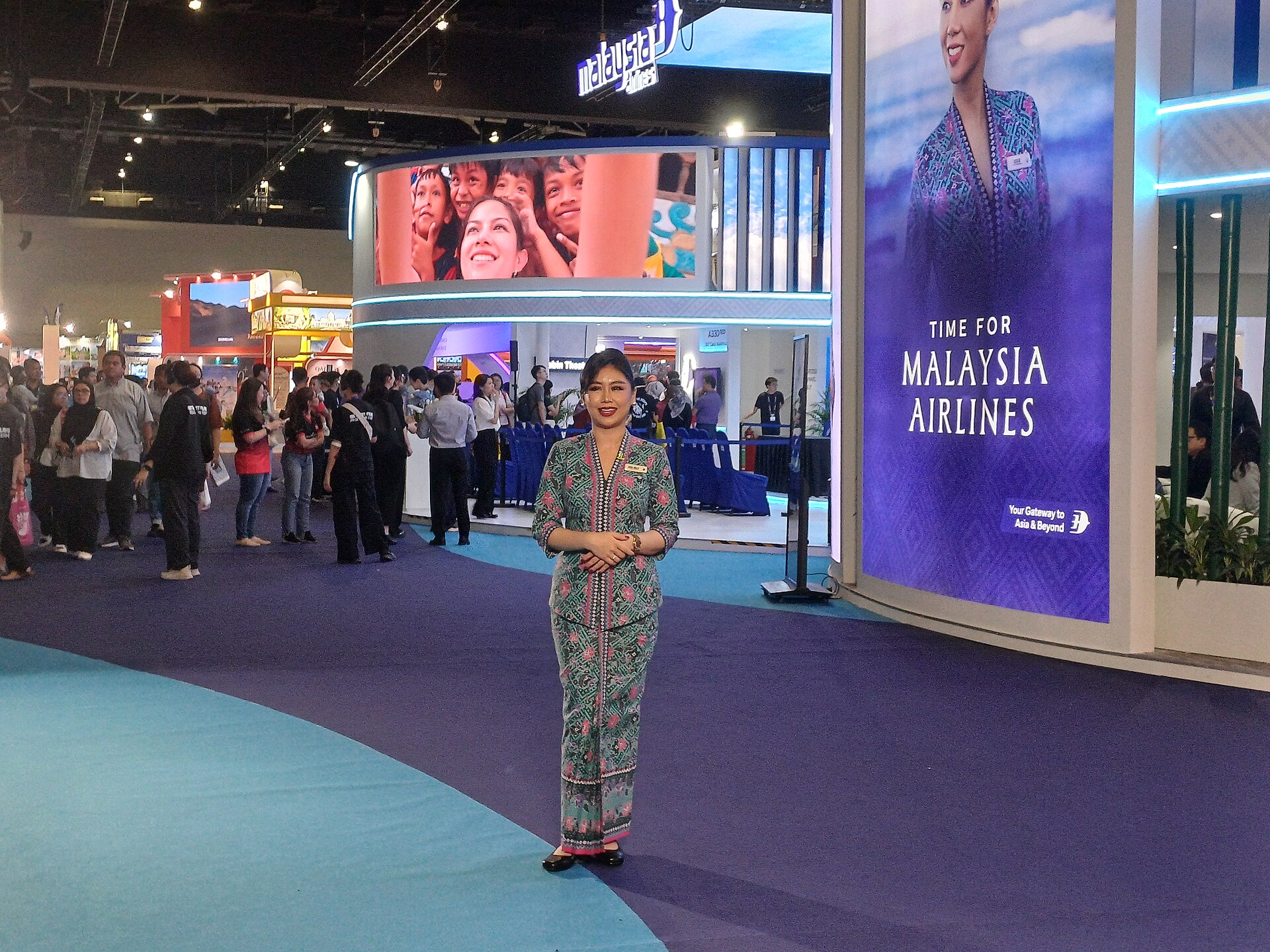
Two smaller dates complete the modern record. The airline's heritage account notes that the 1986 design's colours were enhanced in January 1993, hard on the Gherardini floral update — the deepening process that produced today's pink-and-purple richness was a deliberate early-1990s programme, not gradual drift. And the kebaya's survival since then has not been for want of alternatives: the 2016 Farah Khan announcement, told in the panel above, was a fully scoped succession — every staff group, a named designer, a launch quarter — and it still did not displace the Mara design.
In November 2024 the airline flew all six historic kebayas on selected flights (3–16 November) for the 50th anniversary of the Kuala Lumpur–London route — a flying museum of its own dress. The year's real change, though, happened on the ground: on 10 January 2024 Malaysia Aviation Group unveiled the new AeroDarat Services ground uniform — an in-house design by, in the release's words, "the creative young minds in MAG": a tailored three-piece suit in classic navy blue, women choosing skirt or trousers, a songket motif on the blazer, a lightweight removable blazer, the optional hijab, and handbags and clutches repurposed from retired kebaya uniforms. The cabin crew kebaya was untouched, and no cabin-crew successor has been announced as of this guide.
The Icon
Why This Uniform Matters
There is a final, quiet distinction to record: this is one of the very few great airline uniforms designed by a school. The Mara Institute of Technology's fashion students and teachers were handed the national dress of the national airline — and the design they produced has now outlasted every couture commission of its decade. Institutional design is supposed to be timid; this one has flown for forty years.
The Malaysia Airlines kebaya is a federation worn as a dress: Sarawakian weave geometry under Peninsular batik flora, designed by a national fashion school, decorated by an Italian house, and defended — against a announced couture succession in 2016 — by sheer institutional affection. It has outlived the airline's restructurings, its rebrandings and its ground staff's departure into navy suiting, and in 2024 the airline chose to celebrate it by flying its five ancestors alongside it. Uniforms that survive that long stop being clothing decisions and become national ones. For the country behind it, see our Malaysia clothing industry page.
Airlines refresh their uniforms from time to time, so the details here describe the uniform as documented for this guide — the airline’s own site always carries the latest version.
Common Questions
Common Questions
Who designed the Malaysia Airlines uniform?
The kebaya in service was designed by the School of Fashion at the Mara Institute of Technology and introduced on 1 March 1986. In 1992 the Italian house Gherardini added the local floral patterns, and today's version is that 1992 reiteration with deeper pink and purple hues, in the airline's own description.
Is the Malaysia Airlines kebaya the same as Singapore Airlines'?
No. Both descend from the sarong kebaya Pierre Balmain designed for the joint predecessor, Malaysia–Singapore Airlines, in 1968 — but after the 1972 split that lineage continued at Singapore Airlines. Malaysia Airlines' line runs from its 1972 kebaya to the 1986 Mara design and the 1992 Gherardini update.
What does the red Malaysia Airlines kebaya mean?
Red is the Inflight Supervisor's kebaya, worn with yellow flowers — the one red uniform on the aircraft. Chief, Leading and Flight Stewardesses wear the standard green kebaya with pink flowers and are not colour-separated from each other. The airline has not published a rank chart; this is the code consistently described in Malaysian reporting and passenger accounts.
Did Farah Khan redesign the Malaysia Airlines uniform?
She was announced as designer in 2016, for the full uniform range with an unveiling planned for late that year — but no Farah Khan uniform ever entered service. The airline was still celebrating the unchanged kebaya lineage in 2024, and crew wear the same kebaya today.
Did Malaysia Airlines ground staff get a new uniform?
Yes — on 10 January 2024 Malaysia Aviation Group unveiled a new ground uniform for AeroDarat Services frontliners: an in-house-designed navy three-piece suit with a songket motif, a skirt-or-trousers choice for women, an optional matching hijab, and handbags repurposed from retired kebaya uniforms. Cabin crew were unchanged.
Keep Exploring
More to Explore
In This Series
Airline Uniforms by Airline
The series hub — every airline's guide, the designers behind them, and the ones in preparation.
Read ↑Malaysia Clothing Industry
The airline's home country in the World Clothing Industry directory.
Read ↑Go Deeper
Uniforms — Definition
What a uniform is, and why organisations dress their people alike.
Read ↑Kebaya Guide
The garment itself — its history, styles and place in Southeast Asian dress.
Read ↑Batik — Definition
The wax-resist tradition behind the kebaya's printed flora.
Read ↑Songket Guide
The woven cloth whose motif now trims the ground staff's navy blazer.
Read ↑Keep Exploring
Explore Fashion for Travel
The crew are only half the fashion on a flight — the other half is what the passengers are wearing. Our travel guides cover the traveller’s side of the same subject, and they link back here.
Outfits for Flying
Travel Outfits
What to wear when you are going somewhere — outfit systems built for transit days.
Read ↑Airport Outfits
Security-friendly shoes, cabin layers and the full airport dressing system.
Read ↑What to Wear on a Long Flight
Dressing for the overnight haul — comfort, warmth and arriving presentable.
Read ↑What to Wear When Traveling
The destination-rules guide to building a travel wardrobe that works on arrival.
Read ↑Business Travel Wardrobe Guide
A working wardrobe that travels — suits, wrinkle strategy and boardroom-ready arrivals.
Read ↑Packing & Capsule Wardrobes
Travel Capsule Wardrobe Guide
A small set of pieces that combine into a trip’s worth of outfits.
Read ↑Travel Packing Guide
The complete packing method — lists, order and wrinkle control.
Read ↑How to Pack a Suit
Getting a tailored jacket and trousers across the world without the creases.
Read ↑Carry-On Packing Guide
Everything in one bag — the carry-on-only system, piece by piece.
Read ↑Travel Comfort & Accessories
Search Apparel Search