Airline Uniforms by Airline · Fiji
The Fiji Airways Uniform: Masi Cloth at 35,000 Feet
Most airline uniforms borrow a little local colour. Fiji Airways built its entire wardrobe out of it: a traditional sulu jaba for the women, a Bula shirt for the men, and three hand-drawn masi motifs — unity, friendly service, and clear blue skies — carrying the whole design. This is the story of the 2013 uniform that relaunched an airline under its original name.
The Design
A Uniform Born From a Rebrand
On 27 June 2013, the airline long known as Air Pacific officially returned to its founding name, Fiji Airways — and it did not change the name alone. The relaunch arrived with a new Airbus A330 fleet, a new livery, new cabin interiors, and a completely new uniform, every element of it built on the same artwork. The uniform was never a standalone clothing project; it was one garment cut from a whole new national brand.
The rebrand itself had been a long time coming. The new brand identity — Matemosi’s artwork at its centre — was revealed on 10 October 2012, more than eight months before the name change took legal effect, so by the time the first A330 arrived in Fiji Airways colours the motifs were already becoming familiar. The uniform was the last piece of the set to be seen in public, and deliberately so: aircraft, interiors and logos can be unveiled in a hangar, but a uniform only means something on people, doing the job.
The designer chosen for the wardrobe was Alexandra Poenaru-Philp, a French designer resident in Fiji since 2010, selected after an extensive process from a pool of Fiji-based designers. Her approach, in her own words at the launch, was to revisit tradition rather than invent a new look: “We determined that re-visiting the sulu jaba… for women and the Bula shirts for men, in a very modern way, would be the best way to respect this tradition and modernity.” The airline’s brief pointed the same way — Acting CEO Aubrey Swift said the uniforms “had to stay deeply rooted in the Fiji Airways’ brand and remain true to Makereta Matemosi’s stunning masi artwork.”
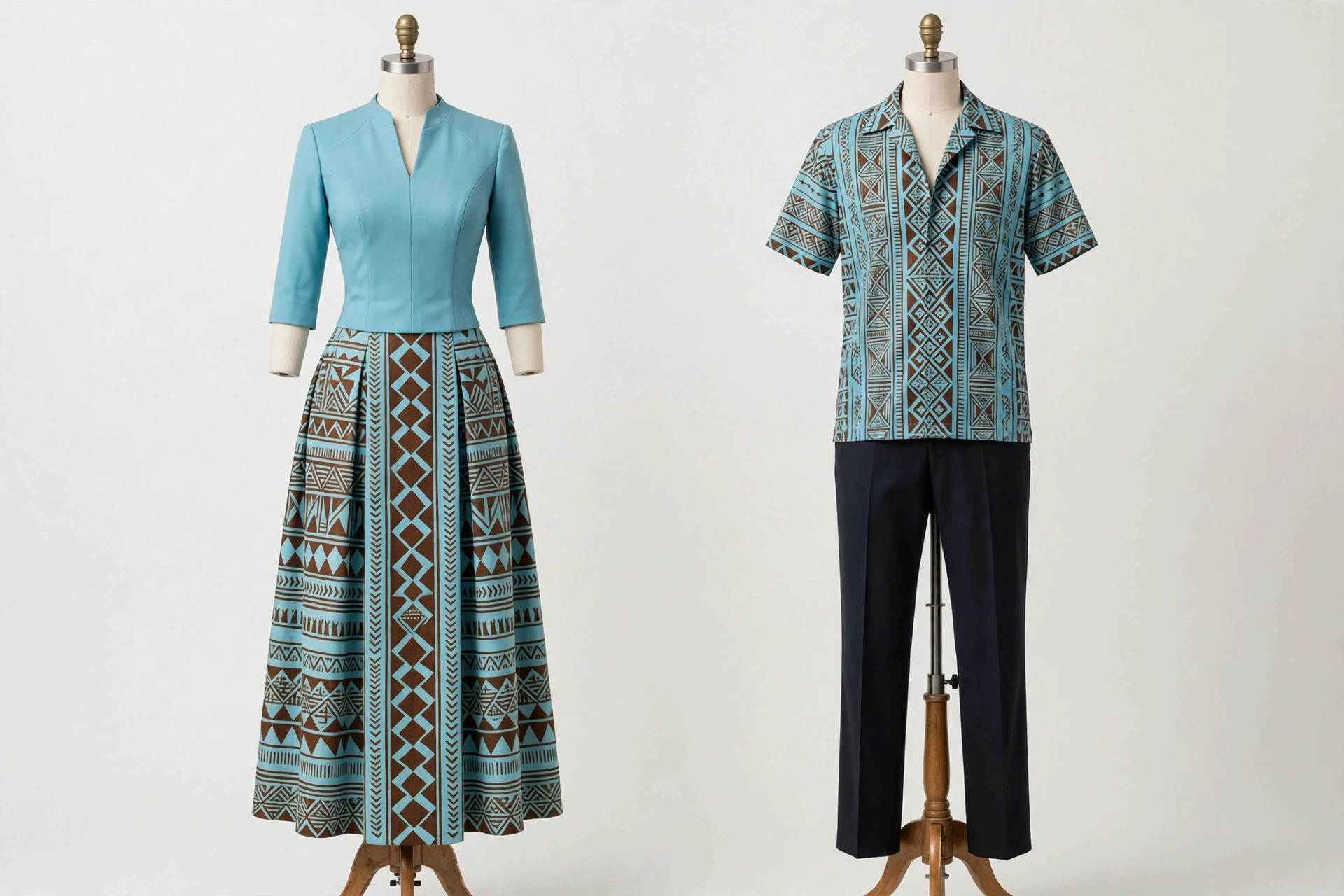
That division of labour matters, and the two names are often confused. Poenaru-Philp designed the uniform — the garments, the cuts, the wardrobe system. Makereta Matemosi, one of Fiji’s most respected masi (tapa cloth) artists, created the artwork the uniform carries — the motifs that also form the airline’s brandmark and livery, developed with brand agency FutureBrand. The colour story follows the art: rich chocolate brown, now a core Fiji Airways colour across its cabins, dining service and linens, set against a vibrant aqua that echoes the sea and sky of the islands.
The Artwork
Three Motifs, Three Promises
Masi — known elsewhere in the Pacific as tapa cloth — is made from the inner bark of the paper mulberry tree, beaten into sheets and decorated with geometric designs in brown and black pigments. It is ceremonial cloth: presented at weddings, births and chiefly occasions, it carries meaning in its patterns. Matemosi’s artwork for Fiji Airways created three motifs, and each one was given a meaning the crew literally wear.
- Qalitoka
- The unity of people coming together to complete a task — the motif of teamwork, and a fitting emblem for a crew, whose whole job is people combining to get a flight safely and graciously done.
- Tama
- Friendly service — the welcome Fiji is famous for, woven into the cloth itself. Where Qalitoka is about the crew, Tama is about the passenger: the promise the uniform makes before a word is spoken.
- Droe
- Clear blue skies and the cool breeze on Fiji’s beaches — the destination itself, carried onto the aircraft. Droe is the holiday in the pattern: sea air and open sky rendered as geometry.
To understand why the airline built so much on this cloth, it helps to know how masi is made. The bark is stripped, soaked and beaten with wooden mallets until the fibres fuse into a soft, paper-like sheet; larger cloths are pasted together from smaller ones. The designs are then stencilled or freehanded in earth pigments — browns from bark infusions, black from candlenut soot. It is slow, skilled, communal work, traditionally women’s work, and the finished cloth is wealth: stored, gifted, and laid down for honoured guests to walk on. Printing Matemosi’s motifs onto uniform fabric is a translation of that world into industrial cloth — the meanings travel even where the bark cloth itself cannot.
Because the same artwork anchors the tail fin
, the brandmark and the cabin, the uniform does not merely match the airline’s identity — it is made of it.The masi symbol sits at the centre of the airline’s mark the way a tapa motif sits at the centre of a ceremonial cloth, and the crew carry the pattern at body scale, walking it through foreign airports where no billboard could follow. Among those presenting the uniform at its launch was the airline’s Manager Cabin Crew, Raelene Gibson — a reminder that this wardrobe was launched by the people who would manage it daily, not only by marketers.
A short airline film at the time documented the uniforms being designed and produced in Fiji, underlining the point: this was a wardrobe made at home, from home materials and home meanings, for the national carrier.The Components
The Outfit, Piece by Piece
- The Women’s Sulu Jaba
- A modernised sulu jaba, the traditional Fijian two-piece dress: a fitted top worn with a long sulu skirt, in the aqua-and-brown palette with masi motifs. The airline’s own cabin-crew recruitment guidance describes the women’s presentation as the sulu jaba — or a blouse with a below-the-knee skirt — worn with court shoes.
- The Men’s Bula Shirt
- An open-neck patterned Bula shirt in the aqua masi print, worn with trousers. The Bula shirt — Fiji’s famous printed leisure shirt, named for the national greeting — is everyday formal wear in Fiji, and the uniform takes it straight into the cabin.
- The Suit Jacket
- A dark suit jacket layered over the Bula shirt gives the men’s wardrobe its formal register — the “full uniform” option for cooler stations and formal duties.
- The Winter Overcoat
- A long dark overcoat forms the winter uniform, so the tropical print can disappear under a proper coat on a cold-weather turnaround without losing the uniform underneath.
- The Sleeveless Cardigan / Vest
- A brown sleeveless cardigan or vest offers a middle layer between the open Bula shirt and the full jacket — warmth and formality in steps, matched to the destination’s weather.
- The Service Apron
- A black service apron worn for cabin service — the working layer of the uniform, put on for the meal service and taken off again, as on many airlines in this series.
Two of these garments deserve a word of cultural background, because both were Fijian institutions long before they were uniform items. The sulu is Fiji’s wrapped lower garment, worn by women and men alike; the sulu jaba pairs it with a fitted top as women’s formal and church dress across the islands — modest, elegant, and unmistakably Fijian. The Bula shirt is its festive counterpart: a boldly printed, open-neck shirt that is standard wear for celebrations, Fridays in Fijian offices, and welcomes of every kind. “Bula” is the greeting of Fiji — hello, welcome, life — so a crew in Bula shirts are quite literally wearing the welcome. Poenaru-Philp’s insight was that Fiji had already designed its national dress; the airline only had to tailor it.
The wrapped skirt at the heart of the women’s outfit
belongs to the same family of garments as the sarong worn across the Pacific and Southeast Asia — a reminder that the sulu jaba is not a costume invented for an airline, but Fiji’s own formal dress, tailored for the cabin.Reading the Uniform
Layers, Not Rank Stripes
Many guides in this series decode a system of stripes, scarves or colours that announce a crew member’s rank. Fiji Airways, on everything it has published, has no such system: no scarf colour code, tie ladder or sleeve-stripe hierarchy for cabin crew has been documented in the airline’s launch material or reporting. This guide states that plainly rather than inventing one.
What does vary is function and climate. The apron marks the service phase of the flight, not a seniority level. The jacket, vest and overcoat mark the weather at the destination, not the wearer’s grade. It is a wardrobe organised around where the aircraft is going and what stage the flight has reached — a practical Pacific logic, and a useful contrast with the rank-coded uniforms elsewhere in this series.
Dressing the Destination
Every airline says its uniform reflects its home. Fiji Airways could make the claim literally: the cloth’s motifs were drawn by a Fijian artist from a Fijian ceremonial art, the women’s outfit is Fiji’s traditional dress, the men’s shirt is the shirt Fiji itself wears to celebrate, and the uniforms were designed and produced in Fiji. Board a Fiji Airways aircraft and the destination has, in a real sense, already arrived.
The Rules
What Is — and Is Not — Published
Fiji Airways has not publicly documented a grooming code for its crew in the material available for this guide: no published rules on hair, makeup or jewellery were found in the airline’s launch reporting or reputable coverage, and this guide does not invent any. The one presentation detail the airline itself puts in writing is in its cabin-crew recruitment guidance, which describes the women’s application-photo dress as the sulu jaba, or a blouse and below-the-knee skirt, with court shoes — a glimpse of the standard expected, offered here for exactly what it is.
Evolution
From Air Pacific to Fiji Link
Before 2013, crew wore the brighter tropical-era uniforms of Air Pacific; no designer attribution for that earlier wardrobe was verified in the sources opened for this guide, so none is claimed here. The 2013 wardrobe replaced it wholesale as part of the rebrand, and — unusually for the industry — it has simply stayed: airline imagery through 2025 and 2026 still presents the same men’s options of patterned Bula shirt, suit jacket, winter overcoat, sleeveless vest and service apron, and no successor mainline uniform has been announced.
That longevity is itself a design statement. The industry norm is a relaunch every decade or so, with a new designer and a new silhouette; Fiji Airways instead let the 2013 wardrobe settle into icon status — the word the airline’s own group now uses for it. The chocolate-brown of the uniform, meanwhile, had spread through the whole product: the same brown anchors the cabin interiors, the dining service and the linens, so a crew member walking the aisle is dressed in the room’s own colours.
The one recent chapter belongs to the group’s regional arm.
In 2025, Fiji Link — the domestic and regional airline of the Fiji Airways group — unveiled new uniforms described by CEO Andre Viljoen as bringing the subsidiary “in harmony with the iconic Fiji Airways design,” standardising the branding across both airlines. It was an alignment of Fiji Link to the 2013 design, not a redesign of it: the parent uniform had become the group standard worth copying.The Meaning
Why This Uniform Matters
The Fiji Airways uniform is the clearest case in this series of a uniform doing the work of a national brand. A small Pacific carrier cannot out-shout the giants, so it dressed its people in the one thing no competitor can copy: Fiji’s own ceremonial art, given meanings — unity, friendly service, clear skies — that double as a service promise. The masi motifs work at every scale, from a tail fin to a shirt print, and the garments underneath them are the clothes Fijians themselves recognise as their own. For more on how traditional garments become modern national dress, see our Traditional Dress guides.
Airlines refresh their uniforms from time to time, so the details here describe the uniform as documented for this guide — the airline’s own site always carries the latest version.
Common Questions
Common Questions
Who designed the Fiji Airways uniform?
Fiji-based French designer Alexandra Poenaru-Philp, selected from a pool of Fiji-based designers. The masi motifs printed on the uniform are a separate work: they were created by Fijian masi artist Makereta Matemosi, whose artwork also anchors the airline’s brand identity.
When did the Fiji Airways uniform debut?
On 27 June 2013, the day Air Pacific officially returned to its original name, Fiji Airways, alongside the arrival of the Airbus A330. The uniform was created as part of that complete rebrand and remains the mainline uniform.
What do Fiji Airways crew wear?
Women wear a modernised sulu jaba — the traditional Fijian two-piece of a fitted top and long sulu skirt — in aqua and chocolate brown with masi motifs. Men wear open-neck Bula shirts in the aqua masi print with trousers, with layered options including a suit jacket, a winter overcoat, a sleeveless cardigan or vest, and a service apron worn in the cabin.
What are the three masi motifs on the uniform?
Qalitoka, symbolising the unity of people coming together to complete a task; Tama, symbolising friendly service; and Droe, symbolising clear blue skies and the cool breeze on Fiji’s beaches. All three were created by masi artist Makereta Matemosi.
How can you tell a Fiji Airways crew member’s rank from the uniform?
You cannot, on published information: Fiji Airways has not published a scarf, tie or stripe rank system for its cabin crew. The differences visible in the wardrobe are functional rather than hierarchical — a service apron for meal service, and jackets or overcoats according to the climate of the destination.
Keep Exploring
More to Explore
In This Series
Airline Uniforms by Airline
The series hub — every airline’s guide, the designers behind them, and the ones in preparation.
Read ↑Traditional Dress Around the World
The dress traditions behind uniforms like this one — including the Pacific and Asian garments the sulu jaba belongs with.
Read ↑Go Deeper
Keep Exploring
Explore Fashion for Travel
The crew are only half the fashion on a flight — the other half is what the passengers are wearing. Our travel guides cover the traveller’s side of the same subject, and they link back here.
Outfits for Flying
Travel Outfits
What to wear when you are going somewhere — outfit systems built for transit days.
Read ↑Airport Outfits
Security-friendly shoes, cabin layers and the full airport dressing system.
Read ↑What to Wear on a Long Flight
Dressing for the overnight haul — comfort, warmth and arriving presentable.
Read ↑What to Wear When Traveling
The destination-rules guide to building a travel wardrobe that works on arrival.
Read ↑Business Travel Wardrobe Guide
A working wardrobe that travels — suits, wrinkle strategy and boardroom-ready arrivals.
Read ↑Packing & Capsule Wardrobes
Travel Capsule Wardrobe Guide
A small set of pieces that combine into a trip’s worth of outfits.
Read ↑Travel Packing Guide
The complete packing method — lists, order and wrinkle control.
Read ↑How to Pack a Suit
Getting a tailored jacket and trousers across the world without the creases.
Read ↑Carry-On Packing Guide
Everything in one bag — the carry-on-only system, piece by piece.
Read ↑Travel Comfort & Accessories
Search Apparel Search