Women's Leather Fashion
Leather fashion is the styling question: how much leather in one outfit, what it pairs with, and how the same pieces move from season to season.
Shop Women's Leather Fashion Now
Shop Women's Leather Fashion on Amazon Shop Women's Leather Fashion on eBayThe Amazon and eBay links on this page are affiliate links. If you make a purchase through them, Apparel Search may earn a commission.
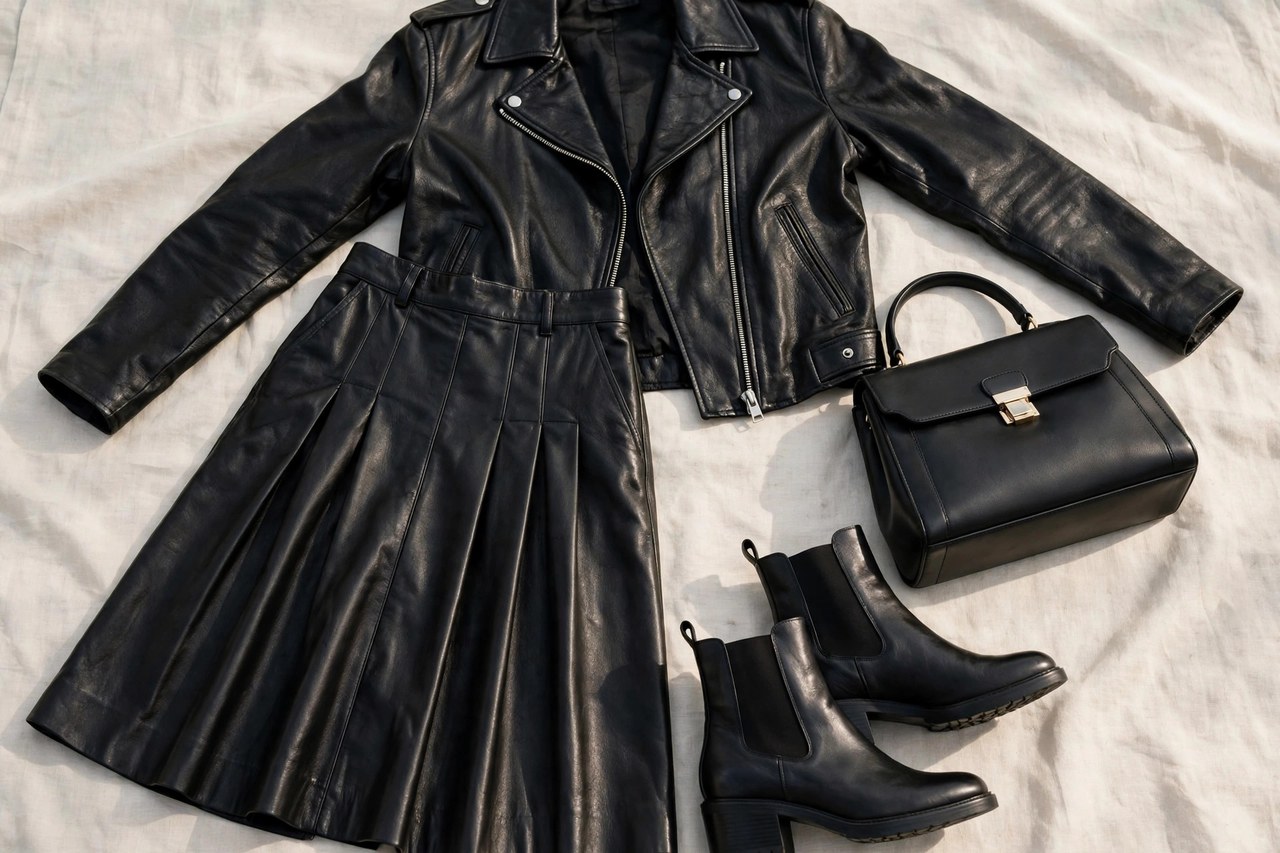
This section of the women's clothing guide is for finding women's leather fashion and leather fashion accessories. Leather is a material made from the skin of an animal by tanning or a similar process — a natural, durable and flexible material created by tanning animal rawhides and skins. But knowing what leather is is only half the subject. This page covers the other half: how leather is worn, and why it has cycled from workwear to rebellion to luxury staple without ever leaving the wardrobe.
Leather's fashion power comes from contrast. It is at once tough and luxurious, structured and liquid, and it reads instantly: a plain t-shirt and jeans become an outfit the moment a leather jacket goes over them. Styling leather well is mostly about managing that strength — deciding how much of it an outfit can carry.
The Head-to-Toe Question
The classic rule is one leather piece per outfit — jacket or pants or skirt — with the rest of the look in softer materials for contrast: knits, denim, cotton, silk. That rule is a good default, but it has well-worn exceptions. A matched leather suit in a soft lambskin reads deliberate rather than loud, especially in a color other than black. Head-to-toe black leather works when the finishes differ — matte pants, a semi-gloss jacket, suede boots — because the eye reads texture changes as separate pieces.
What rarely works is several near-matching leathers that almost, but don't quite, coordinate: two blacks of different depths, or a brown bag against brown boots in clashing undertones. Either match leathers exactly or separate them clearly by color, finish or texture.
Pairing and Mixing
Leather loves a soft partner. The reliable pairings: a moto jacket over a knit dress; leather pants with an oversized sweater; a leather skirt with a tucked silk blouse; leather leggings under a long tunic. Denim is leather's oldest companion — the two share a workwear heritage — and the only caution is weight: a heavy hide jacket over heavy denim can look armored, so lighten one of the two.
Mixing finishes within the leather itself adds depth: smooth with suede, matte with patent accents, pebbled with smooth. Mixing metals in the hardware — a silver-zipped jacket with gold jewelry — is no longer a rule anyone enforces; matching undertones matters more than matching metals.
Leather by Season
Spring and autumn are leather's home seasons: the jacket as outerwear, the skirt with bare legs or light tights. Summer narrows the options to the lightest pieces — perforated leather, leather sandals, a sleeveless leather top, an unlined lambskin piece in the evening — and to paler colors, since black leather drinks the sun. Winter is where heavy leather earns its keep: lined coats and trenches, insulated boots and gloves, with the caution that road salt is leather's enemy and winter footwear needs wiping and conditioning after wet, salted streets.
Across all seasons the styling constant is fit. Leather fashion dates fastest at the extremes — the very oversized or very skinny cut of a particular year — while a clean, close, classic silhouette in a good hide stays current for decades. Buy the classic, wear it everywhere, and let the styling around it do the changing.
More Leather Guides
Looking for Women's Clothing Stores?
This guide helps you choose women's leather fashion and the pieces that carry it. To browse where to buy, visit our women's clothing store directory, where you can find retailers that carry them.