Women's Stability Running Shoes Guide
A stability running shoe is built to slow excess inward roll of the foot — firmer medial support and guide features that keep an overpronating stride aligned.
Shop Women's Stability Running Shoes Now
Shop Women's Stability Running Shoes on Amazon Shop Women's Stability Running Shoes on eBayThe Amazon and eBay links on this page are affiliate links. If you make a purchase through them, Apparel Search may earn a commission.
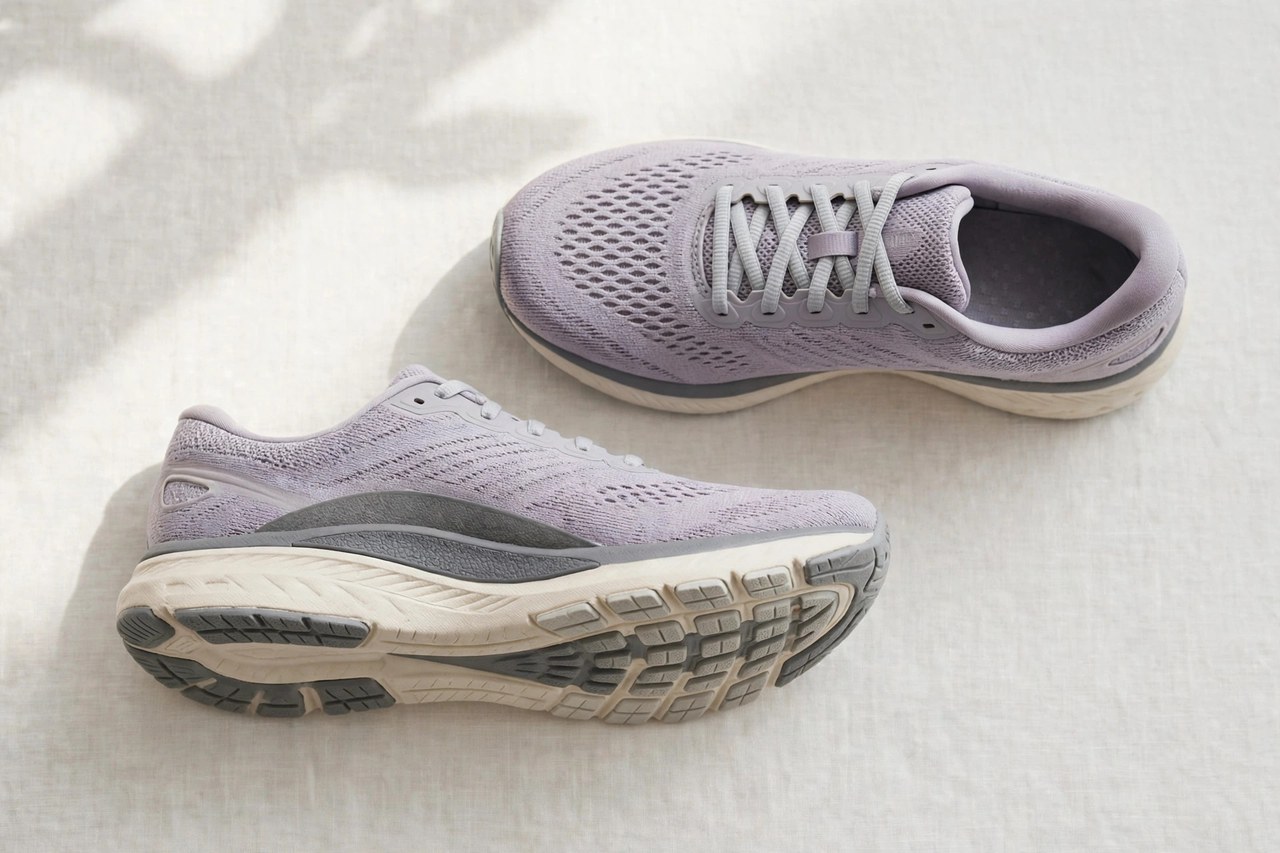
A stability running shoe is a trainer with a job beyond cushioning: it is designed to control overpronation, the excessive inward roll of the foot that follows landing for many runners. Some inward roll is normal and healthy — it is the body's shock absorption. When the roll goes too far or lasts too long, the ankle, shin and knee are asked to compensate, and a stability shoe intervenes with firmer support on the inner, or medial, side of the midsole to slow and limit that motion.
This guide is specifically about that control technology: how medial posts, dual-density foams and guide rails work, how stability differs from both neutral cushioning and maximum motion control, and how to tell whether you actually need it. Support in the everyday comfort sense is a broader topic covered elsewhere on this site; here the focus stays narrow, on pronation, mechanics and the shoes built to manage them.
How Pronation Control Works
The classic tool is the medial post: a firmer wedge of foam built into the inner midsole, often visible as a darker or grayer block under the arch and heel. As the foot rolls inward, it meets that firmer material, which resists compression and slows the roll. Dual-density midsoles achieve the same result by molding the whole inner section from firmer foam. Neither device blocks motion like a brace; a good stability shoe guides the foot through its roll rather than stopping it abruptly.
Newer designs take a different route. Guide rail systems place raised rails of firmer foam along both sides of the heel and midfoot, acting like bumpers that only engage when the foot's alignment drifts — support on demand rather than a constant wedge. Other shoes use a structured heel counter, a straighter last shape, or a wider base under the midfoot. The labels differ by brand, but the test is the same: the shoe should feel stable under the arch without feeling like a plank, and the transition from landing to toe-off should feel guided, not fought.
Stability vs Neutral vs Motion Control
Running shoes sit on a support spectrum. Neutral cushioned shoes offer no pronation control and suit runners whose feet roll normally or roll outward; putting an overpronator in them invites the roll the foot already exaggerates. Stability shoes are the broad middle: moderate medial support in a trainer still light and flexible enough for daily miles, and the right answer for most mild-to-moderate overpronators. Motion control shoes are the maximum end — stiffer, firmer and heavier, built for severe overpronation or larger runners who overwhelm ordinary stability features.
Choosing too much control is a real error: a neutral runner in a stiff stability or motion control shoe may find the firm medial side pushing her foot outward and irritating the outer knee or ankle. Honest self-assessment helps — check the wear pattern on old shoes for heavy inner-heel and inner-forefoot wear, watch your ankles roll inward in a slow-motion phone video, or get a gait check at a running store. Buy the least control that keeps your stride aligned and comfortable.
Fit for a Working Trainer
Fit a stability shoe as a running shoe first: about a thumbnail's length of space beyond the longest toe, a secure heel and midfoot so the support features stay positioned under your arch where they belong, and enough toe-box room for feet that swell over distance. A stability feature in the wrong place is worse than none — if the shoe is too long, the medial post sits ahead of the arch it was meant to support. Try shoes late in the day, in running socks, and jog in the store if you can.
Women-specific lasts are worth seeking out: many stability models are built on a narrower heel and lower-volume midfoot for women's feet rather than simply shrunk from a men's pattern, which keeps the heel counter and rails correctly placed. Wide and narrow widths exist in most major stability lines — an overpronator with a wide forefoot should take the wide version rather than sizing up, preserving both the fit and the geometry of the control features.
Lifespan and When to Replace
Stability features die before the shoe looks dead. The firmer medial foam compresses with miles, and once it packs down the shoe quietly becomes a neutral shoe with a worn upper — often the moment old aches return. Most runners get roughly 300 to 500 miles from a pair, less for heavier runners or those whose pronation loads the medial side hard. Rotating two pairs extends both pairs' lives and lets midsole foam recover between runs.
Track mileage, press the medial midsole for dead, unresponsive spots, and set the shoes on a table to check whether they now lean visibly inward — a lean means the support structure is spent. Replace on evidence, not on the calendar, and transition gradually: alternate new and old pairs for a few runs. A stability shoe doing its job is nearly invisible, which is precisely its virtue — you notice this category most on the day it stops working.
Related Women's Guides
More to Explore on Apparel Search
- Women's Shoes
- Women's Footwear
- Fashion
- Clothing Retail Stores
- Fashion News
- Fashion Designers
- Popular Brands
- Apparel
- Women's Clothing Stores
- Women's Clothing Wholesalers
- Women's Fashion
- Women's Shoe Stores
- Women's Footwear Guide
- Women's Shoes
- Footwear Definitions
- Shoe Search
- Fashion Videos
- Fashion Calendar
- Celebrity Fashion
- Fashion Designer Directory
- Women's Athletic Shoes
- Women's Boots
- Women's Casual Shoes
- Women's Dress Shoes
- Women's Sandals
- Women's Trend Shoes
- Cross Country Running Shoes
- Cushioning Running Shoes
- Jogging Sneakers
- Trail Running Shoes
Women’s Clothes Guide by Letter: Women's Apparel Directory N · Women's Clothes Directory O · Women's Clothing Directory P · Women's Apparel Directory Q · Women's Fashion Directory R · Women's Clothes Directory T
Looking for Women's Clothing Stores?
This guide helps you choose women's stability running shoes. To browse where to buy, visit our women's clothing store directory, where you can find retailers that carry them.