EN 13402
Miscellaneous Definitions — the European clothing size standard, from Apparel Search
Search Apparel Search
At a Glance
Definition: EN 13402 is a European standard for labelling clothes sizes, based on body dimensions measured in centimetres, which aims to replace many older national dress-size systems with labels that state the body measurements a garment was designed for.
Also known as: Size designation of clothes (the standard's full title)
Category: Miscellaneous Definitions
A size label can state a measurement, or it can state a code and leave the shopper to guess what the code means. EN 13402 is Europe's attempt to make labels do the first of those things: it is a European standard for labeling clothes sizes, based on body dimensions measured in centimetres, aiming to replace many older national dress-size systems. Instead of asking what a Size 12 means this year at this brand, the shopper matches their own measured centimetres, taken by the standard's own procedure, to the ranges printed on the label — the same ground covered from the shopper's side by the dress size definition. Apparel Search offers the summaries on this page as a clothing size reference only, at the reader's own risk: all bodies are different, and the standards may have been updated since the page was posted. This page covers why the standard was written, its four parts, and how its ranges, bra sizes and letter codes work.

On This Page
Three Ways to Label a Size, and Why One Was Chosen
There are three approaches for size-labeling of clothes. Under body dimensions, the product label states for which range of body dimensions the product was designed — a bike helmet labelled “head girth: 56–60 cm”, or a shoe labelled “foot length: 28 cm”. Under product dimensions, the label states characteristic measures of the product itself — jeans labelled with their inner-leg length in centimetres or inches, which is not the several centimetres longer inner leg length of the intended wearer. Under an ad-hoc size, the label provides a size number or code with no obvious relationship to any measurement — Size 12, or XL.
Traditionally, clothes have been labelled using many different ad-hoc size systems, and that approach has led to a number of problems. Country-specific or even vendor-specific labels create additional costs. Ad-hoc sizes have changed with time, often due to vanity labelling — an inflation in body dimensions associated with a size, to avoid confronting aging customers with uncomfortable anthropometric truths. Mail-order purchasing requires accurate methods for predicting the best-fitting size, and many garments need to be selected based on two or three body dimensions to fit adequately, not a single scalar. Scalar ad-hoc sizes based on 1950s anthropometric studies are no longer adequate, as changes in nutrition and lifestyles have shifted the distribution of body dimensions.
Therefore the European standards committee CEN/TC 248/WG 10 started in 1996 the process of designing a new modern system of labelling clothes sizes, resulting in the standard EN 13402, “Size designation of clothes”. It is based on body dimensions, the metric system (SI), data from new anthropometric studies of the European population performed in the late 1990s, and similar existing international standards such as ISO 3635. It was expected to replace many older national systems, most likely after the year 2007 — the problem the American system, covered at US standard clothing sizes, presents in its own form.
Part 1: The Body Dimensions and the Pictogram
EN 13402-1, Terms, definitions and body measurement procedure, defines the list of body dimensions to be used for designating clothes sizes, together with an anatomical explanation and measurement guidelines. The dimensions are: head girth; neck girth; chest girth; bust girth; underbust girth; waist girth; hip girth; height; inside leg length; arm length; hand girth; foot length; and body mass. Each is defined by exactly where the tape passes and how the subject stands and breathes. Waist girth, for example, is the girth of the natural waistline between the top of the hip bones (iliac crests) and the lower ribs, measured with the subject breathing normally and standing erect with the abdomen relaxed; chest girth is the maximum horizontal girth measured during normal breathing, the tape passed over the shoulder blades, under the armpits and across the chest; arm length is measured from the shoulder line over the elbow to the wrist bone, the fist clenched on the hip and the arm bent at 90 degrees.
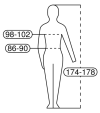
These dimensions are meant to be measured preferably with no, or as few as possible, clothes. All body dimensions are measured in centimetres, except for body mass, which is measured in kilograms. The standard also defines a pictogram that can be used in language-neutral labels to indicate one or several of the body dimensions, so a label can be read across Europe's languages at a glance — the figure below is the page's original example, showing chest, waist and height ranges on one outline. Practical measuring guidance of the same kind is collected at Body Measurements and Clothing Size Measurements.
Part 2: Primary and Secondary Dimensions
EN 13402-2, Primary and secondary dimensions, defines for each type of garment one primary dimension — the body measure according to which the product must be labelled. For some types of garment a single measure may not be sufficient to select the right product, and in these cases one or two secondary dimensions can be added to the label. For men's jackets the primary dimension is chest girth, with height and waist girth secondary; for women's jackets it is bust girth, with height and hip girth secondary; for children's jackets, height is primary. Trousers and shorts for both men and women are labelled primarily by waist girth; dresses by bust girth; shirts by neck girth; bras by underbust girth and bust girth together; gloves by hand girth; head wear by head girth; and stockings and socks by foot length.
The table in the standard works garment by garment in the same pattern — suits, overcoats, skirts, knits such as cardigans and sweaters, T-shirts, blouses, shorts, underpants, vests, pyjamas, swimwear, corsetry, pantyhose, stockings, socks, gloves and head wear, each with its primary dimension and any secondary dimensions in brackets. The system this creates is deliberately different from a dress size number: fit becomes a comparison of measurements rather than an act of faith in a code.
Part 3: Ranges, Steps, Bra Sizes and Letter Codes
EN 13402-3, Measurements and intervals, defines preferred numbers of primary and secondary body dimensions. The product should not be labelled with the average body dimension for which the garment was designed — not “height: 176” — but should show the range of body dimensions from half the step size below to half the step size above the design size, such as “height: 172–180”. For heights the standard generally recommends design dimensions with a step size of 8 cm (…160, 168, 176, 184…); for trousers the recommended step size for height is 4 cm. Men's chest girth steps run 84, 88, 92, 96, 100 and upward with 4 cm ranges, and the standard's example table works on a drop of −12 cm, where drop = waist girth − chest girth: a manufacturer designing for chest girth 100 cm will typically fit waist girth 88 cm, but may combine the same chest with the neighbouring waist steps 84 or 92 to cover drop types −16 and −8 as well. Neck girth and arm length are likewise tabulated against chest girth and height.
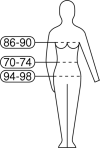
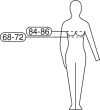
For women, bust, waist and hip girths step together — bust 76, 80, 84, 88, 92… against waist 60, 64, 68, 72, 76… and hip 84, 88, 92, 96, 100…. Bra sizes work from underbust girth steps of 5 cm (60, 65, 70, 75, 80…), with cup size as the secondary dimension, expressed as cup size = bust girth − underbust girth and labelled compactly by a letter code appended to the underbust girth: AA for a difference of 10–12 cm, A for 12–14, B for 14–16, and so on through G at 24–26. Bra size 70B, the example pictured below, is therefore suitable for underbust girth 68–72 cm and bust girth 84–86 cm — see also the Bra Glossary. For clothes where a larger step size is sufficient, the standard also defines a letter code representing chest girth for men and bust girth for women (no such code is defined for children): XXS, XS, S, M, L, XL, XXL and 3XL, each range combining two adjacent size steps — M, for instance, covers chest girth 94–102 cm for men and bust girth 90–98 cm for women — and the ranges can be extended, to 4XL and 5XL, if necessary.
Part 4: A Compact Coding System
EN 13402-4, Coding system, was still under review when this page was written, and was expected to be published in late 2007. It was to define a compact coding system for clothes sizes, originally intended primarily for industry use in databases and as part of stock-keeping identifiers and catalogue ordering numbers, though users later also expressed a desire to use compact codes for customer communication. Writing out all the centimetre figures of all the primary and secondary measures can require up to 12 digits, and the full list on the pictogram contains redundancy that lookup tables can squeeze into fewer characters.
An earlier draft attempted to list all in-use combinations of measures and assign each a short 2- or 3-digit code; some industry representatives considered that approach too restrictive, others argued the primary dimension in centimetres should be a prominent part of the code, and the proposal, originally expected to be adopted in 2005, was rejected. A later proposal by the European Association of National Organisations of Textile Traders (AEDT) offered a 5-character alphanumeric code: the 3-digit centimetre figure of the primary body dimension, followed by one or two letters coding a secondary dimension, somewhat like the system already defined for bra sizes. An item designed for bust girth 100 cm, hip girth 104 cm and height 176 cm would bear, in addition to the explanatory pictogram, the compact code “100BG”. The proposal was agreed at a March 2006 meeting in Florence, and a final draft was produced by AEDT on 6 June 2006.
Common Questions
What is EN 13402?
EN 13402 is a European standard for labeling clothes sizes, also titled Size designation of clothes. It is based on body dimensions measured in centimetres and aims to replace many older national dress-size systems.
What problems does EN 13402 address?
Traditionally clothes have been labelled using many different ad-hoc size systems, creating country-specific and vendor-specific labels and extra costs. Ad-hoc sizes have changed over time, often due to vanity labelling, and mail-order purchasing requires accurate methods for predicting the best-fitting size.
What are primary and secondary dimensions in EN 13402?
The second part of the standard defines for each type of garment one primary dimension, the body measure according to which the product must be labelled. Where a single measure is not sufficient, one or two secondary dimensions can be added to the label, such as height and hip girth alongside bust girth for women's jackets.
More to Explore
- Miscellaneous Definitions
- Dress Size
- US Standard Clothing Size
- Vanity Sizing
- Clothing Size Measurements
- Body Measurements
- Shoe Size Measurements
- Bra Glossary
- Brassiere
- Jackets
- Trousers
- Dresses
- Corsetry
- Hemline Definition
- Waistline Definition
- Neckline Definition
- Dress Maker Definition
- Tailor Definition
- Color Standards
- Clothing Definitions