Nehru Jacket
Clothing Definitions — definitions of garments and clothing terms from Apparel Search
Search Apparel Search
At a Glance
Definition: A Nehru jacket is a hip-length tailored jacket for men or women with a stand-up mandarin collar and a buttoned front, modelled on the South Asian achkan and named for Jawaharlal Nehru.
Also known as: Band gala coat ("closed-neck coat," its original Indian name)
Category: Clothing Definitions
Word Origin
Named for Jawaharlal Nehru, Prime Minister of India from 1947 to 1964, whose achkan-style jackets made the collar and front famous worldwide. In India the garment began in the 1940s as the band gala coat — Hindi-Urdu for "closed-neck coat" — and was marketed in the West under Nehru's name from the mid-1960s.
The Nehru jacket is a tailored jacket identified by one feature: a short stand-up collar, the mandarin collar, rising around the neck with no lapels and no fold. Below the collar it is built like a suit jacket — fitted body, buttoned front, hip length — but the closed neck changes its whole character, giving it the formal, minimal line of the South Asian achkan and sherwani it was modelled on. It has been standard formal wear in India since the 1940s, had a famous brief vogue in the West in the late 1960s, and remains the jacket most likely to be reached for when a suit without a tie is wanted. This page explains its construction and its double history.
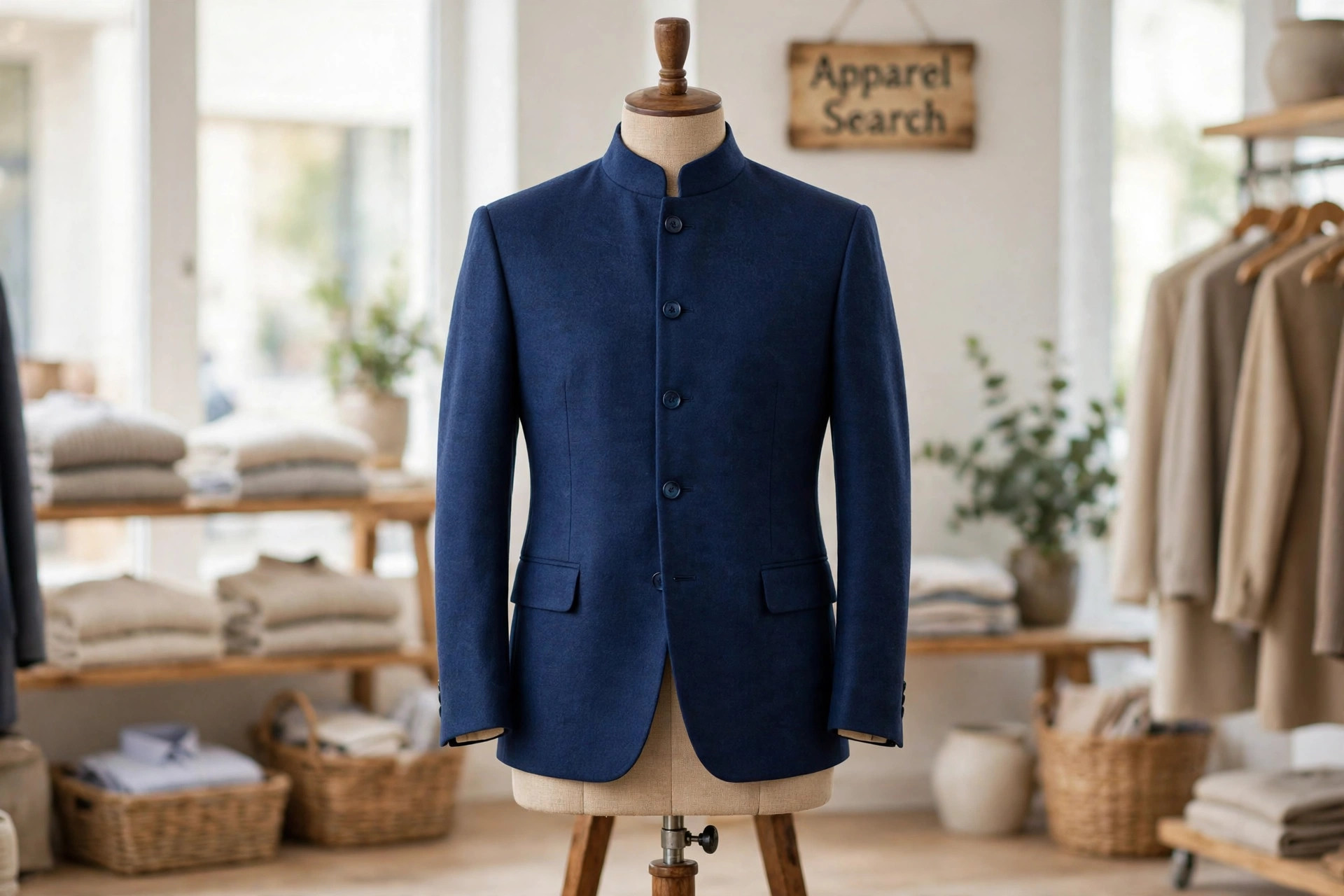
Construction: A Suit Jacket with a Closed Neck
The jacket's parent garments explain its cut. The achkan is a knee-length, closely fitted coat with a stand collar, worn in India for formal occasions; the sherwani is its longer, grander relative. The Nehru jacket takes the achkan's collar and front and shortens the body to hip length, at which point everything below the neck is Western tailoring: a canvassed or lightly structured body, a single-breasted front buttoning up to the collar, straight or flap pockets, and a single vent. It is worn buttoned, usually fully, because the closed front is the design.
It is worn as the top half of a suit — jacket and trousers in the same cloth — or as an odd jacket over contrasting trousers, with a shirt whose own collar sits inside the stand collar, or with no tie by design: the collar closes the neckline that a tie would otherwise fill. Fabrics run the full suiting range, from formal wools and raw silk to cotton and linen for summer, and in India also to richly woven and embroidered cloth for weddings and festivals, where the jacket is often the most decorated garment a man wears.

Two Histories: India and the 1960s West
In India the jacket's history is continuous. Created in the 1940s as the band gala coat, it became the standard formal dress of Indian public life — the uniform, in effect, of politicians and officials — and it has never left: it is worn today at formal occasions across South Asia, and its collar appears on shirts and kurtas as a matter of course. Nehru himself wore the parent achkan, and the jacket that took his name is the achkan adapted to the length of the Western jacket he and his contemporaries paired with it.
The Western history is a fashion episode. Marketed as the Nehru jacket from the mid-1960s, it rose with Western interest in Indian culture and with Mod minimalism, and was popularised above all by the Beatles and the Monkees; for a few years around 1967–1970 it was a genuine high-street and stage garment in Britain and America, sold even as a branded menswear line through makers such as Hart Schaffner & Marx. It then fell as fast as it had risen, surviving in the West mainly as a period marker of the late 1960s and as the standard silhouette for screen villains of the era — while in India, where it had never been a fad, it simply continued. Its Chinese counterpart, the Mao suit, followed the opposite path, and the two are compared in the Not to Be Confused With box below.
The Jacket Today
Outside India the jacket never regained its 1960s height, but it settled into durable niches. It is a standard choice for grooms and guests at South Asian weddings in Britain, North America and the Gulf, worn in silk or brocade over a kurta or with Western trousers; it appears in hotel, airline and ceremonial uniforms, where its closed collar reads as formal without a tie; and menswear revives it periodically whenever collarless tailoring comes round again, usually in linen or cotton for summer. The collar itself had the wider career: the Nehru or mandarin collar on shirts, kurtas and women's jackets is now an ordinary garment feature worldwide, detached from the jacket that carried it west.
Judged as tailoring, the jacket's staying power is easy to explain. It solves a real problem — how to look fully dressed without a tie — with a single change to a familiar garment, and it flatters most builds because the closed front makes one unbroken line from collar to hem. That is why, of all the garments the 1960s borrowed from Asia, this one alone kept a permanent place in the wardrobe on two continents at once: a fad in the West, a fixture in India, and the same jacket in both.
Not to Be Confused With
The two jackets are confused because both are collar-and-front garments named for Asian statesmen, but they are different clothes. A Nehru jacket is a tailored, hip-length jacket in suiting fabrics, worn as dress clothing, its stand collar the only departure from a suit jacket. A Mao suit is a complete uniform outfit — a loose tunic jacket with patch pockets and matching trousers, historically in plain cotton — worn as a full suit, not as a jacket over other clothes. The Nehru jacket is an item of dress; the Mao suit is a uniform.
Common Questions
What is a Nehru jacket?
A Nehru jacket is a hip-length tailored jacket with a stand-up mandarin collar and no lapels, modelled on the Indian achkan and named for Jawaharlal Nehru, who wore the style as Prime Minister of India.
How is a Nehru jacket worn?
It is worn buttoned up, as the top half of a suit or with contrasting trousers, over a shirt with no tie — the closed collar fills the neckline a tie would otherwise occupy.
What is the difference between a Nehru jacket and an achkan?
Length. The achkan is a knee-length coat; the Nehru jacket keeps the achkan's stand collar and buttoned front but is cut to hip length like a Western suit jacket.