POY Winder Machines for Textile Machinery
Textile and clothing machine spare parts — what the part does, how to specify it, and the companies that supply it.
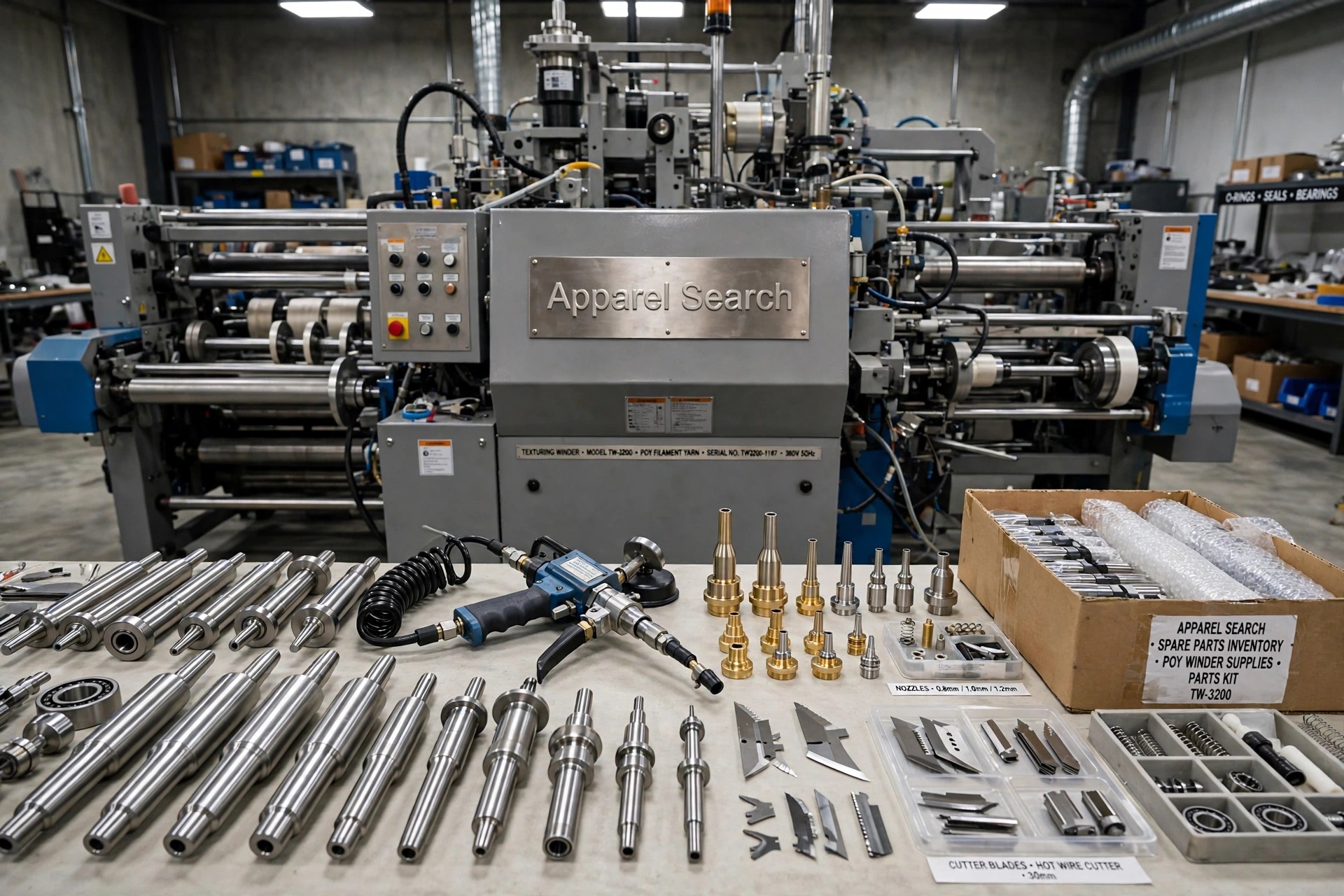
A POY winder is the machine that winds partially oriented yarn — the filament yarn drawn and wound at high speed in synthetic fibre production — into the large, stable packages that go on to texturing, draw-twisting or weaving preparation. The winder has to accelerate a fresh bobbin, traverse the yarn evenly across the package, maintain constant contact and tension, and doff a full package without breaking the filament. Every one of those motions depends on wearing parts — guides, traverse components, chucks, sensors and the yarn suction gun used to thread the machine — so POY winder spares are planned maintenance items, not emergency purchases.
Textile Machinery Directory
How a POY Winder Builds Its Package
POY production runs continuously at high winding speeds, and the package must be wound so it will unwind just as continuously in the next process. The traverse system lays the filament across the bobbin in a precise pattern that prevents ribboning and sloughing, the contact roller controls package density and diameter build, and the yarn guides and tension elements keep a fine, easily damaged filament under steady control from the godets to the bobbin. Because POY is only partially oriented, it is more delicate than fully drawn yarn: a rough guide, a worn traverse part or a nicked contact surface marks or breaks filaments that then show up as defects in textured yarn and fabric.
Threading and transfer are the other critical moments. At doffing and string-up the operator uses a yarn suction gun to capture the running filament and lead it safely to the new bobbin — the suction gun is effectively the winder's threading tool, and a gun with weak suction or a damaged nozzle slows every changeover and wastes yarn. Automatic transfer systems depend on the same principle, catching and cutting the yarn cleanly so production never stops.
Wearing Parts and Spares Planning for POY Winders
The spares shelf for a POY line follows the wear pattern: yarn-contact parts first — guides, nozzles and traverse components that filament abrades continuously — then suction guns and their nozzles, sensors that confirm yarn presence and package state, and cutter and gripper elements used at transfer. Parts are specified by winder make, model and position, because traverse geometry and package dimensions differ between machine builders. Keeping the fast-wearing yarn-path parts in stock matters more than depth on slow parts: a single broken filament path can stop a position, and a stopped position in a continuous POY line is lost production that cannot be recovered. The supplier below covers replacement parts for POY winder machines alongside its weaving machine range.
Preventive replacement beats breakdown replacement on a POY line. Guides and nozzles are changed on inspection intervals based on filament breaks and package quality, not left until they fail, and each position's parts history is worth recording: a position that consumes guides faster than its neighbours usually has an alignment or contact-roller fault behind it. Operators should also keep suction gun air supplies clean and dry, since contaminated air weakens suction and coats the yarn path the gun is meant to keep clear.
Companies Supplying POY Winder Machines
Falcon Engineers
Falcon Engineers (India) provides replacement parts for POY winder machines, and supplies the yarn suction gun used to thread and string up POY winders. Falcon manufactures and supplies spares for looms and autoconer machines, has developed many parts for textile machines, and also supplies imported parts from Germany, Italy and other countries. Across its weaving range it offers high-quality, accurate products to the textile industry at affordable prices, including scissors and cutters for automatic loom and winding machines.
Supplies: POY Winder Parts · Yarn Suction Guns · Winding Machine Parts · Loom Spares · Autoconer Spares
Textile & Clothing Machine Spare Parts
- Beam Heads
- Beams for Weaving Machinery
- Bulb Socket
- Cams
- Ceramic Friction Disks
- Ceramic Thread Guides
- Circular Knitting Machine Parts
- Creel Stands
- Cutters for Looms
- Cylinders
- Dials
- Electric Shears
- Feed Wheel
- Feeders
- Fineblanked Stampled Parts
- Flexible Card Clothing
- Grinder
- Grippers
- Guide Unit s - textile machinery
- Hosiery Camboxes
- Knitting Machine Spare Parts
- Loop Forming Elements
- Loose Needles
- Lycra Feeders
- Metallic Card Clothing
- Metallic Cleaning Tool
- Mounting Pads
- Papermakers for Felt Weaving
- Patterning
- Positive Feeders
- Pulleys for textile machines
- Rapier Tapes
- Rapier Wheel
- Raschel Machinery Parts
- Rotary Hooks
- Safe Needles
- Sample
- Sensors for Looms
- Sewing Machinery Spare Parts
- Sinkers Rings
- Slide Electronic yarn Control Devices
- Springs for Textile Machines
- Stamped Bent Parts
- Stitch Bonding Machine Parts
- Striper
- Swatch Cutters
- Tension Meters
- Thread Break Guard
- Thread Guide Units
- Tricot Machinery Spare Parts
- Warp Knitting Spare Parts
- Warper Beams
- Weaving Machinery Spare Parts
- Weft Feeders
- Weight Scales
- yarn Carriers
- yarn Retainer
- yarn Sensor
- yarn Splicers
- yarn Suction Cups for Winders
- yarn Supervisor by Drop
- yarn Supervisor by Tearing
- yarn Supervisor by Tearing & Drop
Knitting & Weaving Machinery
- Circular Knitting Machinery
- Crotchet Knitting Machinery
- Double Jersey Knitting Machinery
- Fleece fabric Knitting Machines
- Hosiery / Socks Machinery
- Knitting Lubricator
- Knitting Software
- Mesh fabric Knitting Machines
- Pile fabric Knitting Machines
- Plush fabric Knitting Machines
- Rib fabric Knitting Machinery
- Ring Temples
- Seamless Knitting Machinery
- Sewing Machinery Attachments
- Single Jersey Knitting Machinery
- Terry fabric Knitting Machinery
- Terry Machinery
- Velour fabric Knitting Machinery
- Weaving Machinery Manufacturers
Related Guides and Resources
Common Questions
What is POY and why does its winder need special care?
POY is partially oriented yarn, a filament yarn that still has to be drawn in a later process. It is weaker and more easily damaged than fully drawn yarn, so winder guides, traverse parts and contact surfaces must stay smooth and true or the filament breaks and faults carry through to texturing.
What does a yarn suction gun do on a POY winder?
It uses suction to capture the running filament so the operator can thread the winder and lead the yarn to a fresh bobbin at doffing and string-up. A gun with poor suction makes every changeover slower and wastes yarn, so guns and nozzles are kept as spares.
Which POY winder parts wear fastest?
The yarn-contact parts — guides, nozzles, traverse components and cutter elements — wear fastest because filament runs over them continuously at high speed. Sensors and suction gun parts follow; all are ordered by winder make, model and position.