Warper Beams for Textile Machinery
Textile and clothing machine spare parts — what the part does, how to specify it, and the companies that supply it.
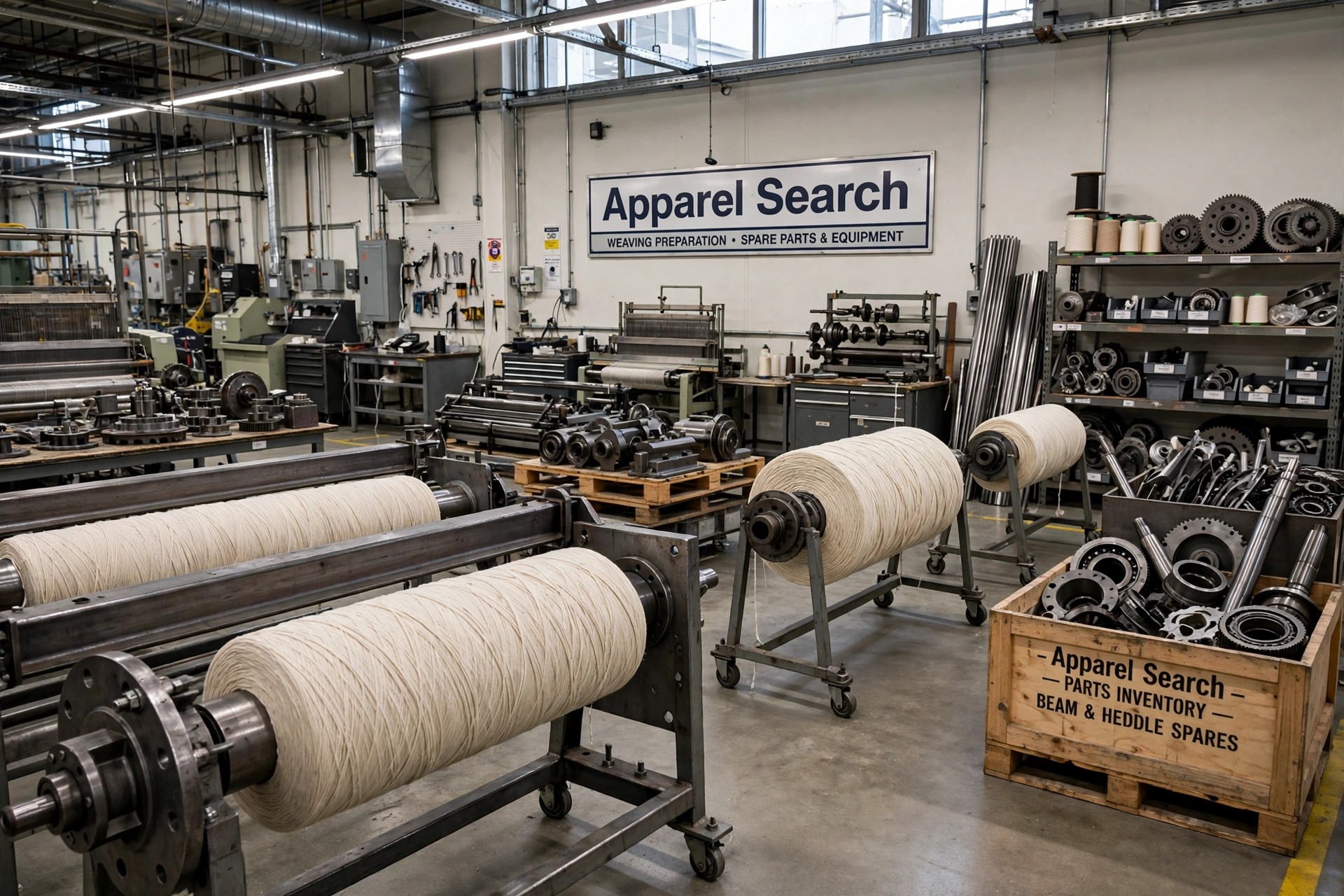
A warper beam is the beam that comes off the warping machine carrying the finished warp — hundreds or thousands of ends wound in a parallel sheet at even tension, ready to go forward to sizing or straight to the loom. It looks like a simple cylinder with two flanges, but it is precision rotating equipment: barrel truth, flange condition and balance decide whether that carefully built warp stays even or arrives at the next process with tension differences woven into it. Warper beams are therefore bought, spared and maintained as machine parts in their own right.
Textile Machinery Directory
How a Warper Beam Is Built and Sized
The barrel is steel tube or fabricated steel, finished smooth so no burr can snag an end, and the two beam heads — the flanges — set the package diameter and hold the sheet in shape as it winds. Working width between the flanges, barrel diameter and flange diameter together decide how long a warp the beam can carry, and the drive end must match the warping machine or the loom that will run it: gear, dog or shaft patterns differ by maker. Heavy packages add a further demand — a full warper beam is a substantial weight turning at speed, so beams are balanced and their flanges must run true, since run-out at the flange becomes a tension wave across the warp sheet.
Warper beams serve both weaving preparation and warp knitting, where sectional and direct warping feed beams straight to the knitting machine, so beam condition matters in both industries. The winding itself is unforgiving of beam faults: ends are laid at a set traverse and tension to build a package of even density, and a flange that stands slightly out of square, a barrel with a flat spot or corrosion pit, or a damaged drive end that lets the beam run eccentrically will each build that fault into the package layer by layer. By the time the warp is unwound, the fault has multiplied into hundreds of ends running at the wrong tension.
Ordering, Handling and Care
Order warper beams against the warping machine or loom make and model, barrel diameter and length, flange diameter, and the drive and brake arrangement. Tranoco, listed below, supplies warper beams as part of a weaving beam range that also includes beams for all types of weaving machines, beam heads and canisters, together with mounting pads for isolating and reducing vibration. In the mill, beams last with basic discipline: keep barrels clean and free of rust and damage, protect flanges from handling knocks, store beams so the wound package is not distorted, and take a beam that has been dropped or repaired out for a truth and balance check before it carries another warp. A single bent flange can spoil every warp wound on that beam until it is found and corrected or replaced.
Companies Supplying Warper Beams
Tranoco
Tranoco (USA) supplies warper beams, beams for all types of weaving machines, beam heads and canisters, plus mounting pads for isolating and reducing vibration. Its range also covers parts for papermakers' felt weaving machines (Jäger, Jurgens and Texo), Flexhold yarn package adapters and holders — one adapter fits most any size cone or tube — parts for velvet and upholstery weaving machines (Van De Wiele, Guesken and Gunne MAV / SACM Dornier), and miscellaneous loom parts including harness frame parts, pulleys and ceramic thread guides.
Supplies: Warper Beams · Beams for Weaving Machines · Beam Heads · Canisters · Mounting Pads
Textile & Clothing Machine Spare Parts
- Beam Heads
- Beams for Weaving Machinery
- Bulb Socket
- Cams
- Ceramic Friction Disks
- Ceramic Thread Guides
- Circular Knitting Machine Parts
- Creel Stands
- Cutters for Looms
- Cylinders
- Dials
- Electric Shears
- Feed Wheel
- Feeders
- Fineblanked Stampled Parts
- Flexible Card Clothing
- Grinder
- Grippers
- Guide Unit s - textile machinery
- Hosiery Camboxes
- Knitting Machine Spare Parts
- Loop Forming Elements
- Loose Needles
- Lycra Feeders
- Metallic Card Clothing
- Metallic Cleaning Tool
- Mounting Pads
- Papermakers for Felt Weaving
- Patterning
- Positive Feeders
- Poy Winder Machines
- Pulleys for textile machines
- Rapier Tapes
- Rapier Wheel
- Raschel Machinery Parts
- Rotary Hooks
- Safe Needles
- Sample
- Sensors for Looms
- Sewing Machinery Spare Parts
- Sinkers Rings
- Slide Electronic yarn Control Devices
- Springs for Textile Machines
- Stamped Bent Parts
- Stitch Bonding Machine Parts
- Striper
- Swatch Cutters
- Tension Meters
- Thread Break Guard
- Thread Guide Units
- Tricot Machinery Spare Parts
- Warp Knitting Spare Parts
- Weaving Machinery Spare Parts
- Weft Feeders
- Weight Scales
- yarn Carriers
- yarn Retainer
- yarn Sensor
- yarn Splicers
- yarn Suction Cups for Winders
- yarn Supervisor by Drop
- yarn Supervisor by Tearing
- yarn Supervisor by Tearing & Drop
Knitting & Weaving Machinery
- Circular Knitting Machinery
- Crotchet Knitting Machinery
- Double Jersey Knitting Machinery
- Fleece fabric Knitting Machines
- Hosiery / Socks Machinery
- Knitting Lubricator
- Knitting Software
- Mesh fabric Knitting Machines
- Pile fabric Knitting Machines
- Plush fabric Knitting Machines
- Rib fabric Knitting Machinery
- Ring Temples
- Seamless Knitting Machinery
- Sewing Machinery Attachments
- Single Jersey Knitting Machinery
- Terry fabric Knitting Machinery
- Terry Machinery
- Velour fabric Knitting Machinery
- Weaving Machinery Manufacturers
Common Questions
What is the difference between a warper beam and a loom beam?
A warper beam carries the warp as it comes off the warping machine; that warp may then be sized, transferred or beamed onto the loom's warp beam, or in some routes woven from the warper beam arrangement. Dimensions and drive ends follow the machine each beam fits.
What decides how much warp a beam holds?
Flange diameter, barrel diameter and the working width between flanges. Larger flanges carry longer warps but add weight, so the beam must stay balanced and true-running at production speed.
How should warper beams be stored?
Clean, dry and protected from knocks, with the package supported as the flange design intends. Barrels are kept rust-free and flanges checked for edge damage that could snag yarn before the beam is used again.