Weight Scales for Textile Machinery
Textile and clothing machine spare parts — what the part does, how to specify it, and the companies that supply it.
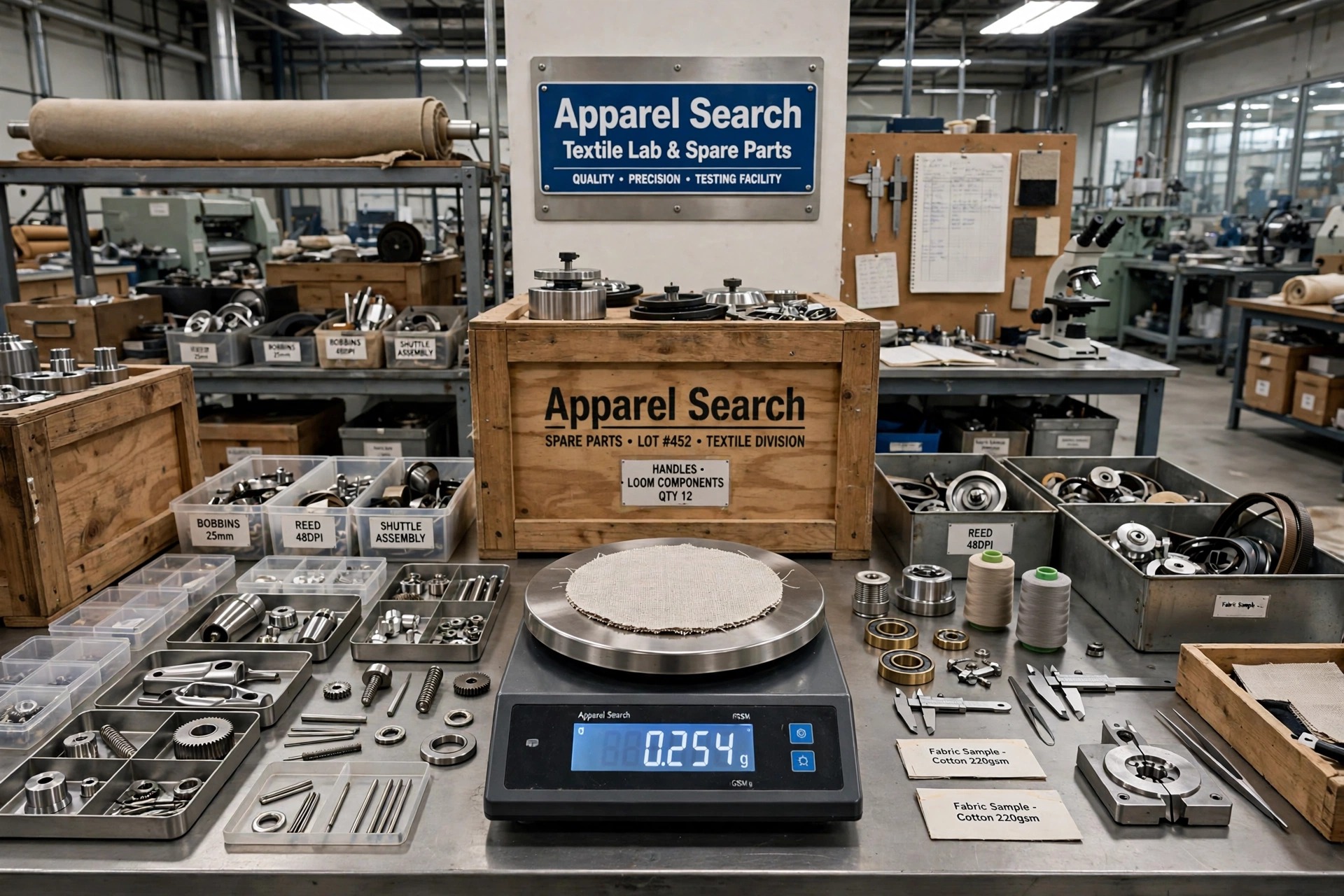
Fabric is sold and specified by weight — grams per square metre decides whether a knitted or woven cloth meets its order, its price and its end use. The weight scale is the mill's everyday check on that figure: a sample of exact area is cut, weighed on a precision scale, and the result converted to fabric weight. Weight scales belong to the testing equipment family that travels with knitting and weaving production — bench instruments used at the machine, in the inspection department and in the laboratory — and they are bought and replaced as machinery accessories rather than laboratory luxuries.
Textile Machinery Directory
Weighing Fabric Weight the Standard Way
The method is simple and strict. A sample cutter punches or cuts a piece of fabric of a defined area — commonly a circular sample — and the weight scale weighs it to the precision the conversion demands, since a small sample stands for a whole square metre. A scale that drifts, or a cutter that no longer cuts its true area, quietly falsifies every fabric weight the mill reports, so the two instruments are used and checked as a pair. Jen-Haur Company of Taiwan, listed below, includes weight scales in its testing equipment range alongside sample cutters and swatch cutters, so the cutting and weighing steps can be sourced together.
The same testing range covers the other quick checks production relies on: magnifiers for close inspection, tension meters, yarn length meters and cleaning guns.
Scales in the Knitting Mill
In a knitting plant the weight check is a production control, not only a final inspection: course length, gauge and machine settings are adjusted to hold fabric weight, and operators weigh samples off the machine so drift is caught within a roll rather than across an order. Jen-Haur, established in 1976, is a leading circular knitting machine spare parts manufacturer, and its testing equipment sits inside that wider range — multi-function positive feeders, Lycra feeders, creel stands and accessories — so weight scales are supplied by a maker whose business is the knitting machine itself. For specification, mills choose scale capacity and readability to suit the sample area and fabric range they run, keep the scale level and clean, and check it with a known weight on a routine. The weighing routine itself needs the same discipline every time it is done: samples taken from defined positions across the fabric width and along the roll, conditioned away from machine heat and draughts where the mill's procedure requires it, cut without stretching the fabric — a stretched sample weighs light for its area — and weighed promptly. Results are recorded against the machine and roll, so a drifting weight can be traced to the settings in force when that roll was knitted or woven, and corrected on the machine rather than argued about at inspection. Keeping cutter and scale together as one checked station — one bench, one record — is what makes the figure the mill quotes to its customer defensible when a delivery is questioned.
Companies Supplying Weight Scales
Jen-Haur Company
Jen-Haur Company (Taiwan), established in 1976, is a leading circular knitting machine spare parts manufacturer. Its testing equipment includes sample cutters, weight scales, swatch cutters, magnifiers, tension meters, yarn length meters and cleaning guns. The wider range covers multi-function positive feeders that supply two or more yarn types at different tensions at the same time (for striper or jacquard machines), aluminium-alloy positive feeders for micro-fibre with auto-clean function, Lycra feeders, and creel stands — side, vertical and vertical tube — with accessories.
Supplies: Weight Scales · Sample Cutters · Swatch Cutters · Tension Meters · Testing Equipment
Textile & Clothing Machine Spare Parts
- Beam Heads
- Beams for Weaving Machinery
- Bulb Socket
- Cams
- Ceramic Friction Disks
- Ceramic Thread Guides
- Circular Knitting Machine Parts
- Creel Stands
- Cutters for Looms
- Cylinders
- Dials
- Electric Shears
- Feed Wheel
- Feeders
- Fineblanked Stampled Parts
- Flexible Card Clothing
- Grinder
- Grippers
- Guide Unit s - textile machinery
- Hosiery Camboxes
- Knitting Machine Spare Parts
- Loop Forming Elements
- Loose Needles
- Lycra Feeders
- Metallic Card Clothing
- Metallic Cleaning Tool
- Mounting Pads
- Papermakers for Felt Weaving
- Patterning
- Positive Feeders
- Poy Winder Machines
- Pulleys for textile machines
- Rapier Tapes
- Rapier Wheel
- Raschel Machinery Parts
- Rotary Hooks
- Safe Needles
- Sample
- Sensors for Looms
- Sewing Machinery Spare Parts
- Sinkers Rings
- Slide Electronic yarn Control Devices
- Springs for Textile Machines
- Stamped Bent Parts
- Stitch Bonding Machine Parts
- Striper
- Swatch Cutters
- Tension Meters
- Thread Break Guard
- Thread Guide Units
- Tricot Machinery Spare Parts
- Warp Knitting Spare Parts
- Warper Beams
- Weaving Machinery Spare Parts
- Weft Feeders
- yarn Carriers
- yarn Retainer
- yarn Sensor
- yarn Splicers
- yarn Suction Cups for Winders
- yarn Supervisor by Drop
- yarn Supervisor by Tearing
- yarn Supervisor by Tearing & Drop
Knitting & Weaving Machinery
- Circular Knitting Machinery
- Crotchet Knitting Machinery
- Double Jersey Knitting Machinery
- Fleece fabric Knitting Machines
- Hosiery / Socks Machinery
- Knitting Lubricator
- Knitting Software
- Mesh fabric Knitting Machines
- Pile fabric Knitting Machines
- Plush fabric Knitting Machines
- Rib fabric Knitting Machinery
- Ring Temples
- Seamless Knitting Machinery
- Sewing Machinery Attachments
- Single Jersey Knitting Machinery
- Terry fabric Knitting Machinery
- Terry Machinery
- Velour fabric Knitting Machinery
- Weaving Machinery Manufacturers
Related Guides and Resources
Common Questions
How is fabric weight measured with a scale?
A sample of exactly defined area is cut with a sample cutter and weighed; the sample weight is then converted to grams per square metre. Cutter accuracy and scale accuracy matter equally, because the sample stands for a much larger area.
Where are weight scales used in a mill?
At the machine for production control, in inspection, and in the laboratory — anywhere fabric weight must be checked against the order specification before more fabric is made or shipped.
What other testing equipment is used alongside scales?
Sample cutters and swatch cutters to prepare the sample, magnifiers for close fabric inspection, tension meters and yarn length meters for yarn checks, and cleaning guns for machine care.