Weft Feeders for Textile Machinery
Textile and clothing machine spare parts — what the part does, how to specify it, and the companies that supply it.
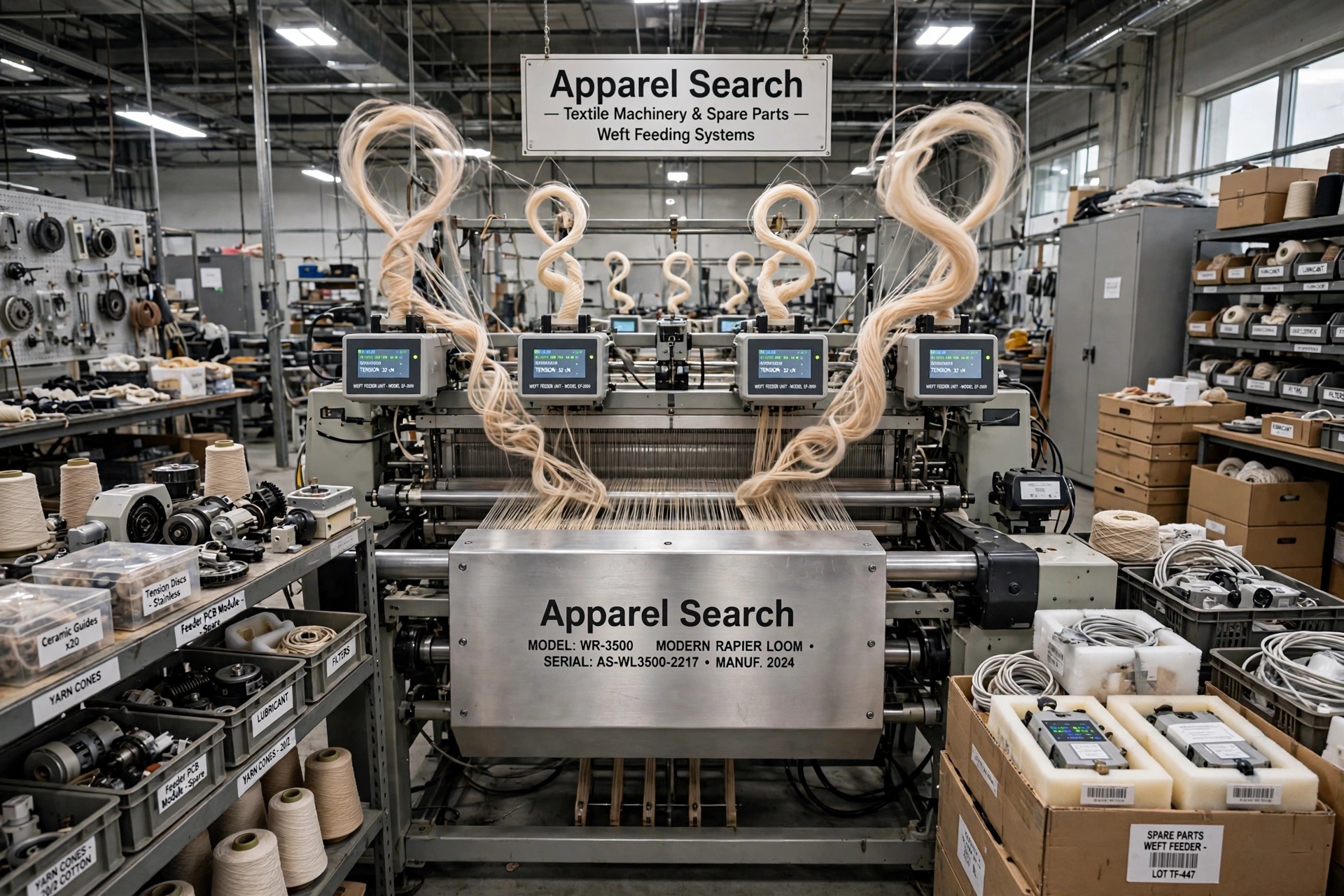
A weft feeder — also called a weft accumulator — sits between the weft package and the loom, winding a store of weft onto its drum and releasing it to the insertion system at a controlled, even tension. Without that buffer, the loom would pull each pick straight off the package, with ballooning, tension peaks and snarls turning into weft breaks and machine stops. On modern high-speed rapier and air-jet looms the feeder is not an accessory but part of the insertion system itself, and its setting decides how gently the loom can weave difficult yarns.
Textile Machinery Directory
How a Weft Feeder Controls the Pick
The feeder winds a reserve of yarn in separated coils on a stationary drum, then releases the coils one by one as the loom calls for a pick. Because the yarn leaves from a controlled store rather than unwinding over-end from a package, tension stays low and steady through the whole pick, and the peaks that break weft or pull it out of a gripper largely disappear. Feeder models add control of the coil separation, the reserve size and the release sensing to suit the yarn — fine filament, spun yarn, elastic or heavy weft each behave differently leaving the drum. LGL Electronics S.p.A. of Italy, listed below, is a leading company in the manufacture of weft feeders, with a position of high respect throughout the world.
Its TWM feeder offers the weaving machine the possibility to weave with the minimum of weft tension, and drastically reduces the number of weft stops.
Service, Setting and Spares
Feeders repay correct setting: reserve size matched to the pick length and loom speed, clean drums and guides, and sensors kept free of fly. A feeder that is dirty or badly adjusted gives the faults it was fitted to prevent — tension variation, reserve run-outs and false stops — so mills treat feeder cleaning and checking as scheduled loom care. LGL supports its feeders with a worldwide presence in the market and first-class after-sales service; in the Far East, including Japan, its branch is managed by Japanese personnel who take care of both the loom manufacturers and the weaving mills in their area. That maker-level support matters when a feeder range has to be matched to new loom models or new weft yarns. Feeder choice itself follows the loom and the weft range: insertion system, maximum pick rate, the counts and types of weft to be woven, and how many colours or weft channels the loom works with. A feeder sized or set for one weft will misbehave on another — a reserve wound for a fine filament behaves differently from one wound for a coarse spun weft — so mills changing styles reset and recheck their feeders as part of the style change, alongside the loom's own insertion settings, rather than treating the feeder as fit-and-forget equipment. The same discipline applies when a loom changes weft supplier: a new package shape or a different yarn finish changes how the weft unwinds into the feeder, and a short trial at the feeder settings catches trouble before a full beam is woven.
Companies Supplying Weft Feeders
LGL Electronics S.p.A.
LGL Electronics S.p.A. (Italy) is a leading company in the manufacturing of weft feeders and has achieved a position of high respect throughout the world. LGL boasts a worldwide presence in the market with a first-class after-sales service, and operates in the Far East including Japan, where its branch is managed by Japanese personnel who take care of and satisfy both the loom manufacturers and the weaving mills in their area. The TWM offers the weaving machine the possibility to weave with the minimum of weft tension and drastically reduces the number of weft stops.
Supplies: Weft Feeders · TWM Feeder
Textile & Clothing Machine Spare Parts
- Beam Heads
- Beams for Weaving Machinery
- Bulb Socket
- Cams
- Ceramic Friction Disks
- Ceramic Thread Guides
- Circular Knitting Machine Parts
- Creel Stands
- Cutters for Looms
- Cylinders
- Dials
- Electric Shears
- Feed Wheel
- Feeders
- Fineblanked Stampled Parts
- Flexible Card Clothing
- Grinder
- Grippers
- Guide Unit s - textile machinery
- Hosiery Camboxes
- Knitting Machine Spare Parts
- Loop Forming Elements
- Loose Needles
- Lycra Feeders
- Metallic Card Clothing
- Metallic Cleaning Tool
- Mounting Pads
- Papermakers for Felt Weaving
- Patterning
- Positive Feeders
- Poy Winder Machines
- Pulleys for textile machines
- Rapier Tapes
- Rapier Wheel
- Raschel Machinery Parts
- Rotary Hooks
- Safe Needles
- Sample
- Sensors for Looms
- Sewing Machinery Spare Parts
- Sinkers Rings
- Slide Electronic yarn Control Devices
- Springs for Textile Machines
- Stamped Bent Parts
- Stitch Bonding Machine Parts
- Striper
- Swatch Cutters
- Tension Meters
- Thread Break Guard
- Thread Guide Units
- Tricot Machinery Spare Parts
- Warp Knitting Spare Parts
- Warper Beams
- Weaving Machinery Spare Parts
- Weight Scales
- yarn Carriers
- yarn Retainer
- yarn Sensor
- yarn Splicers
- yarn Suction Cups for Winders
- yarn Supervisor by Drop
- yarn Supervisor by Tearing
- yarn Supervisor by Tearing & Drop
Knitting & Weaving Machinery
- Circular Knitting Machinery
- Crotchet Knitting Machinery
- Double Jersey Knitting Machinery
- Fleece fabric Knitting Machines
- Hosiery / Socks Machinery
- Knitting Lubricator
- Knitting Software
- Mesh fabric Knitting Machines
- Pile fabric Knitting Machines
- Plush fabric Knitting Machines
- Rib fabric Knitting Machinery
- Ring Temples
- Seamless Knitting Machinery
- Sewing Machinery Attachments
- Single Jersey Knitting Machinery
- Terry fabric Knitting Machinery
- Terry Machinery
- Velour fabric Knitting Machinery
- Weaving Machinery Manufacturers
Related Guides and Resources
Common Questions
What does a weft feeder do on a loom?
It winds a stored reserve of weft and releases it pick by pick at controlled, low tension, so the insertion system is fed evenly instead of pulling yarn directly off the package, where tension peaks cause breaks and stops.
Why does low weft tension matter?
Lower, steadier tension means fewer weft breaks and stops, gentler handling of weak or delicate wefts, and more consistent insertion on rapier and air-jet looms running at high speed.
What maintenance do weft feeders need?
Regular cleaning of the drum, guides and sensors, and setting the reserve to the pick length and loom speed. Fly build-up and a wrongly sized reserve cause the false stops the feeder exists to prevent.