Pulleys for Textile Machinery
Textile and clothing machine spare parts — what the part does, how to specify it, and the companies that supply it.
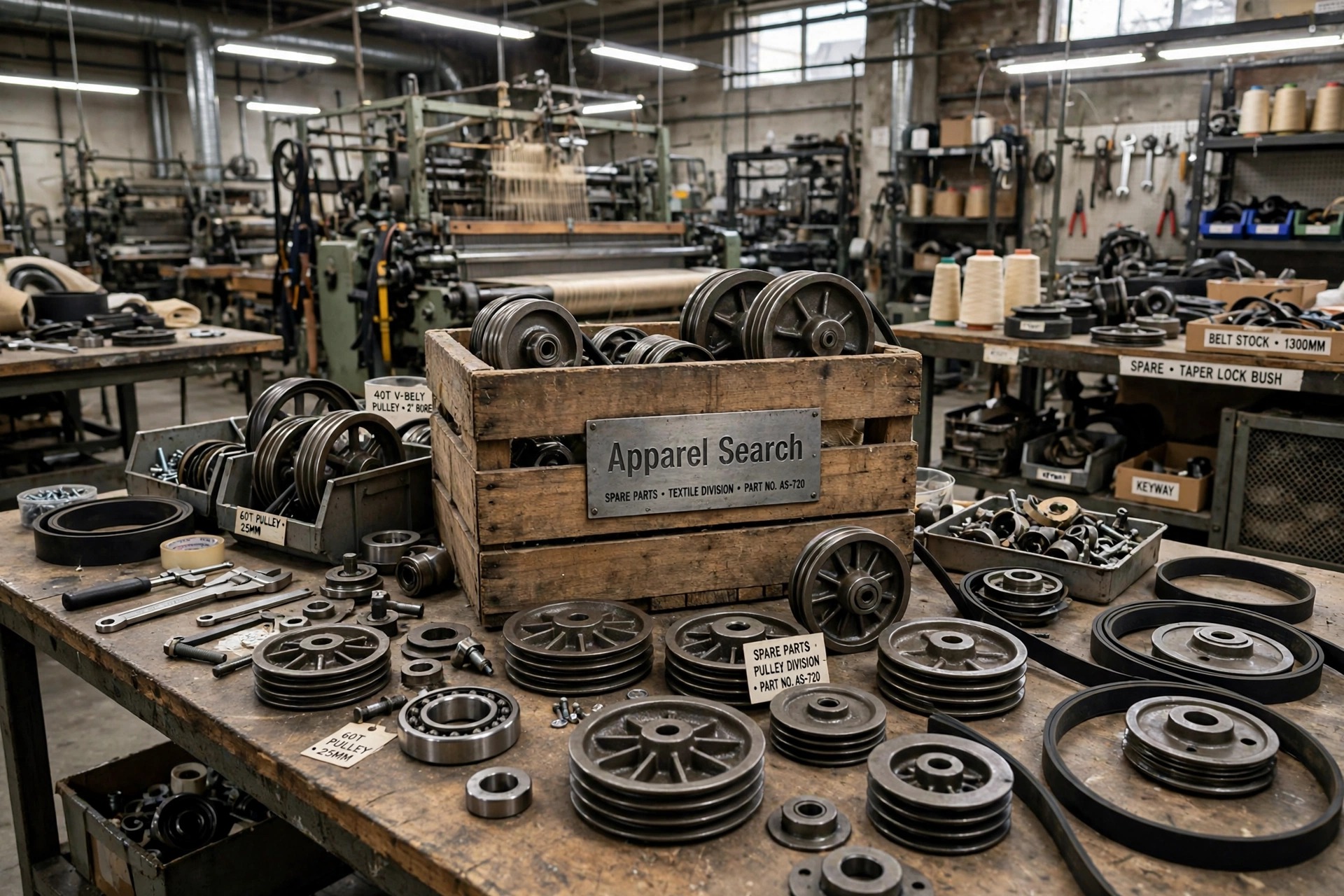
Pulleys transfer almost every drive in a textile mill. A loom's main shaft, its let-off and take-up motions, dobby and jacquard heads, and the line shafts and countershafts behind older machines all run through pulleys and belts, and winding, warping and preparation machines use the same principle at smaller scale. A pulley is a simple part — a grooved or flat-faced wheel on a shaft — but its diameter sets the machine speed ratio, its face decides belt tracking, and its condition decides how much vibration and belt wear the drive produces, which makes pulleys a routine but important spare part.
Textile Machinery Directory
Pulley Types and What They Drive
Three families cover most mill work. Flat pulleys, often slightly crowned so the belt centres itself, drive flat belts on line shafts and older loom drives. V-pulleys (sheaves) carry one or more V-belts and handle the higher power of modern motor drives, with the groove angle and pitch matched exactly to the belt section. Toothed or timing pulleys mesh with synchronous belts where motions must stay in fixed timing, as on electronically controlled loom motions and feeders. In every case the pulley's outside diameter and the driven pulley's diameter together set the speed change between shafts, so a replacement with the wrong diameter quietly changes machine speed and fabric or process settings.
Pulley materials follow duty: cast iron for most mill drives, steel for high loads and small diameters, and lighter alloys where rotating weight matters. Faces and grooves are machined smooth, and pulleys that run fast are balanced, because an unbalanced pulley shakes its shaft, bearings and belt on every revolution.
Specifying and Maintaining Drive Pulleys
Order a replacement pulley by bore and keyway or taper-bush fitting, outside diameter, belt type and groove or face width, and the shaft it mounts on — and confirm the speed ratio the pair must give. In service, the warning signs are polished or worn grooves that let a V-belt ride low and slip, cracks at the hub, belt dust from misalignment, and a belt that runs to one side of a flat pulley, which points to shaft misalignment or a damaged face. Keep pulley faces clean of oil and size, align shafts before blaming a belt, and replace a cracked pulley at once: a pulley that bursts at speed is a serious safety hazard. The US supplier below lists pulleys among its miscellaneous loom parts.
Belt and pulley care go together. A new belt fitted to a worn pulley inherits the pulley's faults, and a new pulley driven by a glazed, stretched belt will slip the same way, so the pair are judged together at inspection. Keep a record of pulley sizes fitted at each drive position: mills change ratios over the years to alter machine speeds, and the pulley actually on the shaft — not the maker's drawing — is the one a replacement must match. Guards should always be refitted after pulley work, since mill drives run exposed at operator height.
Companies Supplying Pulleys
Tranoco
Tranoco (USA) lists pulleys among its miscellaneous loom parts, together with harness frame parts and ceramic thread guides. The same range supplies beams for all types of weaving machines, warper beams, beam heads and canisters, mounting pads for isolating and reducing vibration, Flexhold yarn package adapters and holders that fit most any size cone or tube, and parts for papermakers' felt weaving machines and for velvet and upholstery weaving machines.
Supplies: Pulleys · Harness Frame Parts · Ceramic Thread Guides · Loom Parts · Beams and Beam Heads
Textile & Clothing Machine Spare Parts
- Beam Heads
- Beams for Weaving Machinery
- Bulb Socket
- Cams
- Ceramic Friction Disks
- Ceramic Thread Guides
- Circular Knitting Machine Parts
- Creel Stands
- Cutters for Looms
- Cylinders
- Dials
- Electric Shears
- Feed Wheel
- Feeders
- Fineblanked Stampled Parts
- Flexible Card Clothing
- Grinder
- Grippers
- Guide Unit s - textile machinery
- Hosiery Camboxes
- Knitting Machine Spare Parts
- Loop Forming Elements
- Loose Needles
- Lycra Feeders
- Metallic Card Clothing
- Metallic Cleaning Tool
- Mounting Pads
- Papermakers for Felt Weaving
- Patterning
- Positive Feeders
- Poy Winder Machines
- Rapier Tapes
- Rapier Wheel
- Raschel Machinery Parts
- Rotary Hooks
- Safe Needles
- Sample
- Sensors for Looms
- Sewing Machinery Spare Parts
- Sinkers Rings
- Slide Electronic yarn Control Devices
- Springs for Textile Machines
- Stamped Bent Parts
- Stitch Bonding Machine Parts
- Striper
- Swatch Cutters
- Tension Meters
- Thread Break Guard
- Thread Guide Units
- Tricot Machinery Spare Parts
- Warp Knitting Spare Parts
- Warper Beams
- Weaving Machinery Spare Parts
- Weft Feeders
- Weight Scales
- yarn Carriers
- yarn Retainer
- yarn Sensor
- yarn Splicers
- yarn Suction Cups for Winders
- yarn Supervisor by Drop
- yarn Supervisor by Tearing
- yarn Supervisor by Tearing & Drop
Knitting & Weaving Machinery
- Circular Knitting Machinery
- Crotchet Knitting Machinery
- Double Jersey Knitting Machinery
- Fleece fabric Knitting Machines
- Hosiery / Socks Machinery
- Knitting Lubricator
- Knitting Software
- Mesh fabric Knitting Machines
- Pile fabric Knitting Machines
- Plush fabric Knitting Machines
- Rib fabric Knitting Machinery
- Ring Temples
- Seamless Knitting Machinery
- Sewing Machinery Attachments
- Single Jersey Knitting Machinery
- Terry fabric Knitting Machinery
- Terry Machinery
- Velour fabric Knitting Machinery
- Weaving Machinery Manufacturers
Common Questions
How do I size a replacement pulley?
Measure the bore and keyway or bush fitting, the outside diameter, and the face width or groove profile for the belt in use, and note the mating pulley so the speed ratio stays correct. A pulley of the wrong diameter changes the driven shaft speed.
What causes a belt to slip on a V-pulley?
Usually a worn groove: as the groove wears, the belt rides deeper, loses its wedge grip and slips under load, glazing itself in the process. The cure is a new pulley and belt as a matched pair, not more tension, which only overloads the bearings.
Why does a flat belt run off to one side?
Flat belts track toward the side where the pulley face or shaft alignment leads them. Check shaft parallelism and the pulley crown and face condition first; a belt that has been running off-centre may also have stretched unevenly and need replacing.