Striper Feeder for Textile Machinery
Textile and clothing machine spare parts — what the part does, how to specify it, and the companies that supply it.
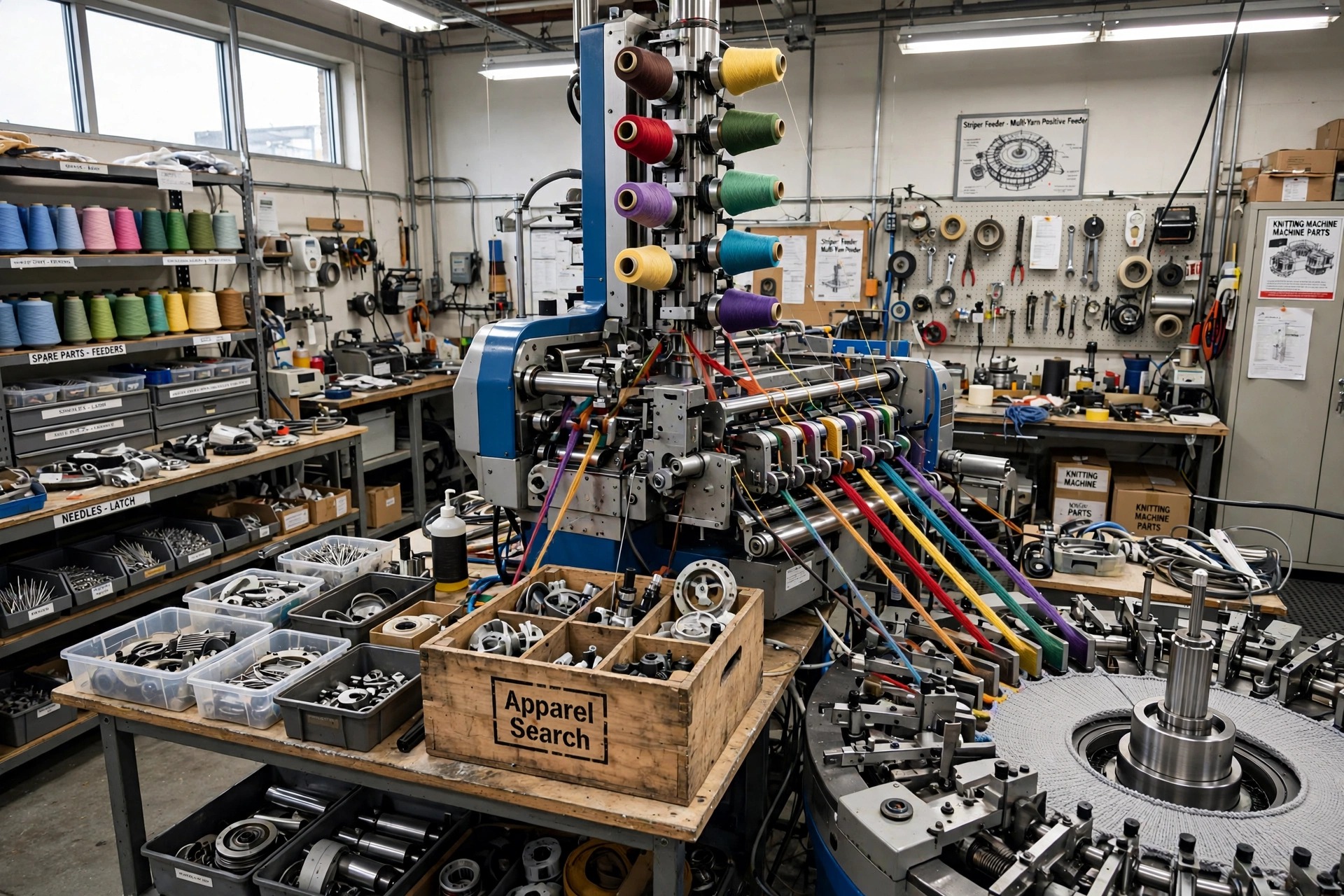
A striper feeder is the yarn feeder that lets a circular knitting machine change colour or yarn at a feed to knit stripes and jacquard patterns. Striping needs more than a yarn change: each yarn in the pattern must arrive at the needles metered at its own correct tension, and yarns of different fibre, count and elasticity cannot share one tension setting. The multi-function positive feeder answers this by supplying two or more different types of yarn with different tensions at the same time, positively driven rather than pulled by the needles, so stripe courses knit at the course length the pattern was set up for.
Textile Machinery Directory
Positive Feeding for Stripes and Jacquard
In positive feeding the feeder, not the needle demand, sets how much yarn is delivered: a driven wheel or tape meters yarn at a rate matched to the machine, and the needles take what they are given. On a striper or jacquard machine several yarns wait at the feed and the selected yarn must feed at its own tension the moment it is chosen - too tight and the stripe course pulls in and shows a tight band, too loose and loops drop or snag. A feeder that holds separate tensions for two or more yarns at once removes the compromise, and keeps course length consistent as packages run down, which is when demand-fed yarn tension drifts most.
Feeder design details decide how well this works in a real mill: horizontal feeding arrangements give more space to change knob catcher sizes and make it easy to clean dust from the cover or the knob catcher, and covers and brackets keep fly off sensitive yarns. The Taiwan supplier below builds its striper feeding around exactly this multi-function positive feeder design, as the core of a circular knitting spares range developed since 1976.
Setting Up and Maintaining Striper Feeders
Set each yarn's tension for the yarn itself, not for the pattern average, and prove the setting across a full stripe repeat before production: stripe faults repeat faithfully, so an error set at the feeder appears in every garment length. Keep feed wheels, catchers and yarn paths clean - dust build-up changes friction and therefore tension, undoing the feeder's precision - and check the changeover action at the feed, where a slow or partial yarn change cuts or traps the outgoing yarn. Replacement feeders and parts are specified by machine make, feed position and the yarn range being run. The supplier below covers striper feeding within its positive feeder, Lycra feeder and creel ranges for circular knitting machines.
The creel completes the striper set-up: stripe yarns wait on the creel for long stretches between selections, so their paths must stay clean and their tensions undisturbed while the other yarns run. A feeder holding several tensions at once only delivers its advantage if the yarns arrive at it in good order - correctly creeled, guided without cross-contact, and protected from the fly that accumulates while a colour stands idle. Checking the idle yarns' paths is therefore part of striper feeder maintenance, not a separate creel chore to be left for another day.
Companies Supplying Striper Feeder
Jen-Haur Company
Jen-Haur Company (Taiwan), established in 1976, is a leading circular knitting machine spare parts manufacturer. For striper and jacquard machines its main product is the multi-function positive feeder, which supplies two or more different types of yarn with different tension at the same time - the feeding striper work depends on. The feeder range also includes positive feeders with horizontal feeding devices and aluminium-alloy positive feeders for micro-fibre with an auto-clean function.
Supplies: Striper Feeders · Multi-Function Positive Feeders · Positive Feeders · Lycra Feeders
Textile & Clothing Machine Spare Parts
- Beam Heads
- Beams for Weaving Machinery
- Bulb Socket
- Cams
- Ceramic Friction Disks
- Ceramic Thread Guides
- Circular Knitting Machine Parts
- Creel Stands
- Cutters for Looms
- Cylinders
- Dials
- Electric Shears
- Feed Wheel
- Feeders
- Fineblanked Stampled Parts
- Flexible Card Clothing
- Grinder
- Grippers
- Guide Unit s - textile machinery
- Hosiery Camboxes
- Knitting Machine Spare Parts
- Loop Forming Elements
- Loose Needles
- Lycra Feeders
- Metallic Card Clothing
- Metallic Cleaning Tool
- Mounting Pads
- Papermakers for Felt Weaving
- Patterning
- Positive Feeders
- Poy Winder Machines
- Pulleys for textile machines
- Rapier Tapes
- Rapier Wheel
- Raschel Machinery Parts
- Rotary Hooks
- Safe Needles
- Sample
- Sensors for Looms
- Sewing Machinery Spare Parts
- Sinkers Rings
- Slide Electronic yarn Control Devices
- Springs for Textile Machines
- Stamped Bent Parts
- Stitch Bonding Machine Parts
- Swatch Cutters
- Tension Meters
- Thread Break Guard
- Thread Guide Units
- Tricot Machinery Spare Parts
- Warp Knitting Spare Parts
- Warper Beams
- Weaving Machinery Spare Parts
- Weft Feeders
- Weight Scales
- yarn Carriers
- yarn Retainer
- yarn Sensor
- yarn Splicers
- yarn Suction Cups for Winders
- yarn Supervisor by Drop
- yarn Supervisor by Tearing
- yarn Supervisor by Tearing & Drop
Knitting & Weaving Machinery
- Circular Knitting Machinery
- Crotchet Knitting Machinery
- Double Jersey Knitting Machinery
- Fleece fabric Knitting Machines
- Hosiery / Socks Machinery
- Knitting Lubricator
- Knitting Software
- Mesh fabric Knitting Machines
- Pile fabric Knitting Machines
- Plush fabric Knitting Machines
- Rib fabric Knitting Machinery
- Ring Temples
- Seamless Knitting Machinery
- Sewing Machinery Attachments
- Single Jersey Knitting Machinery
- Terry fabric Knitting Machinery
- Terry Machinery
- Velour fabric Knitting Machinery
- Weaving Machinery Manufacturers
Common Questions
Why does a striper machine need a multi-function feeder?
Each yarn in a stripe pattern needs its own tension - different fibres and counts knit correctly at different feeds. A multi-function positive feeder supplies two or more yarns at different tensions at the same time, so the selected yarn is already correct when the striper changes to it.
What fabric faults come from wrong striper feed tension?
Tight bands where a stripe course pulls in, loose or dropped loops where feed runs slack, and course-length differences between colours that show as uneven stripe widths across the fabric.
What is positive feeding?
The feeder drives yarn to the needles at a set, metered rate instead of letting needle demand pull yarn from the package. Delivery stays constant as packages run down, which keeps course length and fabric weight consistent.