Sample Cutters for Textile Machinery
Textile and clothing machine spare parts — what the part does, how to specify it, and the companies that supply it.
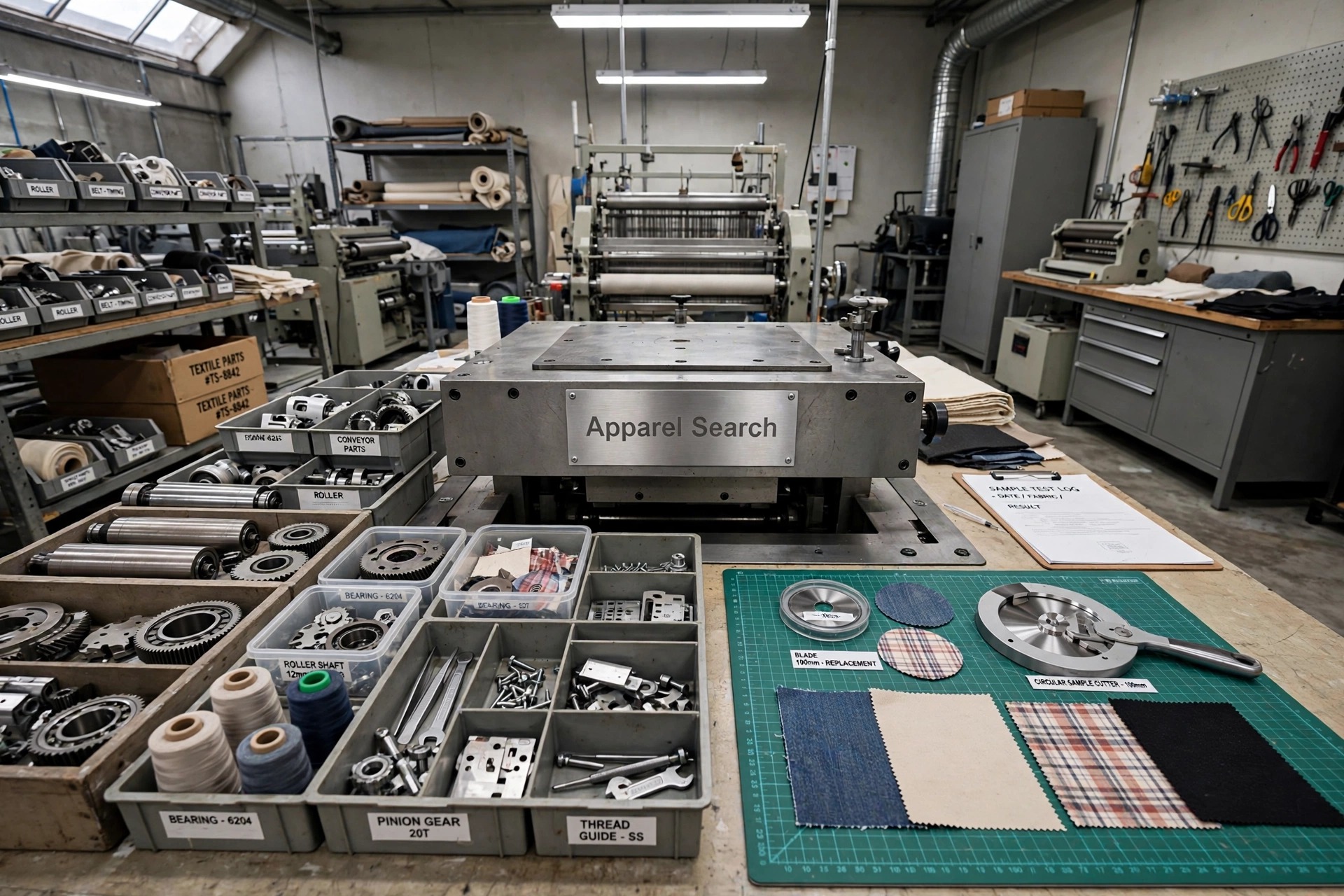
A sample cutter is the small precision instrument that cuts a fabric sample of an exact known area — the standard circle used for weighing fabric to determine its weight per square metre (GSM). Quality control in knitting and weaving mills runs on that number: it confirms the fabric meets its specification, tracks production drift, and settles disputes between maker and buyer. The cutter's blades slice the circle cleanly against a cutting pad in one rotary pass, and because the whole test depends on the sample being exactly the standard area and cleanly cut, the cutter is a calibrated tool, not a pair of scissors.
Textile Machinery Directory
Sample Cutting and the GSM Test
The test is simple in principle: cut the circular sample with the sample cutter, weigh it on an accurate balance (the weight scales in the same testing ranges), and multiply up to grams per square metre. Its accuracy depends entirely on technique and tool condition. The fabric is laid flat and relaxed on the cutter's pad, the cutter is pressed down evenly and turned with steady pressure so the blades complete the circle without dragging, and the sample edge is checked — a sample with pulled, doubled or frayed edges is discarded and cut again. Multiple samples are taken across the width and along the piece, because weight varies with position and a single cut can mislead.
In knitting plants the sample cutter sits in a small testing kit alongside swatch cutters for appearance samples, tension meters, yarn length meters and magnifiers — the bench instruments that let a mill check production without a full laboratory.
Blades, Pads and Cutter Care
Sample cutters cut with several thin blades arranged around the circle, and blade condition is everything: a nicked or dull blade tears rather than cuts, undersizes the sample and falsifies the weight result. Blades are consumables, changed as a set, and the cutting pad beneath is replaced when its surface grooves, because a grooved pad lets fabric creep during the turn. Keep the cutter clean and dry, store it so its blades cannot be knocked, and verify it periodically by cutting and measuring samples of a reference fabric. Order replacement cutters and blades by the sample area standard the mill works to. The Taiwan supplier below includes sample cutters in its testing equipment range for circular knitting plants.
Build the cutter into a fixed testing routine and its results become comparable day to day: condition the fabric, cut at set positions, weigh on the same scales, and record GSM by machine and style so drift is caught before a delivery is out of specification. Pair the cutter with its companion instruments — the swatch cutter for larger appearance and test pieces, and the tension meter and yarn length meter for checking the yarn inputs behind a weight fault — and a small mill bench can trace most fabric weight problems to their cause without outside laboratory help.
Companies Supplying Sample Cutters
Jen-Haur Company
Jen-Haur Company (Taiwan), established in 1976, is a leading circular knitting machine spare parts manufacturer. Its testing equipment range includes sample cutters, weight scales, swatch cutters, magnifiers, tension meters, yarn length meters and cleaning guns. The same company supplies multi-function positive feeders, Lycra feeders and creel stands for circular knitting machines.
Supplies: Sample Cutters · Weight Scales · Swatch Cutters · Tension Meters · Testing Equipment
Textile & Clothing Machine Spare Parts
- Beam Heads
- Beams for Weaving Machinery
- Bulb Socket
- Cams
- Ceramic Friction Disks
- Ceramic Thread Guides
- Circular Knitting Machine Parts
- Creel Stands
- Cutters for Looms
- Cylinders
- Dials
- Electric Shears
- Feed Wheel
- Feeders
- Fineblanked Stampled Parts
- Flexible Card Clothing
- Grinder
- Grippers
- Guide Unit s - textile machinery
- Hosiery Camboxes
- Knitting Machine Spare Parts
- Loop Forming Elements
- Loose Needles
- Lycra Feeders
- Metallic Card Clothing
- Metallic Cleaning Tool
- Mounting Pads
- Papermakers for Felt Weaving
- Patterning
- Positive Feeders
- Poy Winder Machines
- Pulleys for textile machines
- Rapier Tapes
- Rapier Wheel
- Raschel Machinery Parts
- Rotary Hooks
- Safe Needles
- Sensors for Looms
- Sewing Machinery Spare Parts
- Sinkers Rings
- Slide Electronic yarn Control Devices
- Springs for Textile Machines
- Stamped Bent Parts
- Stitch Bonding Machine Parts
- Striper
- Swatch Cutters
- Tension Meters
- Thread Break Guard
- Thread Guide Units
- Tricot Machinery Spare Parts
- Warp Knitting Spare Parts
- Warper Beams
- Weaving Machinery Spare Parts
- Weft Feeders
- Weight Scales
- yarn Carriers
- yarn Retainer
- yarn Sensor
- yarn Splicers
- yarn Suction Cups for Winders
- yarn Supervisor by Drop
- yarn Supervisor by Tearing
- yarn Supervisor by Tearing & Drop
Knitting & Weaving Machinery
- Circular Knitting Machinery
- Crotchet Knitting Machinery
- Double Jersey Knitting Machinery
- Fleece fabric Knitting Machines
- Hosiery / Socks Machinery
- Knitting Lubricator
- Knitting Software
- Mesh fabric Knitting Machines
- Pile fabric Knitting Machines
- Plush fabric Knitting Machines
- Rib fabric Knitting Machinery
- Ring Temples
- Seamless Knitting Machinery
- Sewing Machinery Attachments
- Single Jersey Knitting Machinery
- Terry fabric Knitting Machinery
- Terry Machinery
- Velour fabric Knitting Machinery
- Weaving Machinery Manufacturers
Related Guides and Resources
Common Questions
What sample area does a standard sample cutter cut?
The common standard is a 100 square centimetre circle, so the sample weight in grams multiplied by 100 gives GSM directly. Cutters are made to a stated area standard, so confirm the area when ordering cutters or blades.
Why is my GSM result inconsistent between samples?
Usually cutting technique or tool condition: fabric not relaxed, uneven pressure during the turn, or dull blades tearing the edge and undersizing the sample. Re-cut with fresh blades on a sound pad, and average samples taken across the width.
When should sample cutter blades be changed?
When edges start to tear or feather instead of cutting cleanly, or when check cuts on a reference fabric no longer give consistent weights. Change blades as a set and replace a grooved cutting pad at the same time.