Yarn Suction Cups for Winders for Textile Machinery
Textile and clothing machine spare parts — what the part does, how to specify it, and the companies that supply it.
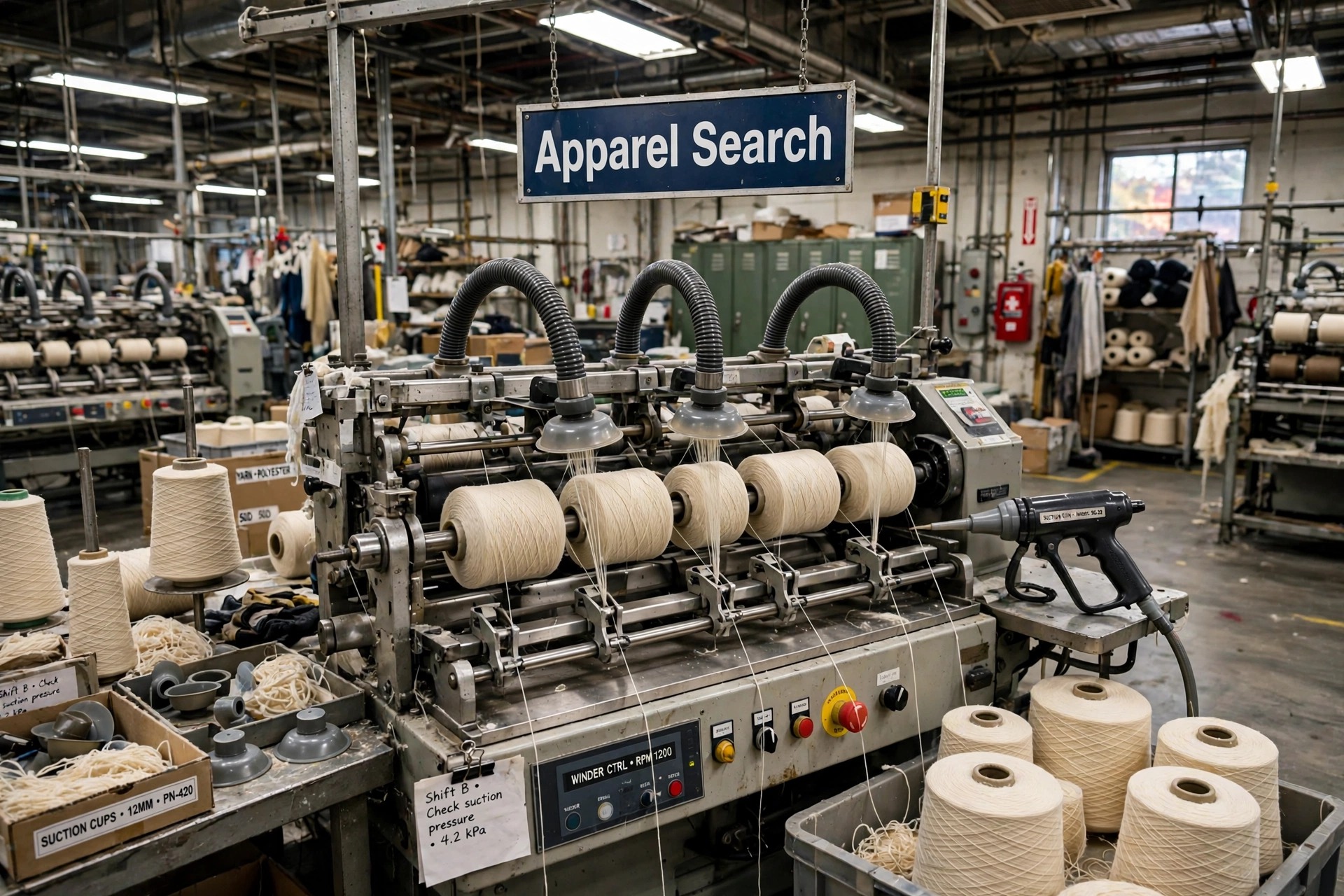
A yarn suction cup is the small, unglamorous fitting that lets a winder catch its own yarn. Winders work by air as much as by machinery: suction arms and nozzles capture the running yarn end, hold it under vacuum while a package is changed or a break is cleared, and present it to the splicer or the new bobbin. The cup at the end of that suction path is the seal between the vacuum system and a yarn end that weighs almost nothing — if the cup is split, hardened or the wrong size, the end escapes, the transfer fails, and a high-speed winder position stands idle while an operator threads it by hand.
Textile Machinery Directory
What Suction Cups Do in the Winding Cycle
At doffing the full package leaves, a fresh tube takes its place, and the yarn end must be found, held and re-anchored without losing tension control. Suction cups and nozzles do that work: vacuum draws the loose end into the cup mouth and holds it captive while arms move it into position for splicing or for wrapping onto the new package. The same suction path clears broken ends after a fault. On POY winders the related yarn suction gun puts the same principle in the operator's hand for string-up, which is why cups, nozzles and guns are stocked and serviced as one suction family.
Cup design balances grip against gentleness: the mouth must seal well enough to hold the end against moving machinery, yet not abrade or flatten the yarn it holds. Bore, mouth flare and material all change with the yarn — a cup that holds coarse spun yarn securely can damage fine filament, and a filament cup will lose a heavy yarn every time the arm moves.
Cup Wear, Vacuum Leaks and Spares Planning
Suction cups live in the dirtiest air in the mill. Fibre fly packs into bores and filters, rubber lips harden and crack with age and heat, and plastic cups score where yarn rubs the same track thousands of times a shift. The symptoms arrive before total failure: transfers that miss occasionally, ends that escape during arm movement, string-up that takes two attempts. Because one leaking cup bleeds vacuum from a shared suction line, a single tired cup can make neighbouring positions unreliable too — vacuum level at the far end of the line is a quick diagnostic when several positions start missing together. Cups are cheap compared with winder downtime, so they belong on the planned-replacement list, changed in sets by position age rather than one failure at a time.
Order replacements by winder make, model and suction-arm position, and quote the yarn range — fibre, count and spun or filament — so bore and mouth geometry match the work. Falcon Engineers, listed below, supplies POY winder machine parts and the yarn suction gun used for winder string-up, within a wider loom and autoconer spares range — the natural source family for winder suction fittings. Keep cups, gun nozzles and suction filters together in the spares cabinet, blow out suction lines on the cleaning rota, and treat any rise in hand-threading as a spares problem to fix.
Companies Supplying Yarn Suction Cups for Winders
Falcon Engineers
For POY winder machines, Falcon Engineers of India is the listed source of the yarn suction gun used at string-up, and the firm provides replacement parts across the winder and weaving ranges. Alongside its own manufacture of loom and autoconer spares — a range it has built up part by part for textile machines — Falcon stocks imported parts sourced from Germany, Italy and other countries, and describes its offer as high-quality, accurate products at affordable prices. Its catalogue also runs to scissors and cutters for automatic loom and winding machines, and to cards, nozzles, sensors, heald wire and jets for all types of looms.
Supplies: Suction Cups · Yarn Suction Guns · POY Winder Parts · Nozzles · Winding Machine Spares · Loom Spares
Textile & Clothing Machine Spare Parts
- Beam Heads
- Beams for Weaving Machinery
- Bulb Socket
- Cams
- Ceramic Friction Disks
- Ceramic Thread Guides
- Circular Knitting Machine Parts
- Creel Stands
- Cutters for Looms
- Cylinders
- Dials
- Electric Shears
- Feed Wheel
- Feeders
- Fineblanked Stampled Parts
- Flexible Card Clothing
- Grinder
- Grippers
- Guide Unit s - textile machinery
- Hosiery Camboxes
- Knitting Machine Spare Parts
- Loop Forming Elements
- Loose Needles
- Lycra Feeders
- Metallic Card Clothing
- Metallic Cleaning Tool
- Mounting Pads
- Papermakers for Felt Weaving
- Patterning
- Positive Feeders
- Poy Winder Machines
- Pulleys for textile machines
- Rapier Tapes
- Rapier Wheel
- Raschel Machinery Parts
- Rotary Hooks
- Safe Needles
- Sample
- Sensors for Looms
- Sewing Machinery Spare Parts
- Sinkers Rings
- Springs for Textile Machines
- Stamped Bent Parts
- Stitch Bonding Machine Parts
- Striper
- Swatch Cutters
- Tension Meters
- Thread Break Guard
- Thread Guide Units
- Tricot Machinery Spare Parts
- Warp Knitting Spare Parts
- Warper Beams
- Weaving Machinery Spare Parts
- Weft Feeders
- Weight Scales
- yarn Carriers
- yarn Control Devices (Slide Electronic)
- yarn Retainer
- yarn Sensor
- yarn Splicers
- yarn Supervisor by Drop
- yarn Supervisor by Tearing
- yarn Supervisor by Tearing & Drop
Knitting & Weaving Machinery
- Circular Knitting Machinery
- Crotchet Knitting Machinery
- Double Jersey Knitting Machinery
- Fleece fabric Knitting Machines
- Hosiery / Socks Machinery
- Knitting Lubricator
- Knitting Software
- Mesh fabric Knitting Machines
- Pile fabric Knitting Machines
- Plush fabric Knitting Machines
- Rib fabric Knitting Machinery
- Ring Temples
- Seamless Knitting Machinery
- Sewing Machinery Attachments
- Single Jersey Knitting Machinery
- Terry fabric Knitting Machinery
- Terry Machinery
- Velour fabric Knitting Machinery
- Weaving Machines
Related Guides and Resources
Common Questions
Why does a winder keep missing yarn transfers?
The usual causes sit in the suction path: a split or hardened suction cup that will not seal, a bore packed with fibre fly, a tired gun nozzle, or vacuum lost through a leak elsewhere on a shared line. Check vacuum level first, then cups and nozzles position by position — missed transfers are rarely a controls fault.
Are suction cups interchangeable between yarn types?
Not safely. Cup bore and mouth shape are matched to yarn size and delicacy: a cup sized for coarse spun yarn can damage fine filament, and a fine-filament cup will keep losing a heavy yarn. Specify the winder model, the arm position and the full yarn range when ordering.
How often should suction cups be replaced?
On condition and in sets, not on failure. Hardened, cracked or scored lips, rising missed transfers and slower string-up are the replacement triggers. Because one leaking cup bleeds a shared vacuum line, changing cups across a winder section together is cheaper than chasing single failures.