Safe Needles for Textile Machinery
Textile and clothing machine spare parts — what the part does, how to specify it, and the companies that supply it.
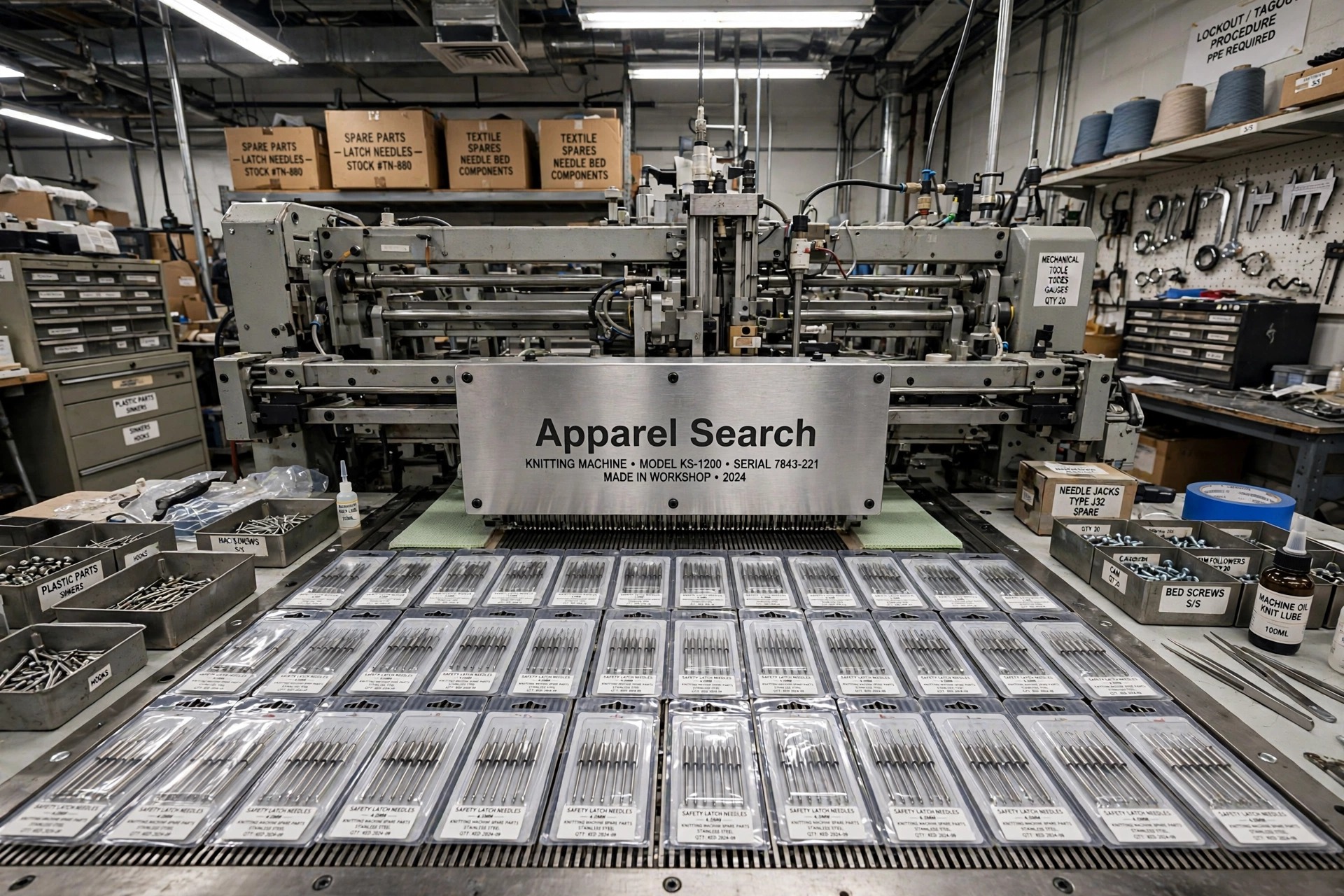
Knitting machine needles work at the fastest, finest tolerances in textiles: hundreds or thousands of latch needles rising and falling in their tricks, each forming a loop on every revolution, with hooks and latches that a single bent needle can damage across a whole cam track. Safe needles belong to the family of needle designs and fittings made to protect that system — needles specified and made so they run reliably in circular and flat knitting machines and reduce the damage and stoppages that a failed needle causes. Whatever the machine, needles are the highest-turnover spare part in knitting, bought in quantity and matched exactly to the machine.
Textile Machinery Directory
Needles in Circular and Flat Knitting
On a circular machine the needles sit vertically in the cylinder (and horizontally in the dial on rib machines), driven by cams acting on their butts; on flat machines they lie in a flat bed and are drawn along by the carriage. In both, the latch needle's cycle is the same: rise to clear the old loop, receive new yarn, and draw down so the latch closes over the hook and the old loop slides off, forming the new stitch. Needle quality shows in the consistency of that cycle — butt height, shank finish, hook form and latch freedom all have to be uniform across every needle in the set, or stitch length and fabric appearance vary needle to needle.
Needles fail by wear and accident alike: latches stiffen or break, hooks bend from yarn faults or foreign matter, and butts wear in the cam track. A damaged needle left running cuts yarn, drops stitches and can score the cylinder trick or cam it travels in.
Specifying and Changing Knitting Needles
Needles are specified by machine make and model, machine gauge, and the needle maker's pattern reference — length, butt position and hook form are all part of the pattern, and mixing patterns in one machine is a false economy even when the needles look alike. Change needles with the machine stopped, work in good light with the fabric or needle bed protected, and after changing a run of needles, knit slowly and inspect the first fabric for needle lines before returning to speed. Mills buy needles as consumables in depth, keep each machine's pattern separate in the stores, and treat a sudden rise in needle breakage as a symptom — of cam wear, yarn faults or timing — not just as needle consumption. The Italian supplier below makes safe needles as part of its parts range for circular and flat knitting machines.
Needle handling decides how many new needles survive fitting. Needles are kept in their oiled packets until use, handled by the shank rather than the hook or latch, and never forced into a tight trick — resistance means a burred trick or the wrong pattern, and forcing it damages both. After a needle change, the latch of each new needle is flicked to confirm it moves freely before the machine turns. Used needles are discarded, not returned to stock: a fatigued latch looks sound and fails in the next run, faulting fabric worth far more than the needle.
Companies Supplying Safe Needles
RMB Massardi
RMB Massardi (Italy) manufactures parts for circular and flat knitting machines, and its range includes safe needles. The same range covers slide electronic yarn control devices, yarn supervisors by drop, by tearing and by tearing and drop, yarn retainers, yarn sensors, bulb sockets and electric shears.
Supplies: Safe Needles · Yarn Control Devices · Yarn Supervisors · Yarn Sensors · Electric Shears
Textile & Clothing Machine Spare Parts
- Beam Heads
- Beams for Weaving Machinery
- Bulb Socket
- Cams
- Ceramic Friction Disks
- Ceramic Thread Guides
- Circular Knitting Machine Parts
- Creel Stands
- Cutters for Looms
- Cylinders
- Dials
- Electric Shears
- Feed Wheel
- Feeders
- Fineblanked Stampled Parts
- Flexible Card Clothing
- Grinder
- Grippers
- Guide Unit s - textile machinery
- Hosiery Camboxes
- Knitting Machine Spare Parts
- Loop Forming Elements
- Loose Needles
- Lycra Feeders
- Metallic Card Clothing
- Metallic Cleaning Tool
- Mounting Pads
- Papermakers for Felt Weaving
- Patterning
- Positive Feeders
- Poy Winder Machines
- Pulleys for textile machines
- Rapier Tapes
- Rapier Wheel
- Raschel Machinery Parts
- Rotary Hooks
- Sample
- Sensors for Looms
- Sewing Machinery Spare Parts
- Sinkers Rings
- Slide Electronic yarn Control Devices
- Springs for Textile Machines
- Stamped Bent Parts
- Stitch Bonding Machine Parts
- Striper
- Swatch Cutters
- Tension Meters
- Thread Break Guard
- Thread Guide Units
- Tricot Machinery Spare Parts
- Warp Knitting Spare Parts
- Warper Beams
- Weaving Machinery Spare Parts
- Weft Feeders
- Weight Scales
- yarn Carriers
- yarn Retainer
- yarn Sensor
- yarn Splicers
- yarn Suction Cups for Winders
- yarn Supervisor by Drop
- yarn Supervisor by Tearing
- yarn Supervisor by Tearing & Drop
Knitting & Weaving Machinery
- Circular Knitting Machinery
- Crotchet Knitting Machinery
- Double Jersey Knitting Machinery
- Fleece fabric Knitting Machines
- Hosiery / Socks Machinery
- Knitting Lubricator
- Knitting Software
- Mesh fabric Knitting Machines
- Pile fabric Knitting Machines
- Plush fabric Knitting Machines
- Rib fabric Knitting Machinery
- Ring Temples
- Seamless Knitting Machinery
- Sewing Machinery Attachments
- Single Jersey Knitting Machinery
- Terry fabric Knitting Machinery
- Terry Machinery
- Velour fabric Knitting Machinery
- Weaving Machinery Manufacturers
Related Guides and Resources
Common Questions
What makes a knitting needle a consumable part?
Its working surfaces — hook, latch and butt — cycle millions of times against yarn and cams. Latches tire and break, hooks bend and butts wear, and because one bad needle faults every course it knits, needles are replaced promptly and bought in quantity.
Can needles of a similar pattern be mixed in one machine?
No. Butt position, length and hook form define the pattern, and mixed needles knit unevenly and can disturb cam timing. Keep each machine's needle pattern separate and order by machine make, model, gauge and pattern reference.
What does a sudden rise in needle breakage mean?
Usually that something else is wrong — worn or stepped cams, a damaged cylinder trick, faulty yarn or incorrect timing — and the needles are the victims. Find and fix the cause or the new needles will break the same way.