Tricot Machine Parts for Textile Machinery
Textile and clothing machine spare parts — what the part does, how to specify it, and the companies that supply it.
Tricot machines are the high-speed workhorses of warp knitting, producing the fine, smooth fabrics used for lingerie, sportswear, linings, nets and technical textiles. Their knitting elements — needles, jacks, sinkers, guides and closing wires working in precise unison thousands of times a minute — are wear parts with fine tolerances, so a tricot mill lives or dies by its spare parts supply. This page covers the parts a tricot machine consumes and the stockist listed below, which specialises in supplying warp knitting spares quickly, wherever in the world the machine is running.
Textile Machinery Directory
The Parts a Tricot Machine Consumes
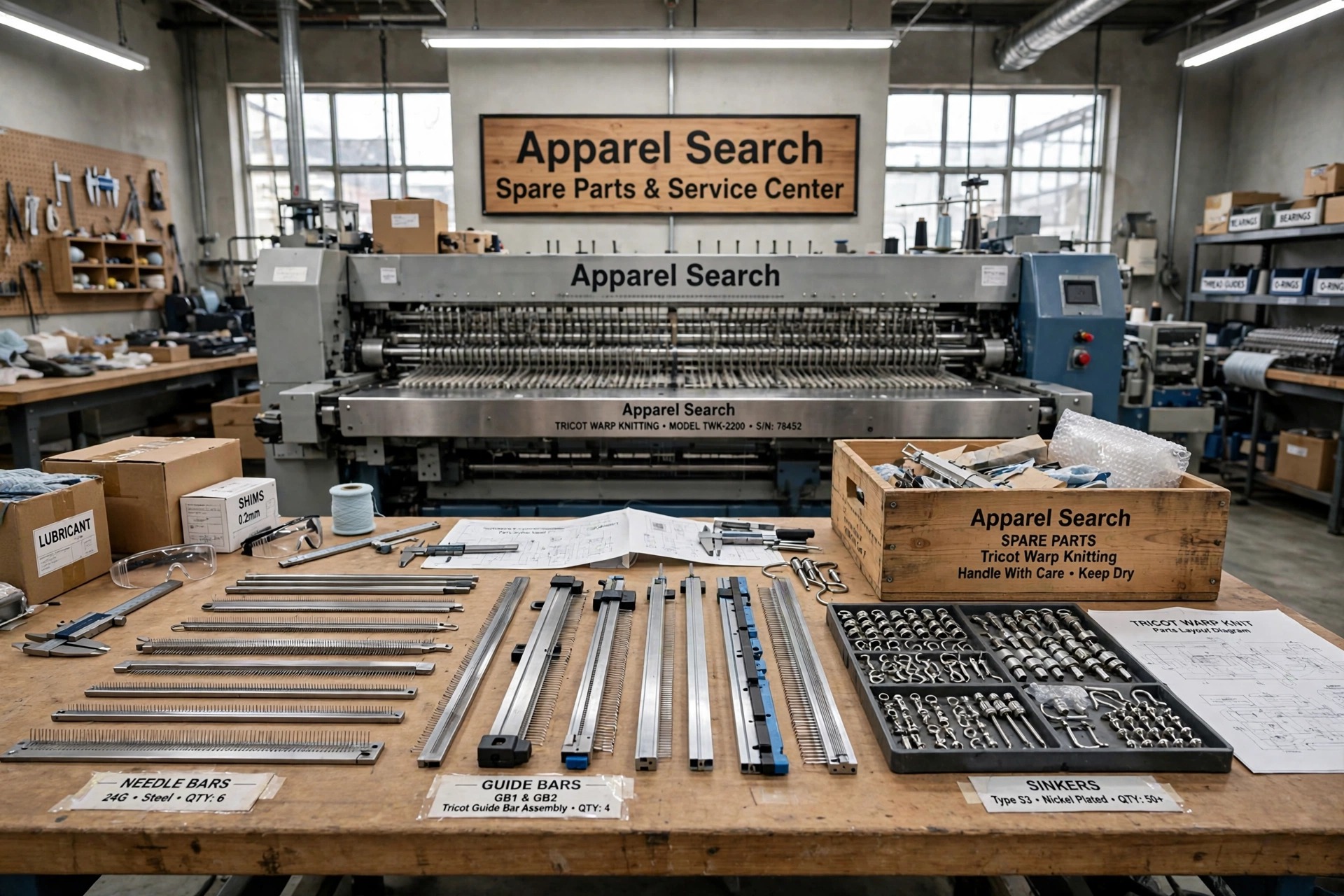
A tricot machine knits with a full width of compound or latch needles, each working with its jack, sinker, guide and closing elements as the needle bar rises and falls and the guide bars shiver to lay in the pattern. Needles bend and break, sinker throats wear, jacks fatigue and guide eyes groove, and because every element repeats across the full working width, faults repeat across the fabric just as visibly. Replacement is therefore in matched quantities across the width, specified by machine make, model, gauge and working width, and experienced mills keep the fastest-moving elements — needles, sinkers and jacks — in depth on the shelf.
Patterning parts, thread break guards and guide units complete the picture: the guide bars and their guides decide the lapping movement that makes the fabric structure, so worn guides quietly change the fabric even before they cause a break. Fabric faults are the usual first evidence: a single damaged needle or sinker prints its mark at the same point in every repeat, barriness follows uneven element wear across the width, and holes or dropped stitches trace back to a bent needle, a worn sinker throat or a guide eye that has grooved enough to shave the yarn. Reading the fabric therefore points the mechanic to the element family at fault before the machine is stripped down. It also pays to record element changes against the machine and the fabric style, because consumption patterns tell the storekeeper which needles, sinkers and jacks a given fleet actually uses fastest, and those are the parts that should never be allowed to run to zero on the shelf while slower lines are overstocked.
Stock, Speed and Getting Parts to the Machine
Betex of Germany, listed below, supplies jacks, sinkers and spare parts for the textile industry in a way it describes as uncomplicated, reliable and quick. From a very big stock with a wide range of products, it can deliver demands immediately through worldwide operating logistical partners — whether it is a needle that needs replacing on the other side of the world or a technical problem it can help to solve by telephone. That combination of deep stock and telephone technical help is exactly what warp knitting needs, because a tricot machine standing for one small element loses high-speed production by the hour.
When ordering, quote the machine maker and model, gauge, working width and the element position, and replace suspect elements across the width in sets so loop formation stays uniform from selvedge to selvedge.
Companies Supplying Tricot Machine Parts
Betex
Betex (Germany) supplies jacks, sinkers and spare parts for the textile industry — uncomplicated, reliable and quick. Regardless of whether it is a needle that needs replacing on the other side of the world or a technical problem they can help to solve by telephone, Betex holds a very big stock with a wide range of products and can deliver demands immediately with its worldwide operating logistical partners. Its warp knitting coverage includes tricot machine parts, Raschel machinery parts and stitch bonding machine parts, alongside loose needles, patterning, thread break guards and guide units.
Supplies: Tricot Machine Parts · Jacks · Sinkers · Raschel Parts · Stitch Bonding Parts · Guide Units
Textile & Clothing Machine Spare Parts
- Beam Heads
- Beams for Weaving Machinery
- Bulb Socket
- Cams
- Ceramic Friction Disks
- Ceramic Thread Guides
- Circular Knitting Machine Parts
- Creel Stands
- Cutters for Looms
- Cylinders
- Dials
- Electric Shears
- Feed Wheel
- Feeders
- Fineblanked Stampled Parts
- Flexible Card Clothing
- Grinder
- Grippers
- Guide Unit s - textile machinery
- Hosiery Camboxes
- Knitting Machine Spare Parts
- Loop Forming Elements
- Loose Needles
- Lycra Feeders
- Metallic Card Clothing
- Metallic Cleaning Tool
- Mounting Pads
- Papermakers for Felt Weaving
- Patterning
- Positive Feeders
- Poy Winder Machines
- Pulleys for textile machines
- Rapier Tapes
- Rapier Wheel
- Raschel Machinery Parts
- Rotary Hooks
- Safe Needles
- Sample
- Sensors for Looms
- Sewing Machinery Spare Parts
- Sinkers Rings
- Slide Electronic yarn Control Devices
- Springs for Textile Machines
- Stamped Bent Parts
- Stitch Bonding Machine Parts
- Striper
- Swatch Cutters
- Tension Meters
- Thread Break Guard
- Thread Guide Units
- Warp Knitting Spare Parts
- Warper Beams
- Weaving Machinery Spare Parts
- Weft Feeders
- Weight Scales
- yarn Carriers
- yarn Retainer
- yarn Sensor
- yarn Splicers
- yarn Suction Cups for Winders
- yarn Supervisor by Drop
- yarn Supervisor by Tearing
- yarn Supervisor by Tearing & Drop
Knitting & Weaving Machinery
- Circular Knitting Machinery
- Crotchet Knitting Machinery
- Double Jersey Knitting Machinery
- Fleece fabric Knitting Machines
- Hosiery / Socks Machinery
- Knitting Lubricator
- Knitting Software
- Mesh fabric Knitting Machines
- Pile fabric Knitting Machines
- Plush fabric Knitting Machines
- Rib fabric Knitting Machinery
- Ring Temples
- Seamless Knitting Machinery
- Sewing Machinery Attachments
- Single Jersey Knitting Machinery
- Terry fabric Knitting Machinery
- Terry Machinery
- Velour fabric Knitting Machinery
- Weaving Machinery Manufacturers
Common Questions
What is a tricot machine?
A high-speed warp knitting machine that produces fine, smooth fabrics — lingerie and sportswear fabrics, linings, nets and technical textiles — using a full-width needle bar and shogging guide bars to lay in the pattern.
Which tricot parts wear fastest?
Needles, sinkers and jacks lead the wear list, followed by guide eyes and closing elements. Because elements repeat across the full width, they are replaced in matched quantities so fabric faults do not repeat with them.
How are tricot spares specified?
By machine make and model, gauge, working width and element position. Warp knitting tolerances are fine, and a part made for one maker or gauge will not substitute for another.