Thread Break Guard for Textile Machinery
Textile and clothing machine spare parts — what the part does, how to specify it, and the companies that supply it.
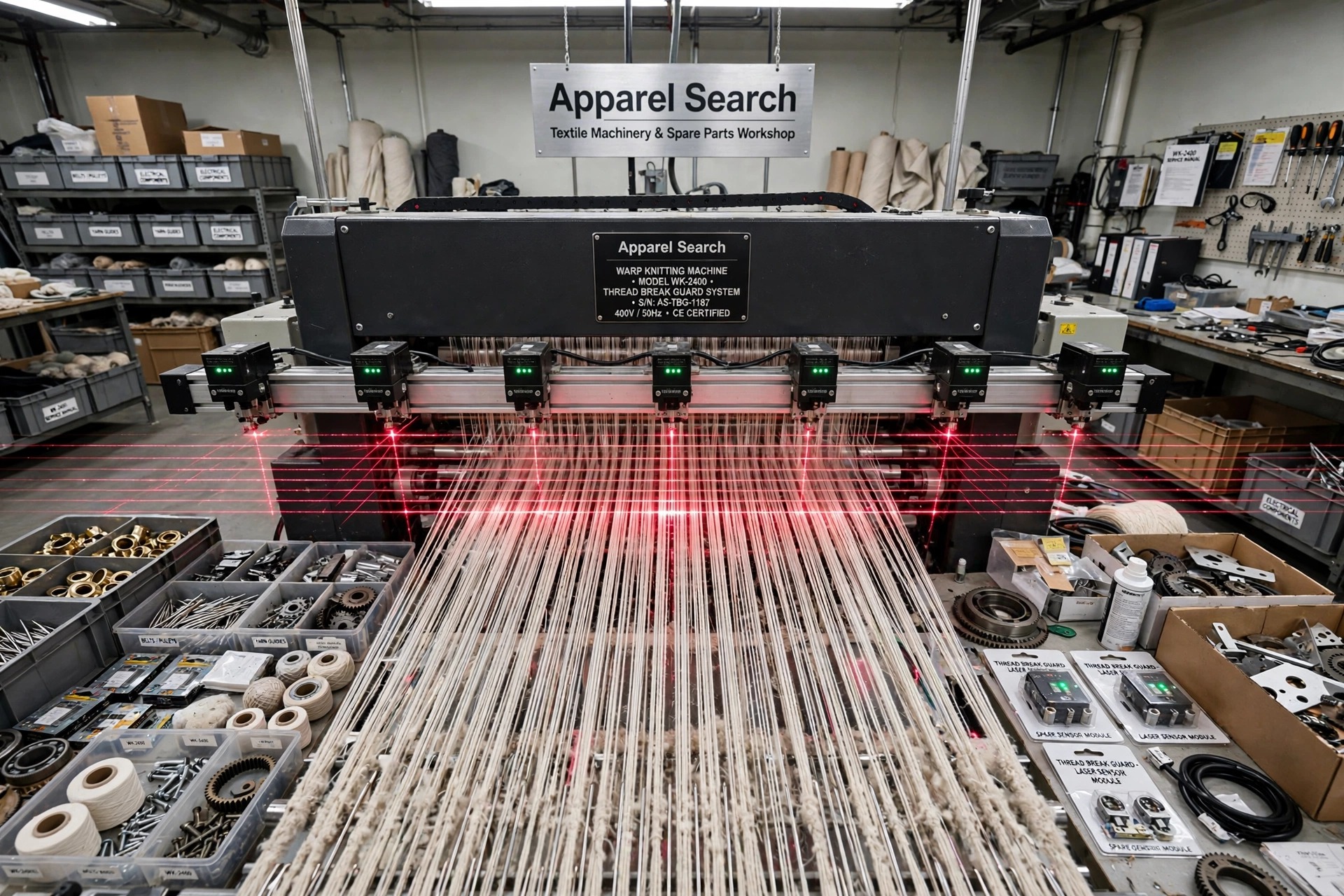
A thread break guard is the watchman of a warp knitting machine. Hundreds or thousands of yarn ends feed from the warp beams through the guides to the needles at full production speed, and when one end breaks, every course knitted afterwards carries the fault - a missing thread working its way through the fabric until a human eye happens to spot it. Thread break guards are systems for identifying thread breaks in the yarn on warp knitting machines and stopping the machine at once: guards may use laser light barriers, which shut the machine down reliably and rapidly so that losses are kept to a minimum.
Textile Machinery Directory
How Thread Break Guards Detect a Broken End
The guard watches the yarn sheet itself. In a laser light barrier system, the running threads pass through or alongside a monitored light field; an intact sheet presents its full pattern of threads, and a broken end changes that pattern the instant it fails - the loose end flies out of its path, the gap registers, and the guard signals the machine control to stop. Detection has to work at full machine speed and on fine yarns that the naked eye struggles to see against the moving sheet, which is why optical systems have become the standard answer on warp knitting machines: they respond to the break itself, not to a secondary effect the break eventually causes.
Speed of response is the whole economic point. A warp knitting machine produces fabric continuously, and every second between the break and the stop adds faulty fabric that must be cut out or downgrades the piece. A rapid, reliable shutdown keeps the loss to the courses around the break, lets the operator find the flagged position, piece the end up and restart - turning a potential piece-length defect into a short stop. Guards must also avoid false stops, since a guard that cries wolf gets switched off, and a switched-off guard protects nothing.
Thread Break Guards in the Warp Knitting Spares Kit
Guards are maintained as part of the machine's yarn-path equipment: optical faces kept clean of the fly and finish that warp knitting sheds, alignment checked after guide bar or beam work, and the stop circuit tested so a detected break provably stops the machine. Replacement units and parts are specified by machine make, model and the guard position across the working width. The German specialist below supplies thread break guards within its warp knitting parts trade - tricot and raschel machine parts, stitch bonding parts, guide units, jacks and sinkers - backed by a very large stock and worldwide logistics partners, so a guard failure can be answered with a delivered part immediately rather than a machine left unprotected.
Guard coverage follows the yarn sheet: each monitored zone protects the ends passing through it, so a machine's guard arrangement forms part of its specification whenever beams, guide arrangements or working width change. Operators are part of the system, too - a break stop only saves fabric if the flagged end is found and correctly pieced up before restart, and a guard whose stops are trusted earns exactly that response, while one known for false alarms gets its stops overridden and its breaks knitted through into the piece.
Companies Supplying Thread Break Guard
Betex
Betex (Germany) supplies thread break guards as part of its warp knitting spare parts range - the guard systems that identify thread breaks in the yarn on warp knitting machines, including laser light barrier guards that shut the machine down rapidly to keep losses to a minimum. Betex supplies jacks, sinkers and spare parts for the textile industry from a very large stock, delivering immediately through worldwide logistics partners, with technical help available by telephone.
Supplies: Thread Break Guard · Guide Units · Tricot Machine Parts · Raschel Machinery Parts · Jacks · Sinkers
Textile & Clothing Machine Spare Parts
- Beam Heads
- Beams for Weaving Machinery
- Bulb Socket
- Cams
- Ceramic Friction Disks
- Ceramic Thread Guides
- Circular Knitting Machine Parts
- Creel Stands
- Cutters for Looms
- Cylinders
- Dials
- Electric Shears
- Feed Wheel
- Feeders
- Fineblanked Stampled Parts
- Flexible Card Clothing
- Grinder
- Grippers
- Guide Unit s - textile machinery
- Hosiery Camboxes
- Knitting Machine Spare Parts
- Loop Forming Elements
- Loose Needles
- Lycra Feeders
- Metallic Card Clothing
- Metallic Cleaning Tool
- Mounting Pads
- Papermakers for Felt Weaving
- Patterning
- Positive Feeders
- Poy Winder Machines
- Pulleys for textile machines
- Rapier Tapes
- Rapier Wheel
- Raschel Machinery Parts
- Rotary Hooks
- Safe Needles
- Sample
- Sensors for Looms
- Sewing Machinery Spare Parts
- Sinkers Rings
- Slide Electronic yarn Control Devices
- Springs for Textile Machines
- Stamped Bent Parts
- Stitch Bonding Machine Parts
- Striper
- Swatch Cutters
- Tension Meters
- Thread Guide Units
- Tricot Machinery Spare Parts
- Warp Knitting Spare Parts
- Warper Beams
- Weaving Machinery Spare Parts
- Weft Feeders
- Weight Scales
- yarn Carriers
- yarn Retainer
- yarn Sensor
- yarn Splicers
- yarn Suction Cups for Winders
- yarn Supervisor by Drop
- yarn Supervisor by Tearing
- yarn Supervisor by Tearing & Drop
Knitting & Weaving Machinery
- Circular Knitting Machinery
- Crotchet Knitting Machinery
- Double Jersey Knitting Machinery
- Fleece fabric Knitting Machines
- Hosiery / Socks Machinery
- Knitting Lubricator
- Knitting Software
- Mesh fabric Knitting Machines
- Pile fabric Knitting Machines
- Plush fabric Knitting Machines
- Rib fabric Knitting Machinery
- Ring Temples
- Seamless Knitting Machinery
- Sewing Machinery Attachments
- Single Jersey Knitting Machinery
- Terry fabric Knitting Machinery
- Terry Machinery
- Velour fabric Knitting Machinery
- Weaving Machinery Manufacturers
Related Guides and Resources
Common Questions
How does a laser light barrier thread break guard work?
The running yarn sheet is monitored by a laser light barrier. When a thread breaks, the loose end leaves its path and the change in the yarn pattern registers at once, signalling the machine to shut down reliably and rapidly.
Why does shutdown speed matter so much on a warp knitting machine?
The machine knits continuously at speed, so every second of delay adds faulty fabric with a missing thread in it. A rapid stop keeps the loss to a few courses around the break instead of a downgraded or cut-out piece.
What maintenance does a thread break guard need?
Clean optical faces, correct alignment after any yarn-path work, and regular testing that a simulated break actually stops the machine. A guard fouled by fly or knocked out of alignment can miss breaks or give false stops.