Stamped Bent Parts for Textile Machinery
Textile and clothing machine spare parts — what the part does, how to specify it, and the companies that supply it.
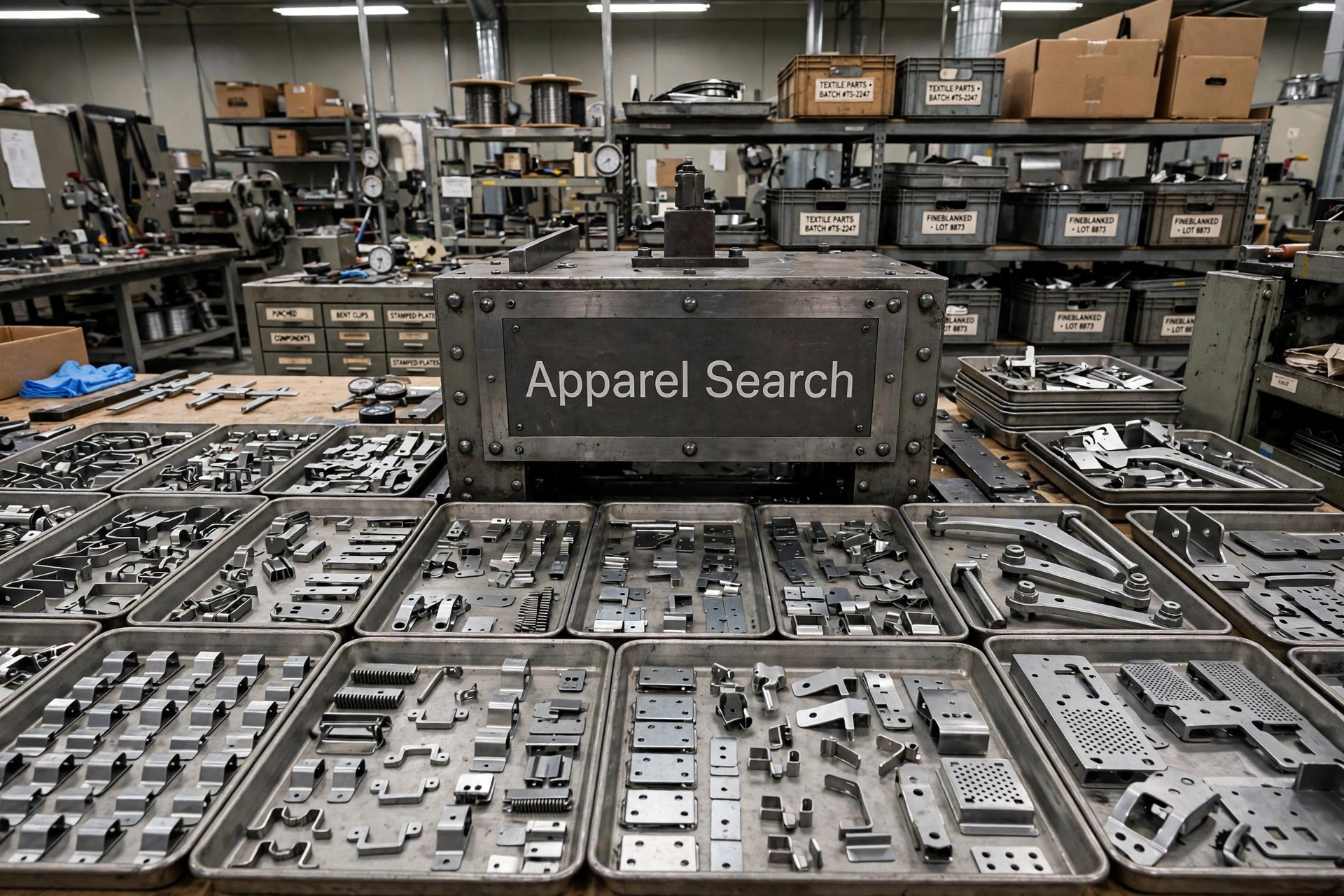
A large share of a textile machine's small metal hardware starts as flat strip and becomes a finished part in a press: stamped, fineblanked and then bent to shape. Brackets, guides, levers, clips, covers, yarn-path components and the flat elements inside knitting assemblies are made this way because pressing is fast, repeatable and accurate in volume - every part from a tool is the same as the last, which is exactly what spare parts need to be. Stamped bent parts are therefore a distinct supply trade for textile machinery, served by presswork specialists rather than general machinists.
Textile Machinery Directory
Stamping, Fineblanking and Bending
Conventional stamping shears a blank from strip or sheet and forms it in one or more press operations; edges carry the characteristic sheared finish and tolerances suit brackets, covers and general hardware. Fineblanking is the precision development of the process: the blank is held under high counter-pressure as it is cut, producing a smooth, square, full-thickness cut edge and flat parts to tolerances that normally need machining - the method used for functional parts such as gear-like elements, levers and knitting machine components whose edges are working surfaces. Bending then takes the flat blank to its final three-dimensional form, with bend radii and springback controlled by the tooling so angles repeat part after part.
Combining the operations in progressive tooling lets a specialist produce a finished bent part - blanked, pierced, formed - in a single press line, which keeps cost down on the long runs textile machine builders and spares programmes order. Material choice follows duty: carbon and alloy steels for strength, stainless where corrosion from mill humidity and finishes is a risk, with heat treatment and surface finishing added where the part works against yarn or moving elements.
Specifying Stamped Bent Spares
Pressed parts are specified by drawing or by the machine builder's part number, never by rough measurement of a worn sample: bend angles relax, edges wear and holes elongate in service, so the sample lies. Where the original tooling source is the presswork specialist itself, repeat supply is straightforward, and builders hold such parts in their spares catalogues as standard items. The group listed below numbers fineblanked and stamped parts among its core products across 34 companies worldwide with approximately 4,000 employees, producing stamped bent parts alongside springs and knitting elements for the textile machinery industry - a single source where a machine's pressed, bent and spring components come from one coordinated supplier.
In the mill, pressed parts fail in predictable ways - a bracket bent by a knock, a guide edge worn bright, a clip fatigued at its bend - and because the parts themselves are inexpensive next to machine downtime, they belong on the planned spares shelf rather than on emergency order. Keeping one of each pressed part fitted to each machine type, labelled by machine and position, turns a presswork failure into a quick bench swap; the removed part then serves as the identification sample for reordering, with its drawing or part number, never its worn dimensions, as the specification.
Companies Supplying Stamped Bent Parts
Kern-Liebers
Kern-Liebers (Germany) produces stamped bent parts within the KERN-LIEBERS Group, where 34 companies worldwide with approximately 4,000 employees make springs, fineblanked and stamped parts and knitting elements. For textile machinery, its presswork capability - fineblanking for precision flat parts with smooth full-thickness edges, stamping and bending to finished form - covers the brackets, levers, guides and formed components machine builders specify and the spares trade reorders to drawing.
Supplies: Stamped Bent Parts · Fineblanked Stamped Parts · Springs · Knitting Elements
Textile & Clothing Machine Spare Parts
- Beam Heads
- Beams for Weaving Machinery
- Bulb Socket
- Cams
- Ceramic Friction Disks
- Ceramic Thread Guides
- Circular Knitting Machine Parts
- Creel Stands
- Cutters for Looms
- Cylinders
- Dials
- Electric Shears
- Feed Wheel
- Feeders
- Fineblanked Stampled Parts
- Flexible Card Clothing
- Grinder
- Grippers
- Guide Unit s - textile machinery
- Hosiery Camboxes
- Knitting Machine Spare Parts
- Loop Forming Elements
- Loose Needles
- Lycra Feeders
- Metallic Card Clothing
- Metallic Cleaning Tool
- Mounting Pads
- Papermakers for Felt Weaving
- Patterning
- Positive Feeders
- Poy Winder Machines
- Pulleys for textile machines
- Rapier Tapes
- Rapier Wheel
- Raschel Machinery Parts
- Rotary Hooks
- Safe Needles
- Sample
- Sensors for Looms
- Sewing Machinery Spare Parts
- Sinkers Rings
- Slide Electronic yarn Control Devices
- Springs for Textile Machines
- Stitch Bonding Machine Parts
- Striper
- Swatch Cutters
- Tension Meters
- Thread Break Guard
- Thread Guide Units
- Tricot Machinery Spare Parts
- Warp Knitting Spare Parts
- Warper Beams
- Weaving Machinery Spare Parts
- Weft Feeders
- Weight Scales
- yarn Carriers
- yarn Retainer
- yarn Sensor
- yarn Splicers
- yarn Suction Cups for Winders
- yarn Supervisor by Drop
- yarn Supervisor by Tearing
- yarn Supervisor by Tearing & Drop
Knitting & Weaving Machinery
- Circular Knitting Machinery
- Crotchet Knitting Machinery
- Double Jersey Knitting Machinery
- Fleece fabric Knitting Machines
- Hosiery / Socks Machinery
- Knitting Lubricator
- Knitting Software
- Mesh fabric Knitting Machines
- Pile fabric Knitting Machines
- Plush fabric Knitting Machines
- Rib fabric Knitting Machinery
- Ring Temples
- Seamless Knitting Machinery
- Sewing Machinery Attachments
- Single Jersey Knitting Machinery
- Terry fabric Knitting Machinery
- Terry Machinery
- Velour fabric Knitting Machinery
- Weaving Machinery Manufacturers
Common Questions
What is the difference between stamping and fineblanking?
Stamping shears parts from strip with a conventional sheared edge, suited to general hardware. Fineblanking holds the blank under counter-pressure as it cuts, giving a smooth, square edge through the full thickness and machined-part accuracy, used for functional precision parts.
Why are so many textile machine parts stamped and bent?
Pressing is fast and exactly repeatable in volume, so every spare matches the original. Flat strip becomes a finished bracket, guide or lever in a few press operations, at a cost machining from solid cannot match for small hardware.
How should a stamped bent spare be ordered?
By the machine builder's part number or a drawing. Measuring a worn part misleads, because bends relax and edges and holes wear in service, so a copy made from the sample reproduces the wear as well.