Rapier Tapes for Textile Machinery
Textile and clothing machine spare parts — what the part does, how to specify it, and the companies that supply it.
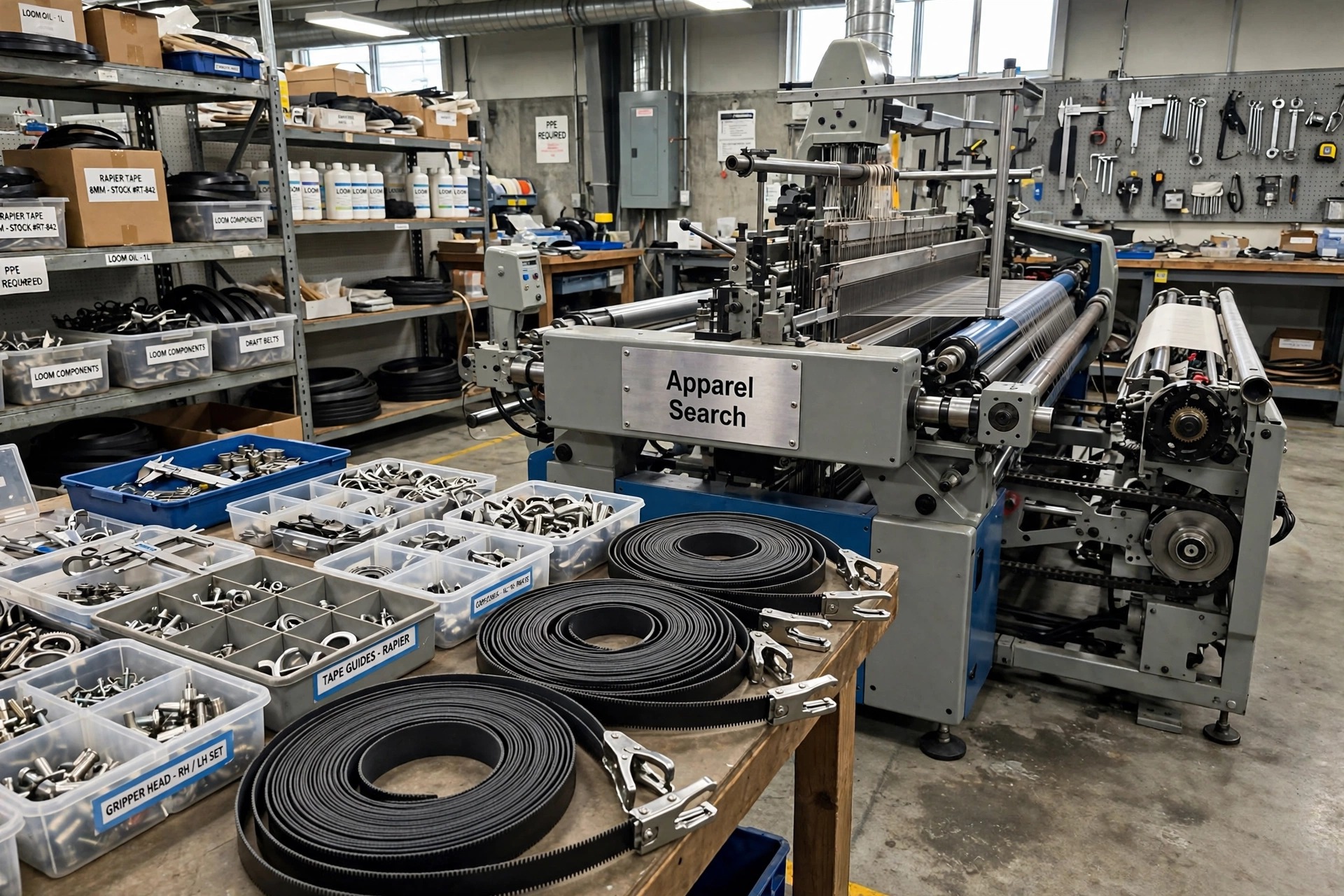
On a flexible rapier loom, the weft is carried across the warp shed by a gripper head mounted on the end of a rapier tape — a thin, strong, flexible band that unwinds from its drive wheel, slides through guides across the loom width, hands the weft to the receiving rapier at the centre, and retracts, once for every pick. The tape flexes around its wheel and bends through the raceway thousands of times an hour, in an atmosphere of lint and size dust, so rapier tapes are consumable precision parts whose condition directly sets how reliably a rapier loom inserts weft.
Textile Machinery Directory
How Rapier Tapes Work
Each side of the loom has its own tape and rapier head. The drive wheel — driven in strict timing with the loom's beat-up and shedding — pays the tape out so the giver rapier carries the weft tip to the centre of the shed, where the taker rapier grips it and the two tapes reverse, drawing the pick through as they retract. Tapes are made as laminated composites, typically with a strong core and low-friction, wear-resistant surfaces and perforations or edge forms that engage the drive wheel and guides. The tape must be stiff enough in its length to push the rapier without buckling, yet flexible enough to wrap its wheel, and light enough not to limit loom speed.
The guides that support the tape through the shed are part of the system: worn or damaged guides abrade the tape edges, and a tape with frayed edges or elongated drive perforations no longer times exactly, which shows first as occasional missed transfers at the centre.
Tape Life, Replacement and Timing
Tapes are replaced in pairs or as a matched set with their rapier heads checked at the same stop, because the giver and taker must meet precisely pick after pick. Symptoms of tape wear are fraying or cracking at the flex point, worn or torn drive holes, edge damage from guides, missed weft transfers and weft breaks at handover. When fitting new tapes, guides are inspected and cleaned, tape tension and stroke are set to the loom maker's figures, and the transfer timing is checked at hand-turn speed before the loom runs. Tapes are ordered strictly by loom make, model and weaving width — length, width, thickness and perforation pattern are all machine-specific. The Indian supplier below provides replacement parts for weaving machines, with rapier tapes among the weaving spares in its range.
Housekeeping extends tape life more than any other habit. Lint and size dust packed into the tape guides raise friction and abrade the tape edges on every pick, so guides and the raceway are blown out and wiped on the mill's routine, and spilt size is cleaned before it hardens in the tape path. Store spare tapes flat or loosely coiled as the maker packs them, away from oil and sharp edges; a kinked tape never runs true again, however new it is. Record tape changes by loom so a loom eating tapes faster than its sisters can be investigated for guide or wheel wear.
Companies Supplying Rapier Tapes
Falcon Engineers
Falcon Engineers (India) provides replacement parts for weaving machines, with rapier tapes among the loom spares covered by its range. Falcon manufactures and supplies spares for looms and autoconer machines and has developed many parts for textile machines, offering high-quality, accurate products to the textile industry at affordable prices. It also supplies imported parts from Germany, Italy and other countries alongside its own manufacture.
Supplies: Rapier Tapes · Weaving Machine Parts · Loom Spares · Rapier Wheels · Grippers
Textile & Clothing Machine Spare Parts
- Beam Heads
- Beams for Weaving Machinery
- Bulb Socket
- Cams
- Ceramic Friction Disks
- Ceramic Thread Guides
- Circular Knitting Machine Parts
- Creel Stands
- Cutters for Looms
- Cylinders
- Dials
- Electric Shears
- Feed Wheel
- Feeders
- Fineblanked Stampled Parts
- Flexible Card Clothing
- Grinder
- Grippers
- Guide Unit s - textile machinery
- Hosiery Camboxes
- Knitting Machine Spare Parts
- Loop Forming Elements
- Loose Needles
- Lycra Feeders
- Metallic Card Clothing
- Metallic Cleaning Tool
- Mounting Pads
- Papermakers for Felt Weaving
- Patterning
- Positive Feeders
- Poy Winder Machines
- Pulleys for textile machines
- Rapier Wheel
- Raschel Machinery Parts
- Rotary Hooks
- Safe Needles
- Sample
- Sensors for Looms
- Sewing Machinery Spare Parts
- Sinkers Rings
- Slide Electronic yarn Control Devices
- Springs for Textile Machines
- Stamped Bent Parts
- Stitch Bonding Machine Parts
- Striper
- Swatch Cutters
- Tension Meters
- Thread Break Guard
- Thread Guide Units
- Tricot Machinery Spare Parts
- Warp Knitting Spare Parts
- Warper Beams
- Weaving Machinery Spare Parts
- Weft Feeders
- Weight Scales
- yarn Carriers
- yarn Retainer
- yarn Sensor
- yarn Splicers
- yarn Suction Cups for Winders
- yarn Supervisor by Drop
- yarn Supervisor by Tearing
- yarn Supervisor by Tearing & Drop
Knitting & Weaving Machinery
- Circular Knitting Machinery
- Crotchet Knitting Machinery
- Double Jersey Knitting Machinery
- Fleece fabric Knitting Machines
- Hosiery / Socks Machinery
- Knitting Lubricator
- Knitting Software
- Mesh fabric Knitting Machines
- Pile fabric Knitting Machines
- Plush fabric Knitting Machines
- Rib fabric Knitting Machinery
- Ring Temples
- Seamless Knitting Machinery
- Sewing Machinery Attachments
- Single Jersey Knitting Machinery
- Terry fabric Knitting Machinery
- Terry Machinery
- Velour fabric Knitting Machinery
- Weaving Machinery Manufacturers
Related Guides and Resources
Common Questions
How long does a rapier tape last?
Life depends on loom speed, width, yarn and guide condition, and tapes are changed on condition rather than a fixed interval. Fraying at the flex point, elongated drive perforations, edge wear and rising missed transfers are the signals that a set is due.
Should rapier tapes be changed singly or in pairs?
In pairs, as a matched set. The giver and taker tapes must meet and transfer the weft at exactly the centre, and a new tape beside a stretched or worn one makes that timing harder to hold.
Can a rapier tape fit more than one loom model?
No. Tape length follows weaving width, and width, thickness, perforation pattern and rapier head fitting all follow the loom maker's design. Order by loom make, model and width, and check the rapier heads and guides at the same stop.