Yarn Supervisor by Drop and Tearing for Textile Machinery
Textile and clothing machine spare parts — what the part does, how to specify it, and the companies that supply it.
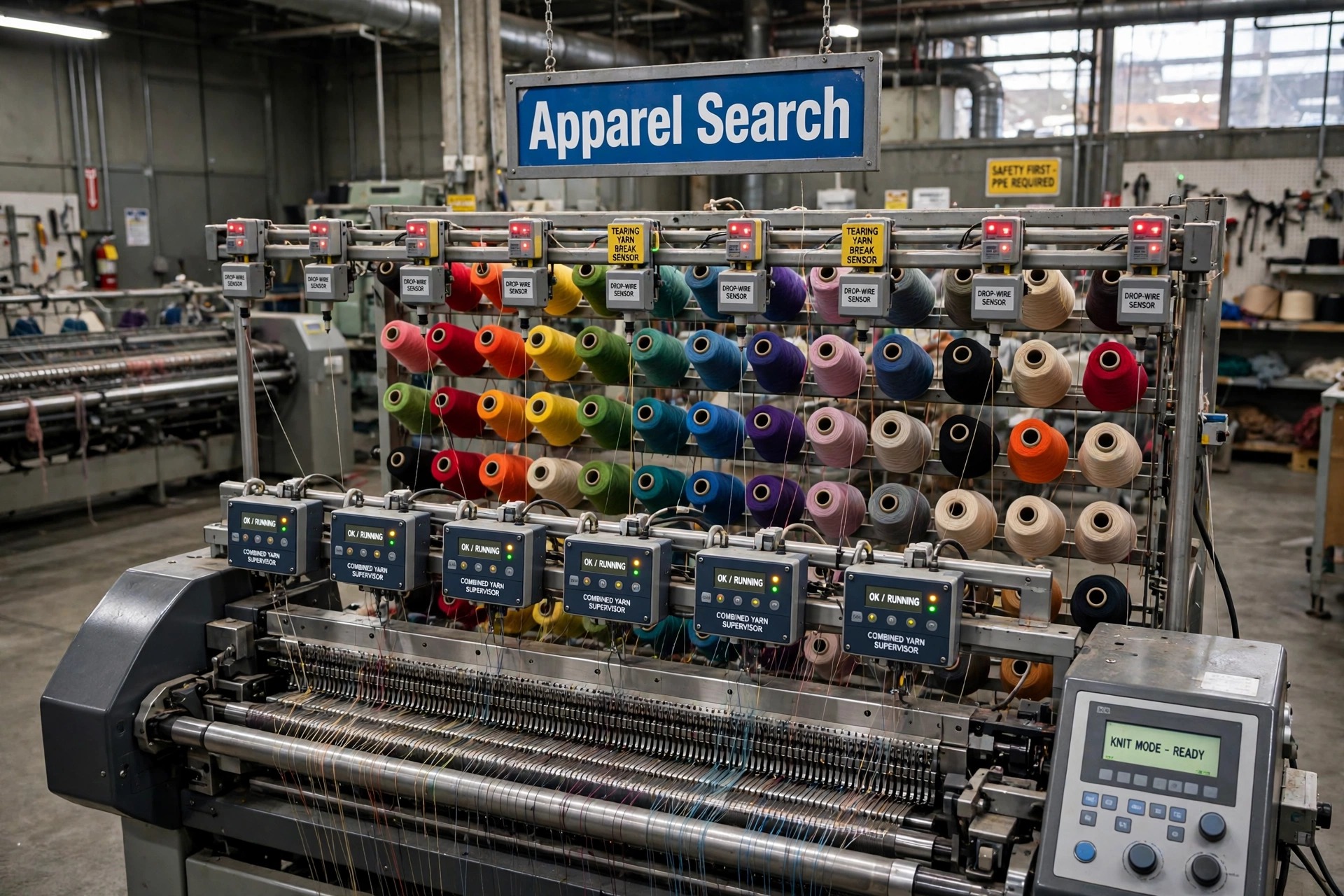
Some yarn faults announce themselves as a break; others arrive quietly as a slack, ballooning or run-out end that is still physically present but no longer feeding. A combined yarn supervisor — by drop and tearing — exists for that awkward middle ground. It carries both sensing principles in one head on the yarn path of a circular or flat knitting machine: a drop element that falls when the yarn supporting it disappears, and a tearing response that reacts when a held end pulls away under tension. Either fault trips the same stop motion, so the machine halts for the full family of yarn failures rather than only the clean breaks a single-principle device is best at.
Textile Machinery Directory
Two Sensing Principles in One Stop Motion
The drop side of the unit works by gravity and presence. The yarn, on its way to the feeder, supports or deflects a light drop element; while yarn is there, the element stays up and the circuit stays closed. Lose the yarn — break, run-out package, end slipped off its path — and the element drops, tripping the stop. The tearing side works by tension and absence: the yarn is held through the sensing point, and a break that whips the end away registers even in cases where a slack remnant might fool a pure drop device into thinking yarn is still present. Together they cover the two ways an end can fail — gone slack, or gone altogether — which is precisely why mills fit combined units on machines running varied yarns, fancy effects or multiple feeders where fault behaviour is hard to predict.
Combined heads ask a little more of the setter than single-principle units. Both responses must be proved at fitting — a deliberate break and a deliberate run-out should each stop the machine — and the yarn path through the head must be threaded exactly as the maker intends, because a mis-threaded combined unit can quietly become a single-principle one, watching for one fault while the other walks past it.
When to Choose Combined Supervision — and How It Wears
Choose the combined unit where the cost of a missed fault is high and the fault mix is mixed: striped and jacquard work with many ends, machines that change yarn types often, and any knitting where a slack end can wrap, tangle neighbouring feeders or feed double before anyone notices. On simple, stable single-yarn work a single-principle supervisor is cheaper and easier to keep honest; the combined head earns its place by catching the faults the simple head argues about. Its wear map is the union of both parents: drop pivots and wires that bend, groove or stiffen, tearing guides and springs that fatigue, and a doubled need for cleaning, since fly can jam either mechanism independently.
RMB Massardi of Italy, listed below, lists yarn supervisors by tearing and drop in its knitting machine parts range, alongside the separate by-drop and by-tearing units, yarn sensors, retainers and slide electronic yarn control devices — so a mill can standardise on one maker's family across machines with different supervision needs. Specify machine make and model, feeder position, yarn count range and the stop-circuit contact arrangement when ordering, and test both trips after every head change. Keep a complete spare combined head per machine type: with two mechanisms inside, field repair is a bench job, while swapping the head is a minute's work.
Companies Supplying Yarn Supervisor by Drop and Tearing
RMB Massardi
The combined tearing-and-drop supervisor comes from RMB Massardi of Italy, a maker of parts for circular and flat knitting machines. Massardi groups the three supervisor principles in one family — by drop, by tearing, and the combined tearing and drop unit listed here — and its wider range covers safe needles, yarn sensors and retainers, slide electronic yarn control devices, bulb sockets and electric shears.
Supplies: Yarn Supervisors by Drop & Tearing · Yarn Sensors · Safe Needles · Yarn Control Devices · Knitting Machine Parts
Textile & Clothing Machine Spare Parts
- Beam Heads
- Beams for Weaving Machinery
- Bulb Socket
- Cams
- Ceramic Friction Disks
- Ceramic Thread Guides
- Circular Knitting Machine Parts
- Creel Stands
- Cutters for Looms
- Cylinders
- Dials
- Electric Shears
- Feed Wheel
- Feeders
- Fineblanked Stampled Parts
- Flexible Card Clothing
- Grinder
- Grippers
- Guide Unit s - textile machinery
- Hosiery Camboxes
- Knitting Machine Spare Parts
- Loop Forming Elements
- Loose Needles
- Lycra Feeders
- Metallic Card Clothing
- Metallic Cleaning Tool
- Mounting Pads
- Papermakers for Felt Weaving
- Patterning
- Positive Feeders
- Poy Winder Machines
- Pulleys for textile machines
- Rapier Tapes
- Rapier Wheel
- Raschel Machinery Parts
- Rotary Hooks
- Safe Needles
- Sample
- Sensors for Looms
- Sewing Machinery Spare Parts
- Sinkers Rings
- Springs for Textile Machines
- Stamped Bent Parts
- Stitch Bonding Machine Parts
- Striper
- Swatch Cutters
- Tension Meters
- Thread Break Guard
- Thread Guide Units
- Tricot Machinery Spare Parts
- Warp Knitting Spare Parts
- Warper Beams
- Weaving Machinery Spare Parts
- Weft Feeders
- Weight Scales
- yarn Carriers
- yarn Control Devices (Slide Electronic)
- yarn Retainer
- yarn Sensor
- yarn Splicers
- yarn Suction Cups for Winders
- yarn Supervisor by Drop
- yarn Supervisor by Tearing
Knitting & Weaving Machinery
- Circular Knitting Machinery
- Crotchet Knitting Machinery
- Double Jersey Knitting Machinery
- Fleece fabric Knitting Machines
- Hosiery / Socks Machinery
- Knitting Lubricator
- Knitting Software
- Mesh fabric Knitting Machines
- Pile fabric Knitting Machines
- Plush fabric Knitting Machines
- Rib fabric Knitting Machinery
- Ring Temples
- Seamless Knitting Machinery
- Sewing Machinery Attachments
- Single Jersey Knitting Machinery
- Terry fabric Knitting Machinery
- Terry Machinery
- Velour fabric Knitting Machinery
- Weaving Machines
Common Questions
Why combine drop and tearing supervision in one device?
Because yarn ends fail in two different ways. A drop element catches an end that disappears or goes slack; a tearing response catches a break that pulls away under tension, even if a remnant still hangs in the path. One combined head trips the stop for both fault families.
Is a combined supervisor always better than a single type?
Not always. On stable, single-yarn work a single-principle head is simpler, cheaper and easier to keep adjusted. Combined units earn their cost on multi-feeder, multi-yarn or high-value work where missed slack-end faults tangle feeders or ruin panels.
How should a combined supervisor be tested after fitting?
Prove both trips: simulate a break so the tearing response stops the machine, then simulate a run-out so the drop element falls and stops it. A head that only trips one way has usually been mis-threaded — correct the yarn path before returning the machine to production.