Springs for Textile Machinery
Textile and clothing machine spare parts — what the part does, how to specify it, and the companies that supply it.
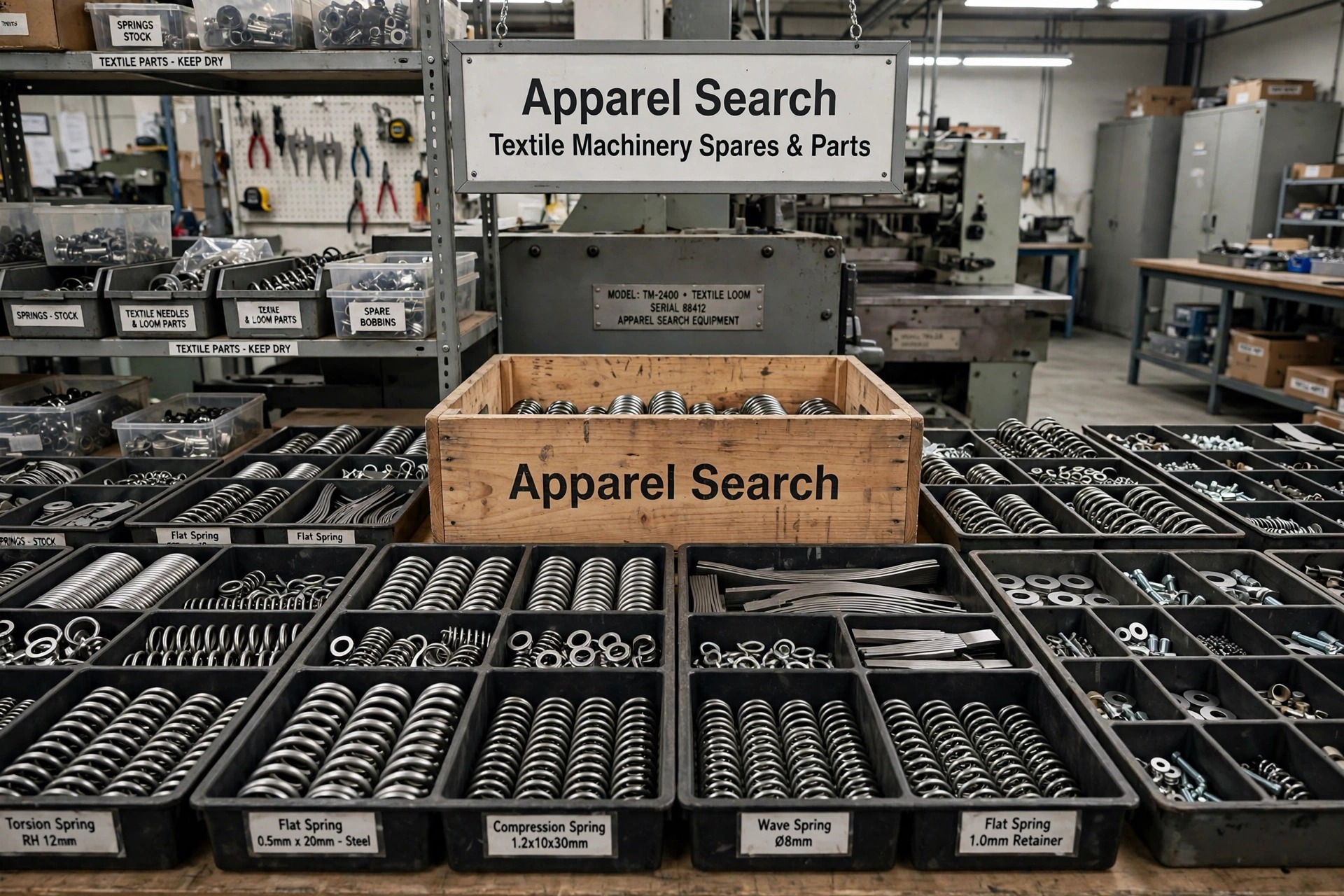
Textile machines run on springs. Small compression, tension and torsion springs return needles and sinkers after their cams move them, load yarn tension devices, hold feeders and guides against their settings, operate stop motions, and keep countless levers, latches and valves working in time. A single knitting or weaving machine carries springs by the dozen, each one a fatigue part with a finite life: when a spring weakens or breaks, the motion it serves drifts out of time, and the fault it causes - a mis-fed yarn, a lazy sinker, a tension device that will not hold its setting - is often blamed on everything except the spring.
Textile Machinery Directory
Spring Types and Jobs on Textile Machines
Compression springs push: they return knitting elements, load pressure fingers and tension discs, and absorb the repeated impacts of machine motion millions of cycles a shift. Tension (extension) springs pull: they return levers and linkages, hold yarn guides in position and keep feed mechanisms tracking. Torsion springs work in twist, powering small rotary returns and latches. All three are wound from spring wire chosen for the load, the space available and the environment - textile mills add oil, lint and humidity to the spring's working life, so material and finish are part of the specification, not an afterthought.
Because springs are designed into the machine by its builder, replacement is by the machine maker's part or an exact equivalent: wire diameter, coil diameter, free length, number of coils and end form together set the rate, and a spring that merely fits the space will rarely give the designed force. Spring specialists supply machine builders and the spares trade to drawing, including the small precision springs used inside knitting elements and yarn-handling assemblies.
Fatigue, Replacement and Supply
Springs fail by fatigue and by set: a spring that has taken a permanent shortening has lost force even if it has not broken, which is why tension and return faults that survive adjustment are traced to springs early. Good practice is to replace springs in the sets the machine builder specifies, keep the common sizes for each machine type on the spares shelf, and never stretch or re-form a weakened spring back into service. The group listed below is one of the textile industry's spring sources at manufacturing scale: 34 companies worldwide producing springs, fineblanked and stamped parts and knitting elements, with approximately 4,000 employees across the group.
For the spares buyer, the practical point is range under one roof: the same group that winds a machine's small return and tension springs also produces the knitting elements those springs work with, so a spring can be specified in the context of the assembly it serves rather than as an isolated coil of wire. Ordering is by the machine builder's part number or a full spring specification - wire, coils, free length, rate and end form - and the springs of one mechanism are best renewed together, since one new spring working against tired partners simply moves the weakness along.
Companies Supplying Springs
Kern-Liebers
Kern-Liebers (Germany): within the KERN-LIEBERS Group, 34 companies worldwide produce springs, fineblanked and stamped parts and knitting elements, with approximately 4,000 employees worldwide. Its spring production serves machine builders and spare-parts users who need springs made to drawing - wire form, rate and finish matched to the textile machine application, from knitting element springs to springs for yarn handling and tension assemblies.
Supplies: Springs · Fineblanked Stamped Parts · Stamped Bent Parts · Knitting Elements
Textile & Clothing Machine Spare Parts
- Beam Heads
- Beams for Weaving Machinery
- Bulb Socket
- Cams
- Ceramic Friction Disks
- Ceramic Thread Guides
- Circular Knitting Machine Parts
- Creel Stands
- Cutters for Looms
- Cylinders
- Dials
- Electric Shears
- Feed Wheel
- Feeders
- Fineblanked Stampled Parts
- Flexible Card Clothing
- Grinder
- Grippers
- Guide Unit s - textile machinery
- Hosiery Camboxes
- Knitting Machine Spare Parts
- Loop Forming Elements
- Loose Needles
- Lycra Feeders
- Metallic Card Clothing
- Metallic Cleaning Tool
- Mounting Pads
- Papermakers for Felt Weaving
- Patterning
- Positive Feeders
- Poy Winder Machines
- Pulleys for textile machines
- Rapier Tapes
- Rapier Wheel
- Raschel Machinery Parts
- Rotary Hooks
- Safe Needles
- Sample
- Sensors for Looms
- Sewing Machinery Spare Parts
- Sinkers Rings
- Slide Electronic yarn Control Devices
- Stamped Bent Parts
- Stitch Bonding Machine Parts
- Striper
- Swatch Cutters
- Tension Meters
- Thread Break Guard
- Thread Guide Units
- Tricot Machinery Spare Parts
- Warp Knitting Spare Parts
- Warper Beams
- Weaving Machinery Spare Parts
- Weft Feeders
- Weight Scales
- yarn Carriers
- yarn Retainer
- yarn Sensor
- yarn Splicers
- yarn Suction Cups for Winders
- yarn Supervisor by Drop
- yarn Supervisor by Tearing
- yarn Supervisor by Tearing & Drop
Knitting & Weaving Machinery
- Circular Knitting Machinery
- Crotchet Knitting Machinery
- Double Jersey Knitting Machinery
- Fleece fabric Knitting Machines
- Hosiery / Socks Machinery
- Knitting Lubricator
- Knitting Software
- Mesh fabric Knitting Machines
- Pile fabric Knitting Machines
- Plush fabric Knitting Machines
- Rib fabric Knitting Machinery
- Ring Temples
- Seamless Knitting Machinery
- Sewing Machinery Attachments
- Single Jersey Knitting Machinery
- Terry fabric Knitting Machinery
- Terry Machinery
- Velour fabric Knitting Machinery
- Weaving Machinery Manufacturers
Common Questions
Why do textile machine springs need regular replacement?
Springs are fatigue parts. Millions of cycles per shift gradually weaken the wire or let the spring take a set, so the force it delivers falls and the motion it serves drifts out of adjustment long before the spring actually breaks.
Can a spring be replaced with one that looks the same?
Only if the specification matches: wire diameter, coil diameter, free length, coil count and end form set the spring's rate and fitted force. A look-alike with a different rate will change how the mechanism behaves.
What faults point to a weak spring?
Motions that no longer return fully or repeatably - tension devices that will not hold a setting, feeders or guides that drift, stop motions that respond sluggishly - especially when the fault survives normal adjustment.