Sensors for Looms for Textile Machinery
Textile and clothing machine spare parts — what the part does, how to specify it, and the companies that supply it.
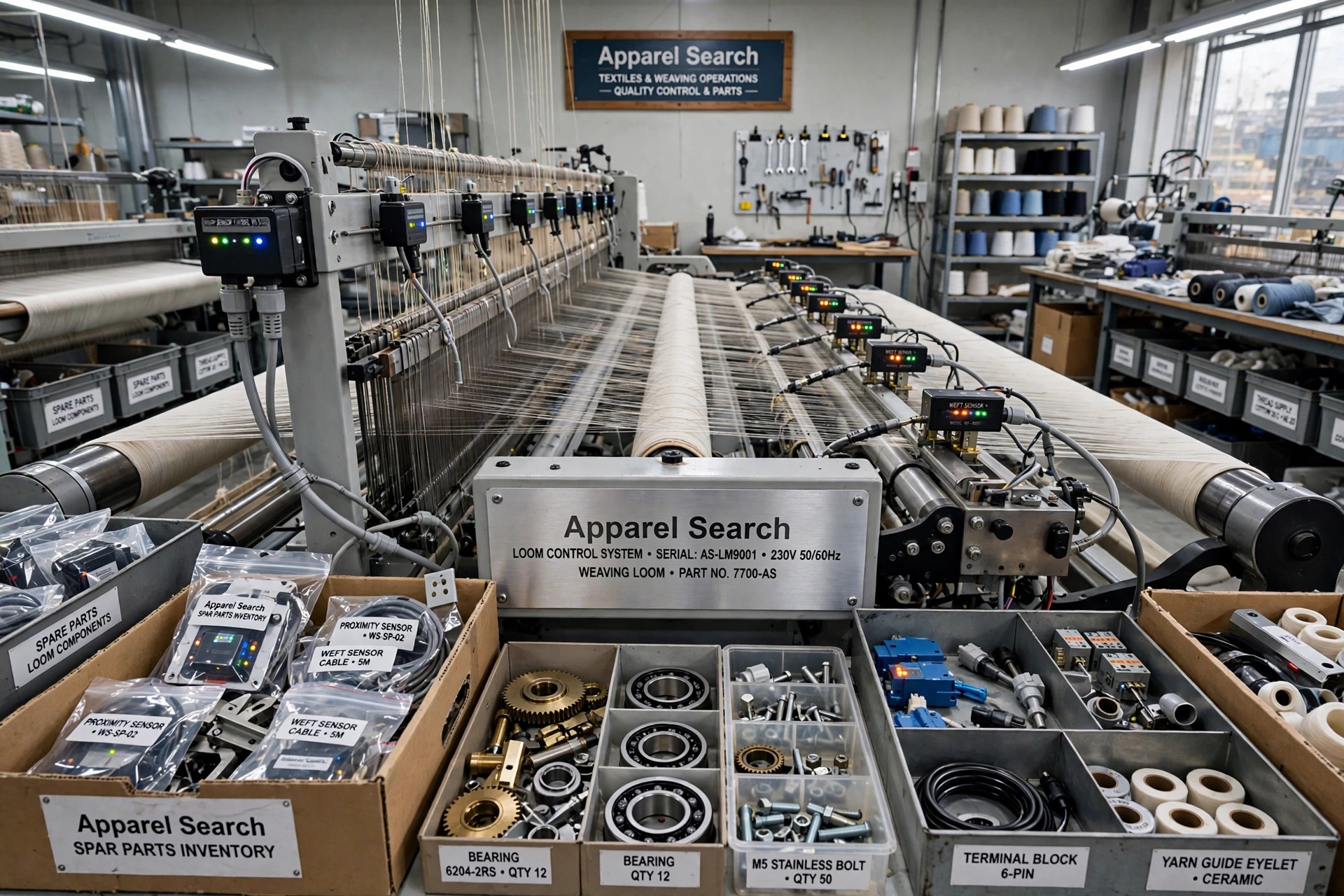
A modern loom watches itself through its sensors. Weft sensors confirm each pick has actually been inserted, warp stop motions detect a broken end, and yarn-presence and feeder sensors monitor the weft supply — and when any of them reports a fault, the loom stops in the same cycle, before the fault weaves into the cloth. Sensors are the loom's nervous system: small electronic parts working in lint, vibration and size dust, whose failure shows up either as faults in the fabric (a sensor that misses) or as infuriating false stops (a sensor that cries wolf). Both make loom sensors important, diagnosable spare parts.
Textile Machinery Directory
The Main Loom Sensor Jobs
Weft detection is the highest-speed job: on air-jet and rapier looms a sensor at the receiving side confirms the weft tip arrived, on every pick, and a missing signal stops the loom before the next pick beats up over a broken or absent weft. Warp stop motions work differently, with drop wires or electronic sensing across the warp sheet that react when a broken end lets a dropper fall. Feeder and package sensors watch the weft accumulator and supply, and additional sensors monitor cloth, temperature and drive states on electronically controlled looms. Each sensor type — optical, piezoelectric, capacitive or mechanical-electrical — suits its position and the yarn it watches.
Position and cleanliness decide whether a sensor tells the truth. Optical eyes blinded by lint, a weft sensor misaligned after a width change, or a connector worked loose by vibration are the everyday causes of sensor faults, ahead of actual electronic failure.
Diagnosing Sensor Faults and Replacing Sensors
Work from symptom to cause: repeated stops at the same point in the cycle point to the sensor watching that event — clean its sensing face, check alignment and the yarn path through it, swap its connector or cable where the design allows, and only then condemn the sensor itself. A sensor that has genuinely failed is replaced by loom make, model and sensor position, because sensing method, mounting, connector and signal type are all matched to the loom's control system; a physically similar sensor with different electronics will not serve. Keep known-good spares of the highest-duty sensors (weft sensors especially) so a loom can be proved by substitution in minutes. The Indian supplier below supplies sensors for all types of looms as part of its loom range.
Prevention is mostly cleaning and inspection. Sensing faces are wiped or blown clear on the same routine as the loom's other lint points, cables are checked where they flex or pass near moving parts, and sensor mountings are re-checked after any style or width change that moves the yarn path. Log repeat stops by loom and sensor position: a loom that false-stops once a shift is announcing a failing sensor, a fouling position or a yarn problem that will otherwise be found later as seconds in the cloth — the log turns guesswork into a planned change at the next stop.
Companies Supplying Sensors for Looms
Falcon Engineers
Falcon Engineers (India) supplies cards, nozzles and sensors for all types of looms, together with heald wire and jets for all types of looms. Falcon manufactures and supplies spares for looms and autoconer machines, has developed many parts for textile machines, and offers high-quality, accurate products to the textile industry at affordable prices, as well as imported parts from Germany, Italy and other countries.
Supplies: Sensors for Looms · Nozzles · Cards · Heald Wire · Jets · Loom Spares
Textile & Clothing Machine Spare Parts
- Beam Heads
- Beams for Weaving Machinery
- Bulb Socket
- Cams
- Ceramic Friction Disks
- Ceramic Thread Guides
- Circular Knitting Machine Parts
- Creel Stands
- Cutters for Looms
- Cylinders
- Dials
- Electric Shears
- Feed Wheel
- Feeders
- Fineblanked Stampled Parts
- Flexible Card Clothing
- Grinder
- Grippers
- Guide Unit s - textile machinery
- Hosiery Camboxes
- Knitting Machine Spare Parts
- Loop Forming Elements
- Loose Needles
- Lycra Feeders
- Metallic Card Clothing
- Metallic Cleaning Tool
- Mounting Pads
- Papermakers for Felt Weaving
- Patterning
- Positive Feeders
- Poy Winder Machines
- Pulleys for textile machines
- Rapier Tapes
- Rapier Wheel
- Raschel Machinery Parts
- Rotary Hooks
- Safe Needles
- Sample
- Sewing Machinery Spare Parts
- Sinkers Rings
- Slide Electronic yarn Control Devices
- Springs for Textile Machines
- Stamped Bent Parts
- Stitch Bonding Machine Parts
- Striper
- Swatch Cutters
- Tension Meters
- Thread Break Guard
- Thread Guide Units
- Tricot Machinery Spare Parts
- Warp Knitting Spare Parts
- Warper Beams
- Weaving Machinery Spare Parts
- Weft Feeders
- Weight Scales
- yarn Carriers
- yarn Retainer
- yarn Sensor
- yarn Splicers
- yarn Suction Cups for Winders
- yarn Supervisor by Drop
- yarn Supervisor by Tearing
- yarn Supervisor by Tearing & Drop
Knitting & Weaving Machinery
- Circular Knitting Machinery
- Crotchet Knitting Machinery
- Double Jersey Knitting Machinery
- Fleece fabric Knitting Machines
- Hosiery / Socks Machinery
- Knitting Lubricator
- Knitting Software
- Mesh fabric Knitting Machines
- Pile fabric Knitting Machines
- Plush fabric Knitting Machines
- Rib fabric Knitting Machinery
- Ring Temples
- Seamless Knitting Machinery
- Sewing Machinery Attachments
- Single Jersey Knitting Machinery
- Terry fabric Knitting Machinery
- Terry Machinery
- Velour fabric Knitting Machinery
- Weaving Machinery Manufacturers
Related Guides and Resources
Common Questions
Why does my loom keep stopping with no visible fault?
False stops usually come from the sensor, not the yarn: a lint-blinded optical face, a misaligned weft sensor, or a loose connector. Clean the sensing face, check alignment against the yarn path, and prove the sensor by substitution before changing settings.
What does a weft sensor do?
It confirms that each inserted pick actually arrived at the receiving side of the loom. If the signal is missing — a broken or short pick — the control stops the loom in that cycle so the fault does not weave into the fabric.
Can any sensor of the same size replace a failed loom sensor?
No. Sensing method, mounting, connector and signal type are matched to the loom model and the sensor's position in its control system. Replace by loom make, model and position, and keep a known-good spare of the weft sensor for fast diagnosis.