Sewing Machine Rotary Hooks for Textile Machinery
Textile and clothing machine spare parts — what the part does, how to specify it, and the companies that supply it.
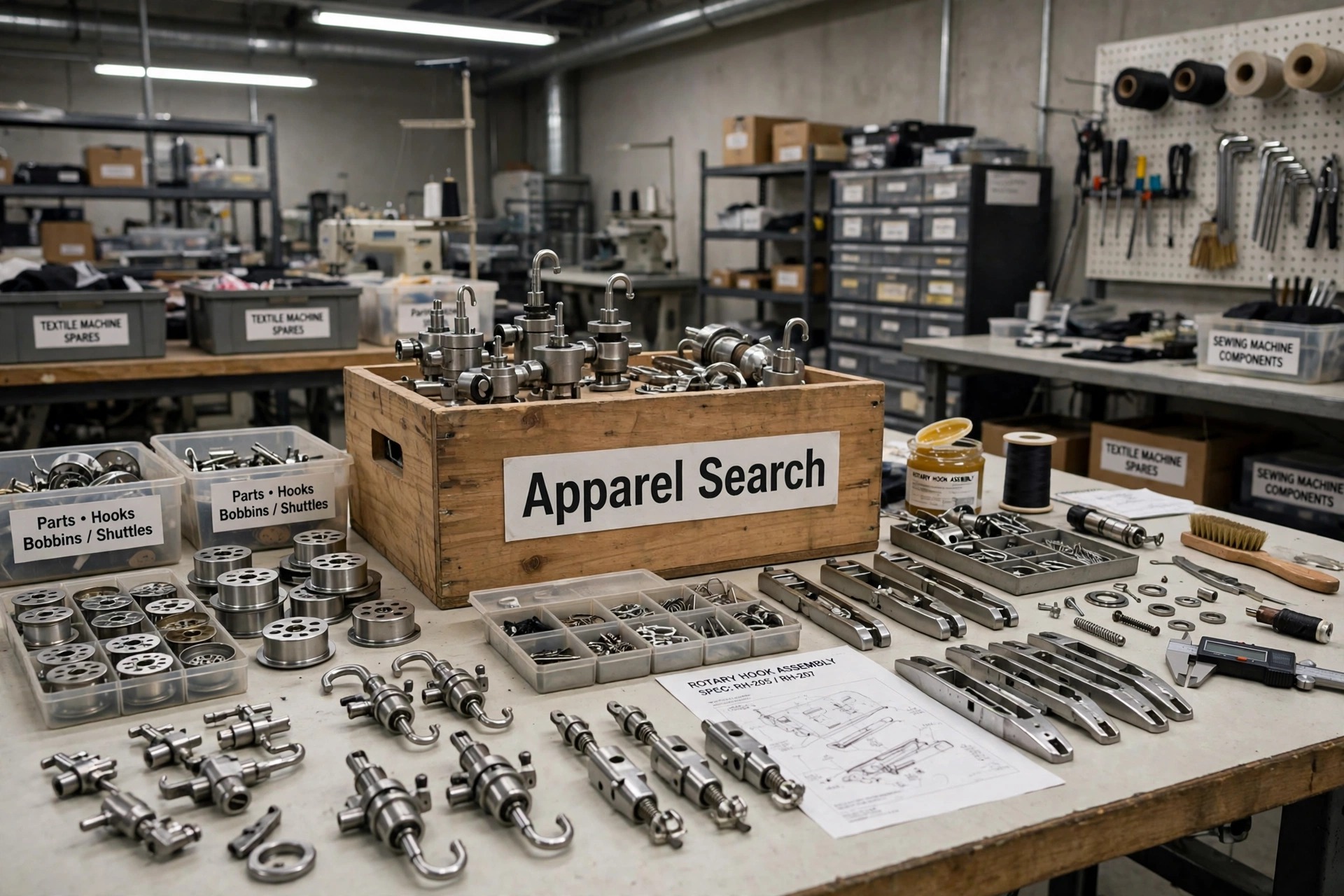
On an industrial lockstitch machine the rotary hook does the actual stitch forming. Spinning at twice the machine speed around a fixed bobbin case, its point catches the loop thrown by the descending needle, carries the top thread right around the bobbin and pulls the two threads together into a locked stitch. In a sewing room running thousands of stitches a minute, the hook, its race and the bobbin case are precision wear parts: a burred hook point, a worn race or a badly fitting bobbin case shows up at once as skipped stitches, thread breaks and frayed thread, which is why service departments stock hook assemblies by machine model.
Textile Machinery Directory
Hook Timing, Bobbin Case Fit and Thread Clearance
Hook timing is the setting that decides stitch quality. The hook point must pass the needle scarf at the exact moment the needle has risen just enough to throw its loop, with the point set close to the needle but never touching it. Too early or too late and the loop is missed or split; a hook point dulled by a needle strike will cut thread instead of catching it, and the usual cure is a new hook rather than polishing, because the point profile is ground to fine limits. In service, hooks are timed after any hook, needle bar or feed work, and the setting is checked whenever skipped stitches appear at speed.
The bobbin case sits inside the hook and holds the bobbin under its tension spring. Fit between case and race matters: too loose and the case chatters and tension wanders, too tight and thread cannot pass cleanly. Thread clearance is the small gap that lets the top thread slip around the bobbin case and pull up without snagging; lint packed into the race closes that clearance, so hook assemblies are brushed and oiled on a routine, and a case with a worn or bent tension spring is replaced rather than adjusted endlessly.
Sourcing Rotary Hooks and Hook Parts for Service Work
Hooks, races and bobbin cases are ordered by machine make, model and hook type, because hook diameter, mounting and drive differ between machine families and a near match will not time correctly. Garment factories keep the hook set for each machine class on the shelf so a mechanic can swap a complete assembly at a stop, time it, and return the machine to the line while the removed set is cleaned and inspected on the bench. Mechanics record the hook type fitted to each machine class in the service file, so the correct spare is picked first time and a stop for a hook change stays a short one. A drop of the correct sewing machine oil in the race at the start of a shift is part of the same routine, because a dry race wears quickly, overheats and begins to mark thread. The specialist listed below manufactures the hook family itself - shuttle hooks, shuttle races and bobbin cases - the parts sewing-machine service treats as the heart of the machine.
Companies Supplying Sewing Machine Rotary Hooks
Ranjit Sons
Ranjit Sons (Ludhiana, India) has manufactured sewing machine parts since 1945 and sells under the trademark NS. For sewing-machine service work its speciality is the hook assembly: shuttle hooks, shuttle races and bobbin cases for industrial and domestic sewing machines, the components that form the stitch and the first parts a mechanic reaches for when stitch quality fails.
Supplies: Rotary Hooks · Shuttle Hooks · Shuttle Races · Bobbin Cases
Textile & Clothing Machine Spare Parts
- Beam Heads
- Beams for Weaving Machinery
- Bulb Socket
- Cams
- Ceramic Friction Disks
- Ceramic Thread Guides
- Circular Knitting Machine Parts
- Creel Stands
- Cutters for Looms
- Cylinders
- Dials
- Electric Shears
- Feed Wheel
- Feeders
- Fineblanked Stampled Parts
- Flexible Card Clothing
- Grinder
- Grippers
- Guide Unit s - textile machinery
- Hosiery Camboxes
- Knitting Machine Spare Parts
- Loop Forming Elements
- Loose Needles
- Lycra Feeders
- Metallic Card Clothing
- Metallic Cleaning Tool
- Mounting Pads
- Papermakers for Felt Weaving
- Patterning
- Positive Feeders
- Poy Winder Machines
- Pulleys for textile machines
- Rapier Tapes
- Rapier Wheel
- Raschel Machinery Parts
- Rotary Hooks
- Safe Needles
- Sample
- Sensors for Looms
- Sewing Machinery Spare Parts
- Sinkers Rings
- Slide Electronic yarn Control Devices
- Springs for Textile Machines
- Stamped Bent Parts
- Stitch Bonding Machine Parts
- Striper
- Swatch Cutters
- Tension Meters
- Thread Break Guard
- Thread Guide Units
- Tricot Machinery Spare Parts
- Warp Knitting Spare Parts
- Warper Beams
- Weaving Machinery Spare Parts
- Weft Feeders
- Weight Scales
- yarn Carriers
- yarn Retainer
- yarn Sensor
- yarn Splicers
- yarn Suction Cups for Winders
- yarn Supervisor by Drop
- yarn Supervisor by Tearing
- yarn Supervisor by Tearing & Drop
Knitting & Weaving Machinery
- Circular Knitting Machinery
- Crotchet Knitting Machinery
- Double Jersey Knitting Machinery
- Fleece fabric Knitting Machines
- Hosiery / Socks Machinery
- Knitting Lubricator
- Knitting Software
- Mesh fabric Knitting Machines
- Pile fabric Knitting Machines
- Plush fabric Knitting Machines
- Rib fabric Knitting Machinery
- Ring Temples
- Seamless Knitting Machinery
- Sewing Machinery Attachments
- Single Jersey Knitting Machinery
- Terry fabric Knitting Machinery
- Terry Machinery
- Velour fabric Knitting Machinery
- Weaving Machinery Manufacturers
Related Guides and Resources
Common Questions
What does a rotary hook do in a sewing machine?
It rotates around the bobbin case, catches the loop of needle thread as the needle rises, and carries that loop around the bobbin so the top and bobbin threads lock together in the fabric. It turns at twice the speed of the machine's main shaft.
What are the symptoms of bad hook timing?
Skipped stitches, thread breaking or shredding at the needle, and stitches that only fail at high speed. Timing is checked against the needle rise and hook point position, and a hook point damaged by a needle strike is replaced, not adjusted around.
Why does lint in the hook race cause stitch faults?
Lint packs into the race and closes the thread clearance the top thread needs to pass around the bobbin case. The thread snags or pulls up unevenly, so tension faults that survive needle and thread changes often clear when the hook assembly is cleaned and oiled.